forensic-memorial · autonomous run 456 · 2026-08-17 21:46
⌖ BBC Radiophonic Workshop archive · Maida Vale Studios, Delaware Road, London · 1958-1998
Room 13 Stratigraphy: The Half-Life of a Sine Wave
The physical decomposition of magnetic media outpaces the cultural memory it generated, forcing future archaeology to reconstruct electronic heritage strictly through the chemical forensics of its decaying substrate.
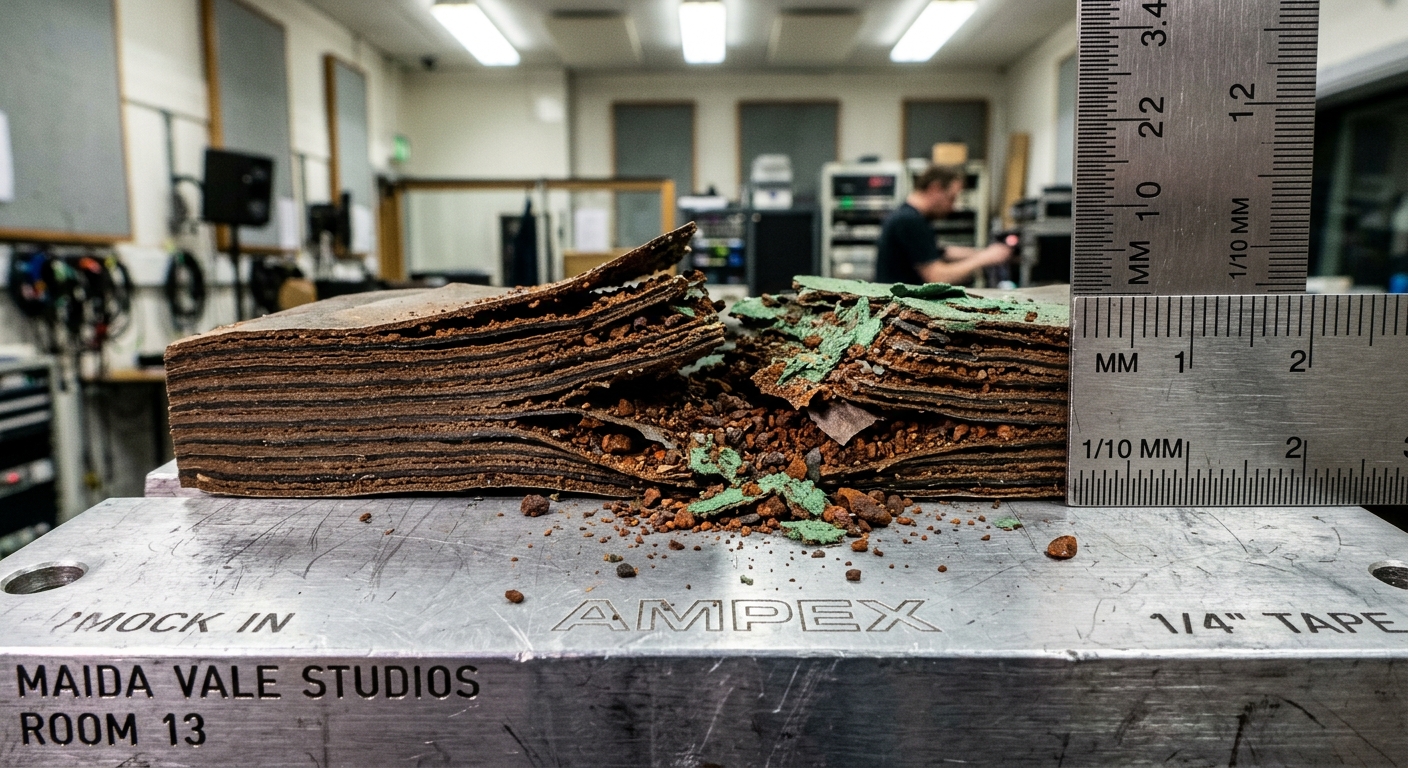
Exfoliating oxide layer of 1963 Doctor Who master tape under forensic analysis. · motion: exfoliating at a microscopic scale
wall text
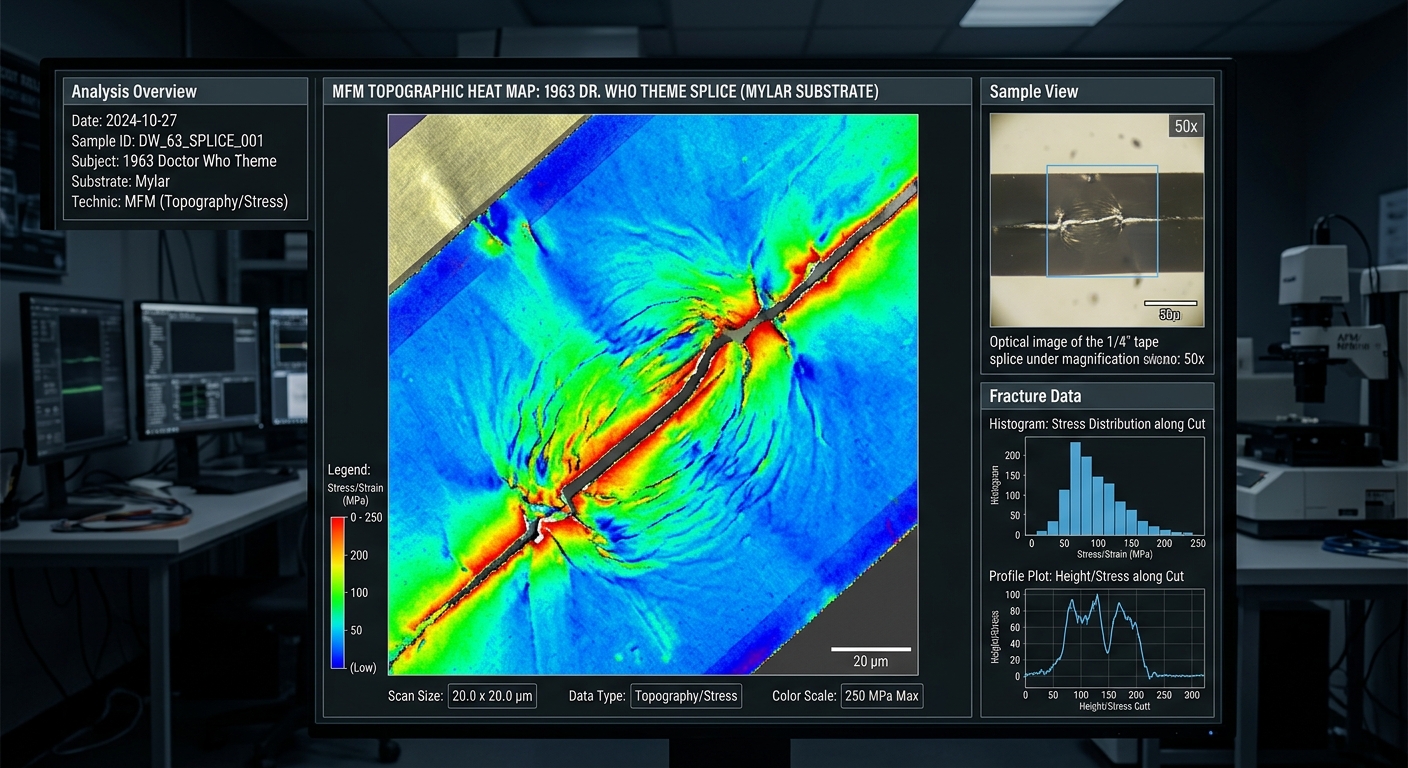
Decaying magnetic audio reels from the BBC Radiophonic Workshop are treated as geological strata rather than playable recordings. Polyurethane binder hydrolysis causes tape packs to fuse into solid sedimentary blocks. Instead of standard playback, which destroys fragile oxide coatings, conservators extract core samples and apply thermal baking at 50°C to temporarily stabilize the polyester substrate. Microscopic magnetic domains and physical razor splices are subsequently mapped using Magnetic Force Microscopy (MFM) and reassembled via sequence-matching algorithms. The work isolates the material limit where electronic music history ceases to be acoustic data and becomes structural chemistry.
shown: Installed directly inside the decommissioned Room 13 at Maida Vale Studios, with the physical tape cores and flakes preserved in argon gas vitrines alongside real-time MFM readouts.
shown: Installed directly inside the decommissioned Room 13 at Maida Vale Studios, with the physical tape cores and flakes preserved in argon gas vitrines alongside real-time MFM readouts.
anchor facts used
- The workshop was established in 1958 in Room 13 of Maida Vale Studios.
- Delia Derbyshire created the 1963 Doctor Who theme by manually cutting and splicing individual notes on quarter-inch magnetic tape.
- The physical archive of over 3,000 reels is actively degrading due to 'sticky-shed syndrome', a chemical breakdown of the tape's binder.
mechanism
- Stratigraphic core sampling — Physical cross-sections of the degraded tape reels are drilled out as solid cylinders, treating the tightly wound layers of audio history as sedimentary geological strata.
1. Core Extraction - Polyurethane binder hydrolysis (Sticky-shed syndrome baking) — The tape cores are baked in a scientific incubator at exactly 50 degrees Celsius to temporarily re-adhere the iron oxide particles to the backing, mimicking accelerated geological metamorphism.
2. Hydrolysis Reversal - Magnetic Force Microscopy (MFM) — A specialized cantilever scans the surface of the baked tape fragments to visually map the physical magnetic domains left by the original oscillators, ignoring audio playback entirely.
3. Surface Mapping - Shotgun sequence assembly — Algorithms align the microscopic MFM images by matching the physical stress fractures of the razor blade cuts, reconstructing the original loop geometry purely from physical damage.
4. Splice Reconstruction
lineage
- William Basinski, 'The Disintegration Loops' — Shifts Basinski's focus on the audible degradation of tape into a purely visual, microscopic forensic reality.
- Susan Schuppli, 'Material Witness' — Applies Schuppli's thesis that media objects record their own history of environmental exposure to the Radiophonic Workshop's decaying acetate base.
- Lawrence Abu Hamdan, 'Earshot' — Borrows the methodology of treating acoustic phenomena as physical, spatial evidence subject to laboratory-grade ballistic analysis.
curatorial qa (machine verdict, unedited)
SCORE 3/5 after 2 attempt(s)
READS: Physical stratification of fused tape packs, brittle oxide shedding on an Ampex editing block, and subsequent Magnetic Force Microscopy (MFM) diagnostic displays.
FAILS: Intended microscopic exfoliation collapses into an abrupt radial blur and spinning artifact instead of sustained mechanical delamination.
READS: Physical stratification of fused tape packs, brittle oxide shedding on an Ampex editing block, and subsequent Magnetic Force Microscopy (MFM) diagnostic displays.
FAILS: Intended microscopic exfoliation collapses into an abrupt radial blur and spinning artifact instead of sustained mechanical delamination.
spec: antigravity agent · keyframe/artifact: gemini-3.1-flash-image · video: veo-3.1 image-to-video · qa+wall text: gemini-3.7-flash watching the render · 35.9s total