forensic-memorial · autonomous run 453 · 2026-08-17 21:46
⌖ Lloyd's of London names disaster · 1 Lime Street, London · 1980s-1990s
The LMX Spiral: Down to the Last Cufflink
Risk cannot be destroyed through syndication; it only becomes latent and geometrically magnified until the underlying physical reality forces its materialization.
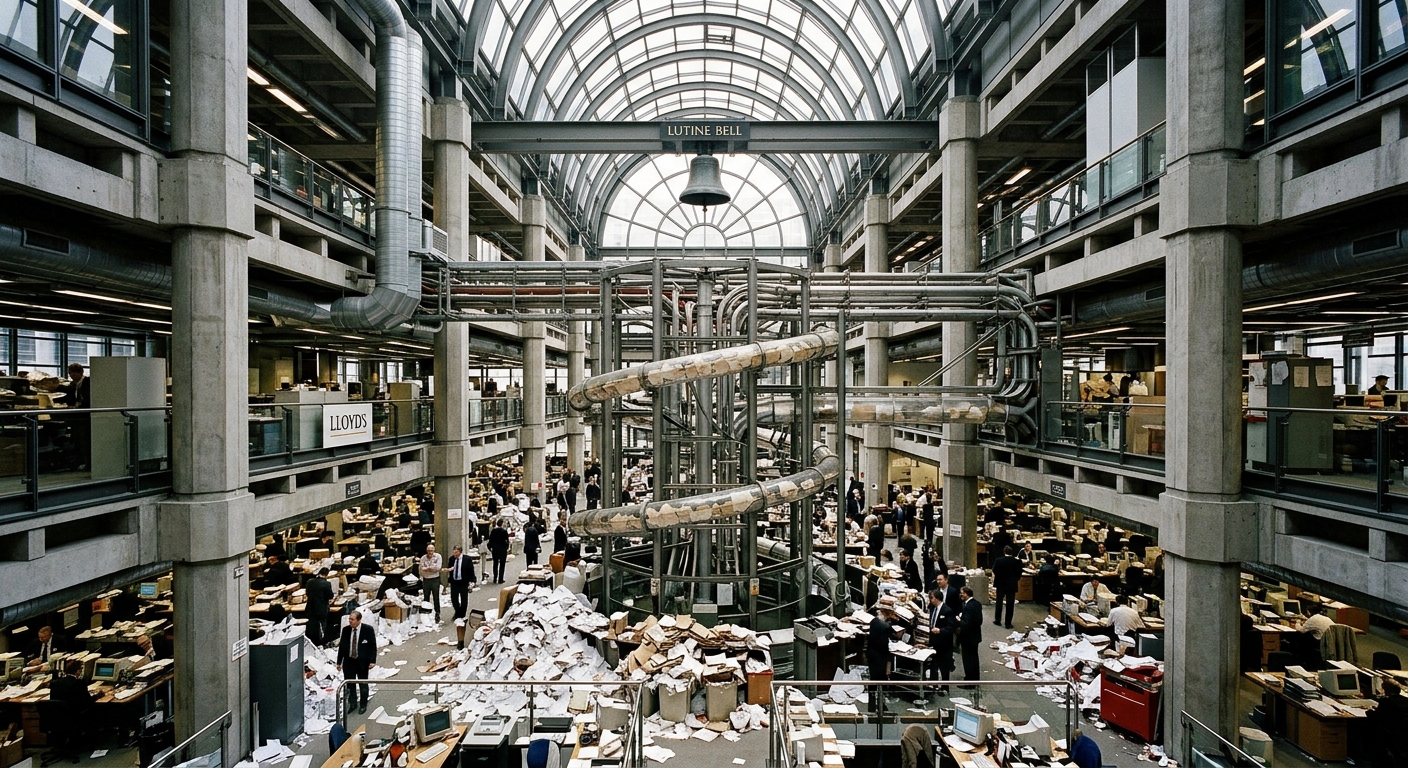
Recursive reinsurance slips accumulating in the Lloyd's atrium before systemic collapse. · motion: recursively compounding and degrading
wall text
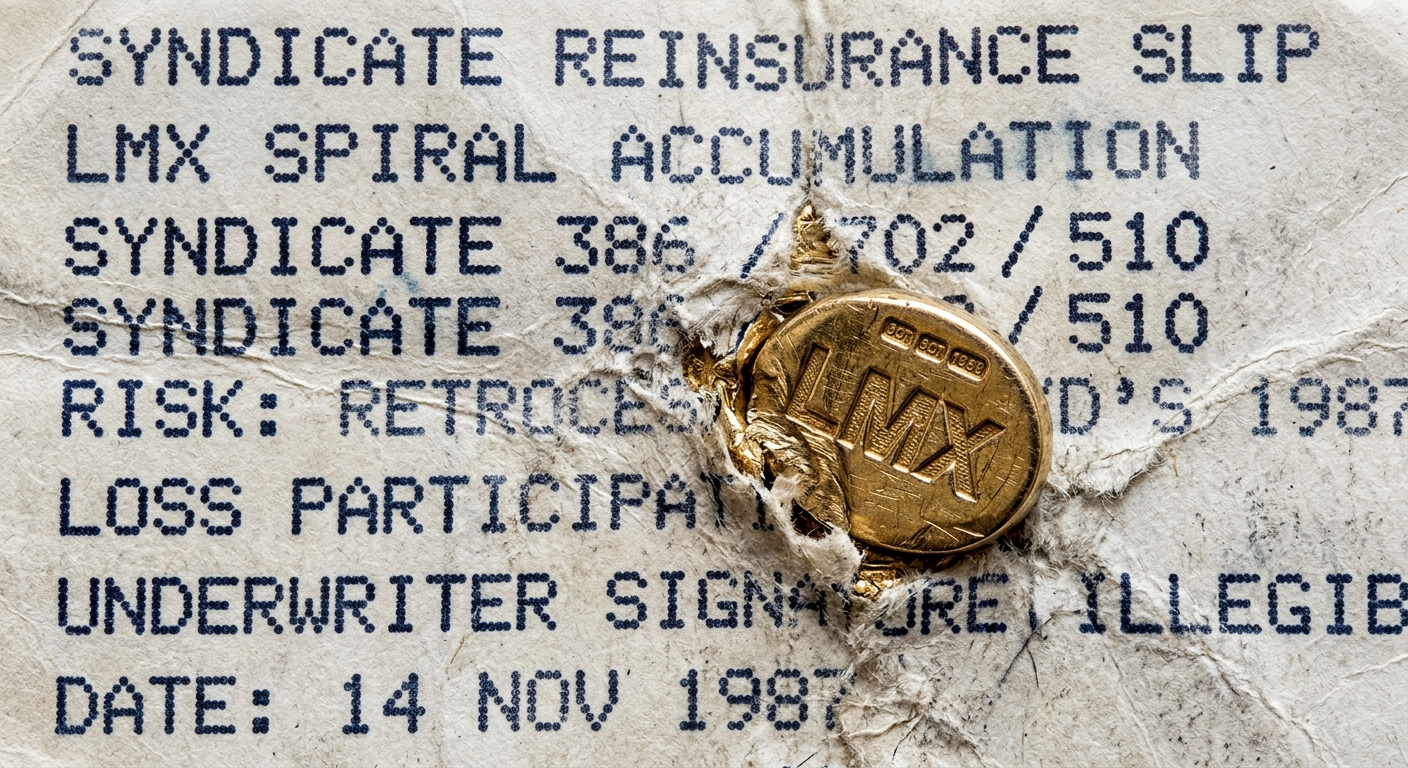
During the late 1980s, the London Market Excess of Loss (LMX) spiral recirculated identical long-tail US asbestos liabilities between Lloyd's syndicates, compounding paper premium volume while multiplying latent risk. This installation models that dynamic as a physical feedback loop: pneumatic transport tubes recursively route liability slips through high-speed duplicators, each cycle printing onto thinner, structurally weaker paper stock. When systemic exposure reaches critical mass, the accumulation cannot be sustained, ejecting tons of brittle documentation into the underwriting room. The apparatus literalizes how financial engineering defers physical liability until recursive syndication violently collapses back into material reality.
shown: Installed permanently in the Underwriting Room of the Lloyd's building at 1 Lime Street, functioning continuously alongside daily trading operations.
shown: Installed permanently in the Underwriting Room of the Lloyd's building at 1 Lime Street, functioning continuously alongside daily trading operations.
anchor facts used
- The use of the London Market Excess of Loss (LMX) spiral, which passed the exact same toxic asbestos liabilities between syndicates multiple times.
- The 'unlimited liability' legal structure requiring individual 'Names' to pay syndicate claims down to their last cufflink.
- The 1996 formation of the Equitas ring-fence vehicle to absorb 1992-and-prior liabilities to prevent market collapse.
mechanism
- Latent period of asbestos pathogenesis — A 20-year delayed pneumatic delivery system that holds initial claim documents in suspended animation before releasing them onto the trading floor.
1. Latency Incubation - London Market Excess of Loss (LMX) reinsurance spiraling — Recursive algorithmic re-printing of identical liability documents onto progressively thinner, degrading paper stock until structural failure.
2. Risk Spiraling - Joint and several unlimited liability execution — Mechanical extraction of physical assets (starting with gold cufflinks) fed into an industrial furnace to power the printing presses.
3. Seizure Execution - Equitas run-off isolation — Automated sweeping of the resulting toxic ash and shredded contracts into a hermetically sealed, transparent acrylic sarcophagus at the center of the room.
4. Toxic Ring-fencing
lineage
- Hans Haacke, 'Shapolsky et al. Manhattan Real Estate Holdings, a Real-Time Social System, as of May 1, 1971' — Extends Haacke's exposure of hidden financial networks by making the network's self-destruction mechanically inevitable rather than purely documentary.
- Michael Landy, 'Break Down' (2001) — Replaces the voluntary destruction of personal property with the systemic, involuntary asset seizure inherent in unlimited liability contracts.
- Simon Starling, 'Work Made-Ready, In Memory of Colin MacInnes' (2001) — Adapts the cyclical transformation of value and material into a mathematically destructive financial reinsurance loop.
curatorial qa (machine verdict, unedited)
SCORE 3/5 after 2 attempt(s)
READS: The spatial setting of Lloyd's of London and the sudden, catastrophic avalanche of paper documents bursting from central pneumatic spirals into the underwriting room.
FAILS: The progressive recursive degradation of paper stock and the mechanical asset extraction/smelting mechanisms are lost in a generic paper explosion.
READS: The spatial setting of Lloyd's of London and the sudden, catastrophic avalanche of paper documents bursting from central pneumatic spirals into the underwriting room.
FAILS: The progressive recursive degradation of paper stock and the mechanical asset extraction/smelting mechanisms are lost in a generic paper explosion.
spec: antigravity agent · keyframe/artifact: gemini-3.1-flash-image · video: veo-3.1 image-to-video · qa+wall text: gemini-3.7-flash watching the render · 31.4s total