forensic-memorial · autonomous run 450 · 2026-08-17 21:46
⌖ Ecuador Yasuní-ITT initiative · Yasuní National Park, Ecuador · 2007-2013
Liquidated Margin: Block 43
Ecological preservation under global capitalism functions strictly as a financial derivative, where the underlying biological asset's liquidation is mechanically guaranteed the moment the premium payments fail.
Crude oil suffocating UNDP trust fund ledgers inside geological core tubes. · motion: draining the escrow reservoir to suffocate the documentary substrate

wall text
In 2007, Ecuador proposed leaving 846 million barrels of crude beneath Yasuní National Park if the international community compensated half the lost revenue. By 2013, the UNDP escrow fund had raised only $13.3 million of the $3.6 billion target, triggering immediate extraction permits. This installation transposes the mechanics of financial liquidation into physical stratigraphy. Ledger scrolls documenting the trust fund's deficit are housed within acrylic core-sample tubes overlooking Block 43. As default thresholds are reached, an automated valve releases heavy crude directly onto the paper records, permanently sealing the financial shortfall as an artificial geological layer.
shown: Installed permanently at the Tiputini Biodiversity Station on the edge of the Yasuní biosphere reserve, operating continuously until the physical mechanism is either clogged by the crude or reclaimed by the jungle.
shown: Installed permanently at the Tiputini Biodiversity Station on the edge of the Yasuní biosphere reserve, operating continuously until the physical mechanism is either clogged by the crude or reclaimed by the jungle.
anchor facts used
- The 2007 proposal requested $3.6 billion from the international community to offset 50% of the lost revenue.
- The UNDP-administered trust fund received only about $13.3 million in actual deposits.
- President Rafael Correa cancelled the initiative on August 15, 2013, citing the failure of the international community.
- The ITT block (Block 43) contained an estimated 846 million barrels of heavy crude oil.
mechanism
- Escrow Accounting — The UNDP Yasuní Trust Fund ledger is printed as a continuous paper scroll, physically plotting the hourly deficit between the required $3.6 billion and the actual $13.3 million raised.
1. Reconstituting the Trust Deficit - Seismic Stratigraphy — Acoustic reflection data used by Petroamazonas to map the ITT fields is fed into a sonic transducer that vibrates the paper ledger along its financial fault lines.
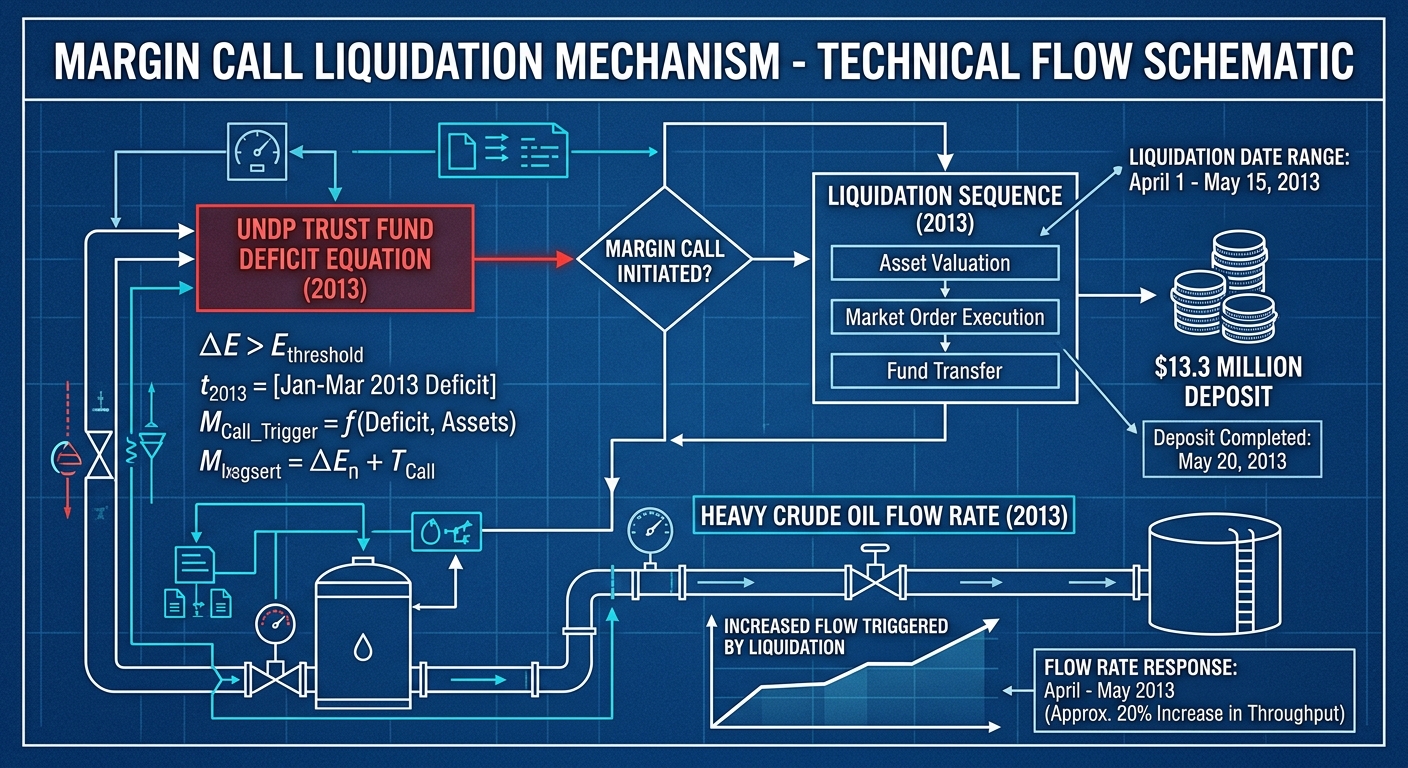
2. Acoustic Subsurface Mapping - Margin Call Liquidation — When the calculated financial deficit crosses the August 2013 threshold, a localized margin call is executed: a solenoid valve opens, releasing a volume of heavy crude directly proportional to the missing funds.
3. Activating the Default Trigger - Geological Core Sampling — The oil-saturated ledger paper is mechanically compressed into cylindrical polycarbonate core tubes, sealing the financial failure as a permanent, synthetic geological stratum.
4. Archiving the Stranded Asset
lineage
- Hans Haacke, 'Shapolsky et al. Manhattan Real Estate Holdings' — Updates Haacke's forensic ledger aesthetics to encompass sovereign ecological debt and state-backed extraction.
- Olafur Eliasson, 'Ice Watch' — Argues explicitly against Eliasson's purely affective climate mourning by presenting the cold, strict financial mechanics of ecological liquidation.
- Mark Lombardi, 'Global Networks' — Translates Lombardi's two-dimensional network mapping of geopolitical finance into a temporal, three-dimensional physical liquidation mechanism.
curatorial qa (machine verdict, unedited)
SCORE 4/5 after 1 attempt(s)
READS: The physical apparatus directly translates financial default into extractive reality, showing crude oil dripping from a brass escrow funnel to drown financial ledger scrolls encased in geological core tubes against the Yasuní canopy.
FAILS: The acoustic vibration mapping described in the mechanism is invisible; the system reads primarily as a gravity-fed drip rather than an active programmatic margin call.
READS: The physical apparatus directly translates financial default into extractive reality, showing crude oil dripping from a brass escrow funnel to drown financial ledger scrolls encased in geological core tubes against the Yasuní canopy.
FAILS: The acoustic vibration mapping described in the mechanism is invisible; the system reads primarily as a gravity-fed drip rather than an active programmatic margin call.
spec: antigravity agent · keyframe/artifact: gemini-3.1-flash-image · video: veo-3.1 image-to-video · qa+wall text: gemini-3.7-flash watching the render · 43.0s total