forensic-memorial · autonomous run 448 · 2026-08-17 21:46
⌖ Argentina corralito · Buenos Aires, Argentina · December 2001
Corralito Tomography: Acoustic Impedance of the 250-Peso Limit
The physical acoustic energy of public dissent acts as a diagnostic seismic wave capable of imaging the structural emptiness of fractional reserve banking when liquidity is legally frozen.
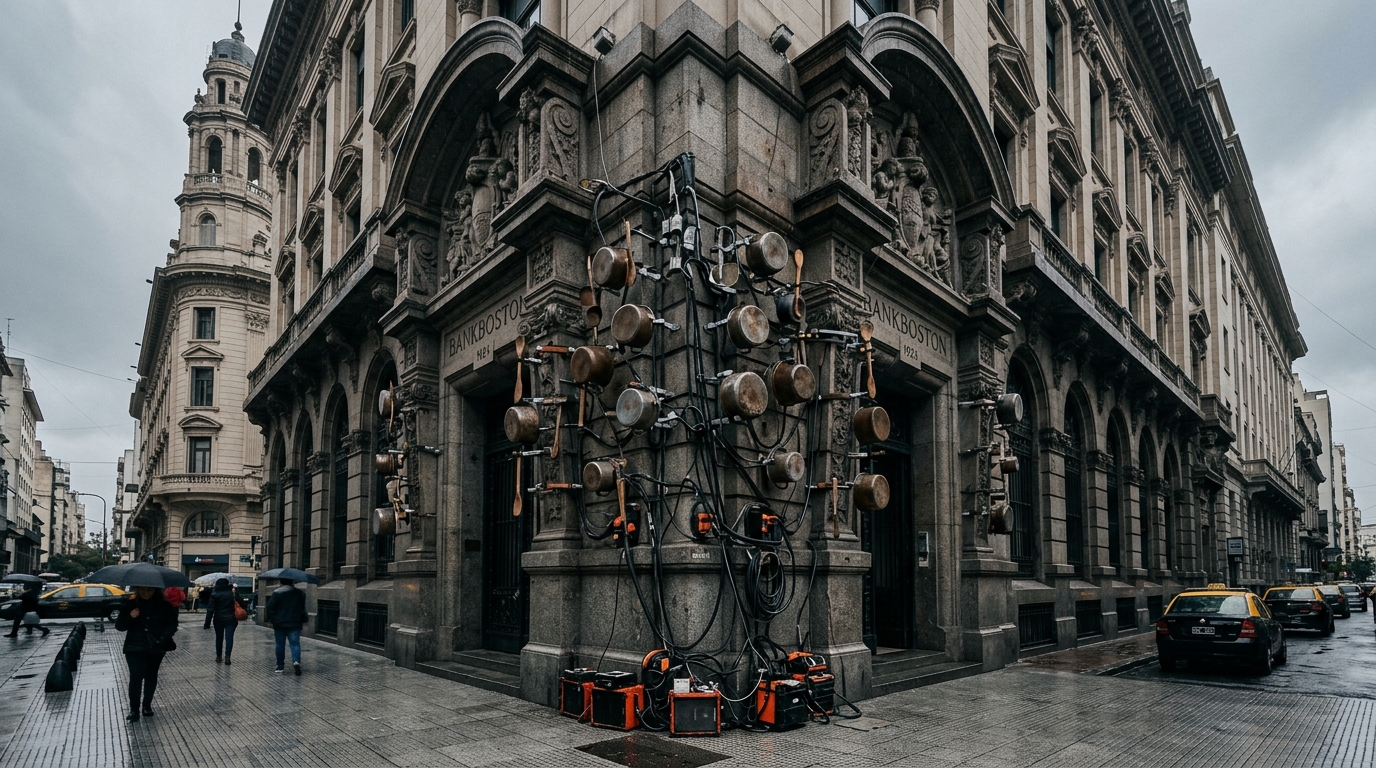
Automated cacerolazo rig pulsing acoustic waves to map empty subterranean bank vaults. · motion: mechanized rhythmic striking producing visible micro-vibrations in solid stone
wall text
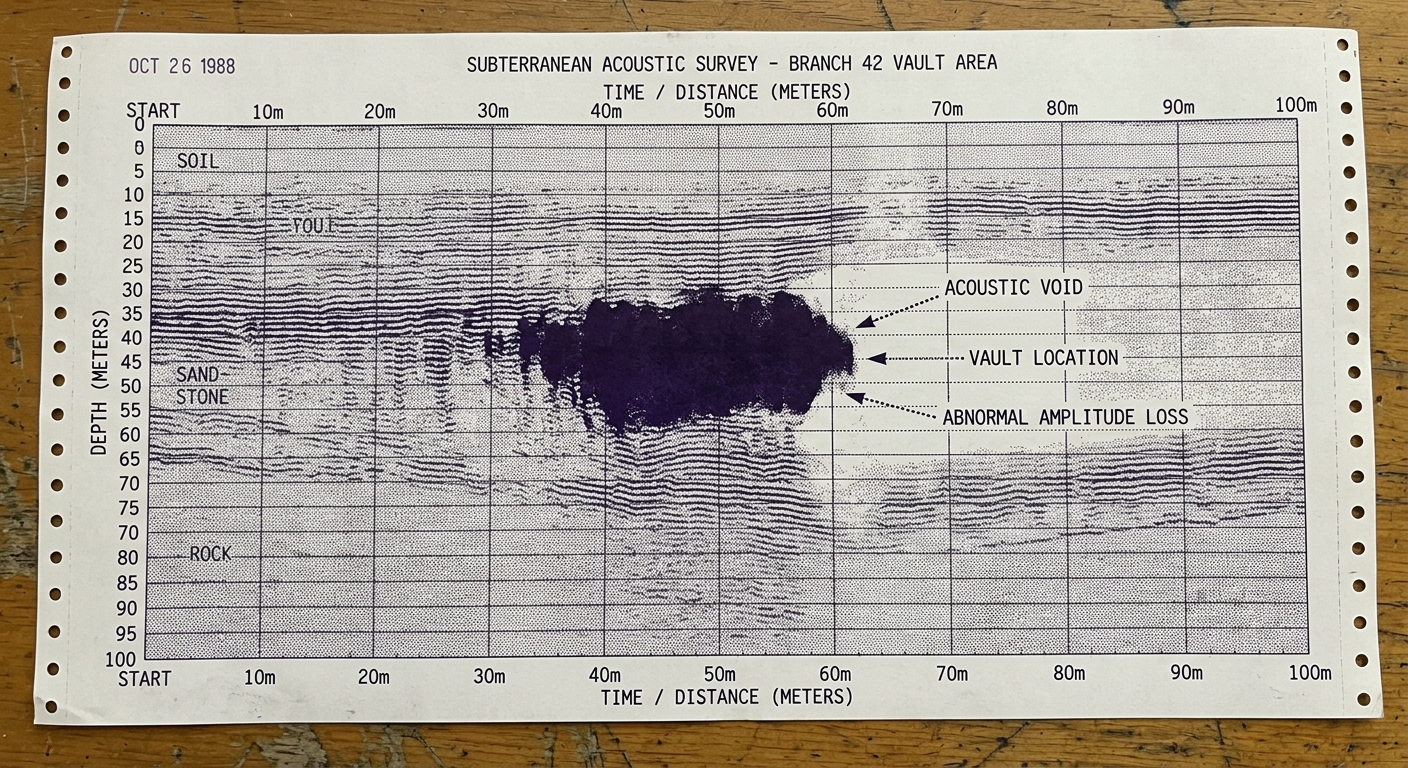
During Argentina's 2001 banking collapse, citizens struck kitchenware against the BankBoston facade in protest of the 'corralito' deposit freeze. This installation transposes the cacerolazo into active seismic reflection profiling. Solenoid-actuated domestic pots emit 2.4 Hz acoustic pulses directly into the masonry. As sound waves traverse granite, reinforced concrete, and subterranean cavities, changes in acoustic impedance mark material boundaries. Pavement geophones capture the reflected signals, performing tomographic inversion to map subsurface spatial density. The resulting echogram reveals the literal structural void of the depleted vault beneath, rendering systemic insolvency as a measurable geological absence.
shown: Installed directly on the sidewalk outside the former BankBoston branch at Florida and Diagonal Norte in Buenos Aires, forcing pedestrians to physically step over the live geophone cables.
shown: Installed directly on the sidewalk outside the former BankBoston branch at Florida and Diagonal Norte in Buenos Aires, forcing pedestrians to physically step over the live geophone cables.
anchor facts used
- Decree 1570/01, authored by Economy Minister Domingo Cavallo on December 1, 2001, froze bank accounts to halt a national bank run.
- Cash withdrawals were strictly legally limited to 250 pesos or US dollars per week.
- During the December 19-20 'cacerolazo', citizens banged domestic kitchen pots directly against the reinforced metal doors and stone facades of foreign banks, notably the BankBoston branch at Florida and Diagonal Norte.
mechanism
- Acoustic pulse generation — Automated solenoids strike domestic aluminum cookware at 2.4 Hz, replicating the exact rhythmic cadence of the December 19 cacerolazo against the bank's exterior.
1. Source Generation - Acoustic impedance — Low-frequency sound waves penetrate the Neoplateresque stone architecture, their velocity altering as they travel through solid granite, structural steel, and air.
2. Wave Propagation - Seismic reflection — The acoustic waves bounce back upon hitting the boundary between the solid structural concrete and the hollow air of the depleted subterranean cash vaults.
3. Signal Reflection - Tomographic inversion — Surface geophones record the reflected waves, mathematically processing the timing and amplitude to generate a 3D spatial map of the inaccessible structural void.
4. Tomographic Inversion
lineage
- Lawrence Abu Hamdan, 'Saydnaya (the missing 19db)' — Shifts Abu Hamdan's acoustic forensics of carceral spaces to the forensic architecture of systemic financial collapse.
- Susan Schuppli, 'Material Witness' — Applies Schuppli's concept of matter recording its own history to the acoustic absorption and reflection of the 2001 bank facades.
- Ryoji Ikeda, 'data.tron' — Rejects Ikeda's frictionless digital data abstractions in favor of heavy, site-specific acoustic friction mapped onto real stone.
curatorial qa (machine verdict, unedited)
SCORE 4/5 after 1 attempt(s)
READS: The automated striking rig mounted directly against the Neoplateresque bank facade, synchronized percussion against domestic cookware, and ground-level geophone arrays recording acoustic feedback.
FAILS: The explosive dust cloud reads as pyrotechnic combustion rather than mechanical resonance or acoustic micro-vibrations penetrating the granite masonry.
READS: The automated striking rig mounted directly against the Neoplateresque bank facade, synchronized percussion against domestic cookware, and ground-level geophone arrays recording acoustic feedback.
FAILS: The explosive dust cloud reads as pyrotechnic combustion rather than mechanical resonance or acoustic micro-vibrations penetrating the granite masonry.
spec: antigravity agent · keyframe/artifact: gemini-3.1-flash-image · video: veo-3.1 image-to-video · qa+wall text: gemini-3.7-flash watching the render · 32.5s total