forensic-memorial · autonomous run 446 · 2026-08-17 21:46
⌖ Whaling station ruins, Grytviken · King Edward Cove, South Georgia Island · 1904-1964
Thermal Cycling Grytviken
The biological deficit of 20th-century industrial extraction can be forensically quantified and chemically resurrected, turning rusting ruins into engines of exponential biological memory.
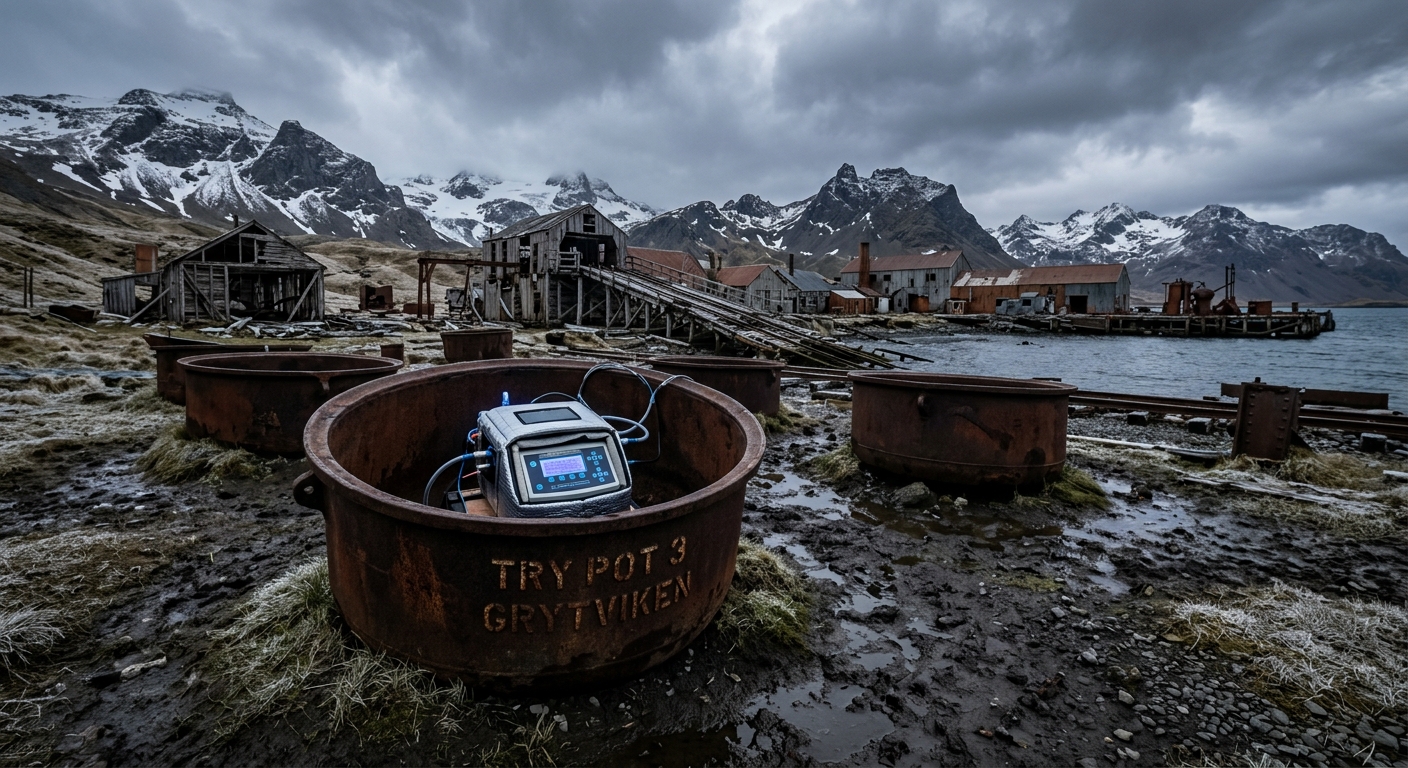
Portable thermal cycler amplifying whale mtDNA inside a Grytviken try-pot. · motion: thermal cycling the oxidized substrate
wall text
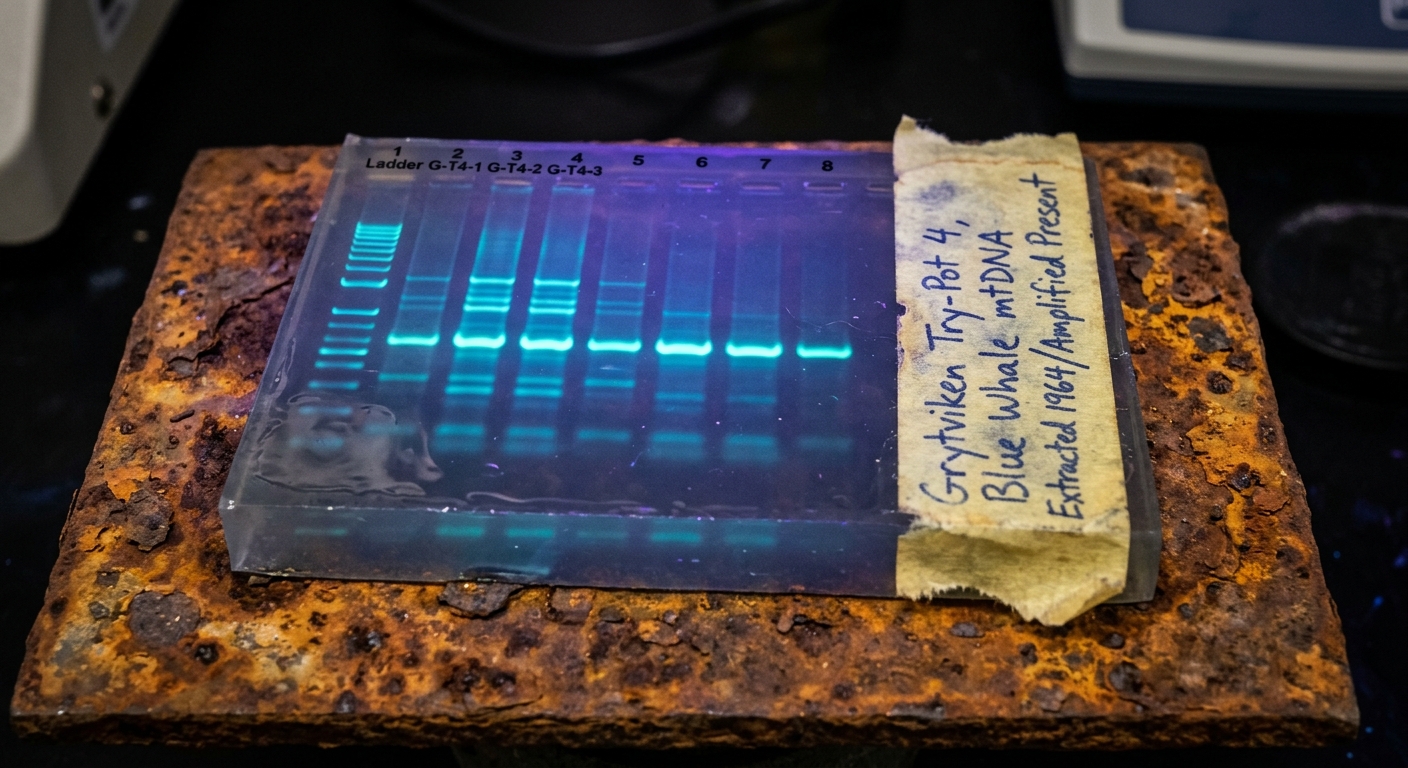
Between 1904 and 1964, Grytviken processed over 54,000 whales into commercial oil and bone meal. This intervention deploys field-grade polymerase chain reaction (PCR) instrumentation directly into the station's abandoned cast-iron try-pots. By scraping lipid-bound residues trapped in the oxidizing iron matrix, the apparatus subjects century-old blubber remnants to standard thermal cycling: denaturation at 94°C, primer annealing targeting blue whale mitochondrial control regions at 55°C, and Taq polymerase extension at 72°C. The resulting amplicons, resolved on agarose gel electrophoresis, translate industrial scrapings into readable genetic barcodes, mechanically forcing the site of slaughter to synthesize the biological data of its eradicated biomass.
shown: Installed temporarily as an active field-laboratory directly on the rotting timber of the Grytviken flensing plan during the brief austral summer.
shown: Installed temporarily as an active field-laboratory directly on the rotting timber of the Grytviken flensing plan during the brief austral summer.
anchor facts used
- Founded in 1904 by Carl Anton Larsen, Grytviken processed over 175,000 whales before its abandonment in 1964.
- The site contains a massive ruined wooden flensing plan (butchering deck) and rows of rusting iron try-pots used to boil whale blubber into oil.
- The extreme sub-Antarctic climate and permafrost conditions act as a natural cold-storage, preserving biological residue.
mechanism
- PCR Denaturation (heating to 94°C to separate DNA strands) — Thermal disruption of the historical rust matrix to liberate trapped environmental DNA.
1. Denaturation - PCR Annealing (cooling to 55°C to allow primers to bind) — Targeting the specific genetic signature of the eradicated resource.
2. Annealing - PCR Extension (heating to 72°C for Taq polymerase to synthesize new strands) — Chemically forcing the erased biomass to exponentially multiply its own data.
3. Extension - Agarose Gel Electrophoresis — Visualizing the resurrected genetic sequence as an irrefutable barcode of industrial slaughter.
4. Gel Electrophoresis
lineage
- Kary Mullis, 'Specific Synthesis of DNA in Vitro via a Polymerase-Catalyzed Chain Reaction' (1985) — Transposes the laboratory methodology of in vitro chemical amplification into a site-specific memorial for mass extraction.
- Oron Catts and Ionat Zurr (Tissue Culture & Art Project), 'Victimless Leather' (2004) — Shifts the bio-art focus from speculative lab-grown futures to the forensic resurrection of the industrial past.
- Forensic Architecture, 'The Nebelivka Hypothesis' (2023) — Shares the methodological use of soil and substrate analysis to reveal erased histories, specifically applied here to sub-Antarctic permafrost ruins.
curatorial qa (machine verdict, unedited)
SCORE 4/5 after 1 attempt(s)
READS: The placement of a portable thermal cycler inside Grytviken's rusted blubber try-pot immediately establishes the extraction context. The rising vapor conveys thermal cycling on-site, and the support artifact cleanly connects iron scraping residue to amplified Antarctic blue whale mtDNA bands on an agarose gel.
FAILS: The PCR phase transitions (denaturation at 94°C, annealing at 55°C) are obscured inside the chassis, leaving the exterior vapor looking slightly atmospheric rather than strictly regulated.
READS: The placement of a portable thermal cycler inside Grytviken's rusted blubber try-pot immediately establishes the extraction context. The rising vapor conveys thermal cycling on-site, and the support artifact cleanly connects iron scraping residue to amplified Antarctic blue whale mtDNA bands on an agarose gel.
FAILS: The PCR phase transitions (denaturation at 94°C, annealing at 55°C) are obscured inside the chassis, leaving the exterior vapor looking slightly atmospheric rather than strictly regulated.
spec: antigravity agent · keyframe/artifact: gemini-3.1-flash-image · video: veo-3.1 image-to-video · qa+wall text: gemini-3.7-flash watching the render · 45.1s total