forensic-memorial · autonomous run 445 · 2026-08-17 21:46
⌖ Guano islands era · Navassa Island, Caribbean Sea (18°24′10″N 75°00′45″W) · 1856-1898
Navassa Amortization Schedule: δ15N Principal
Ecological and historical extraction functions as a literal financial instrument, accruing compounding interest in the form of isotopic soil depletion that requires quantitative, molecular repayment.
Automated restitution rig titrating 0.042 grams of synthetic phosphate into Navassa bedrock. · motion: titrating the historical debt
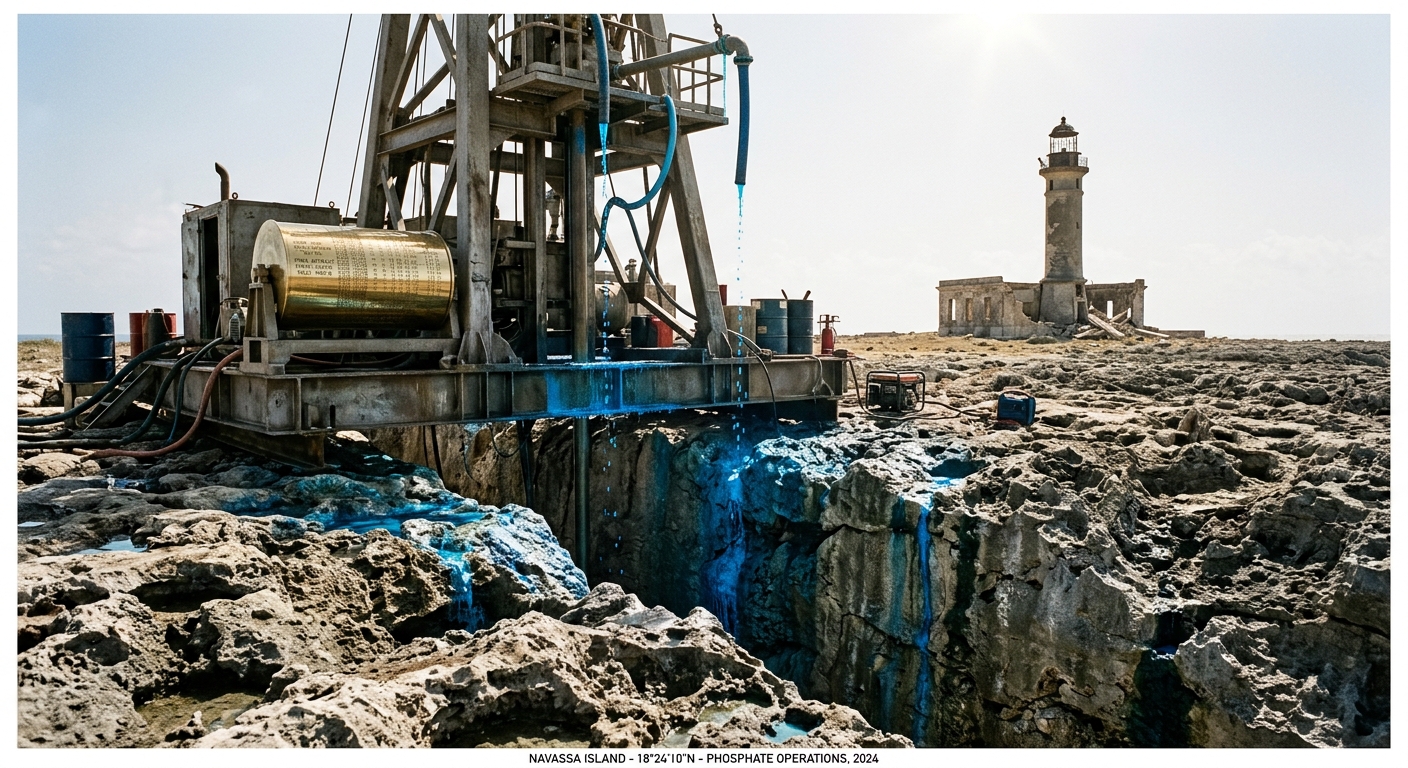
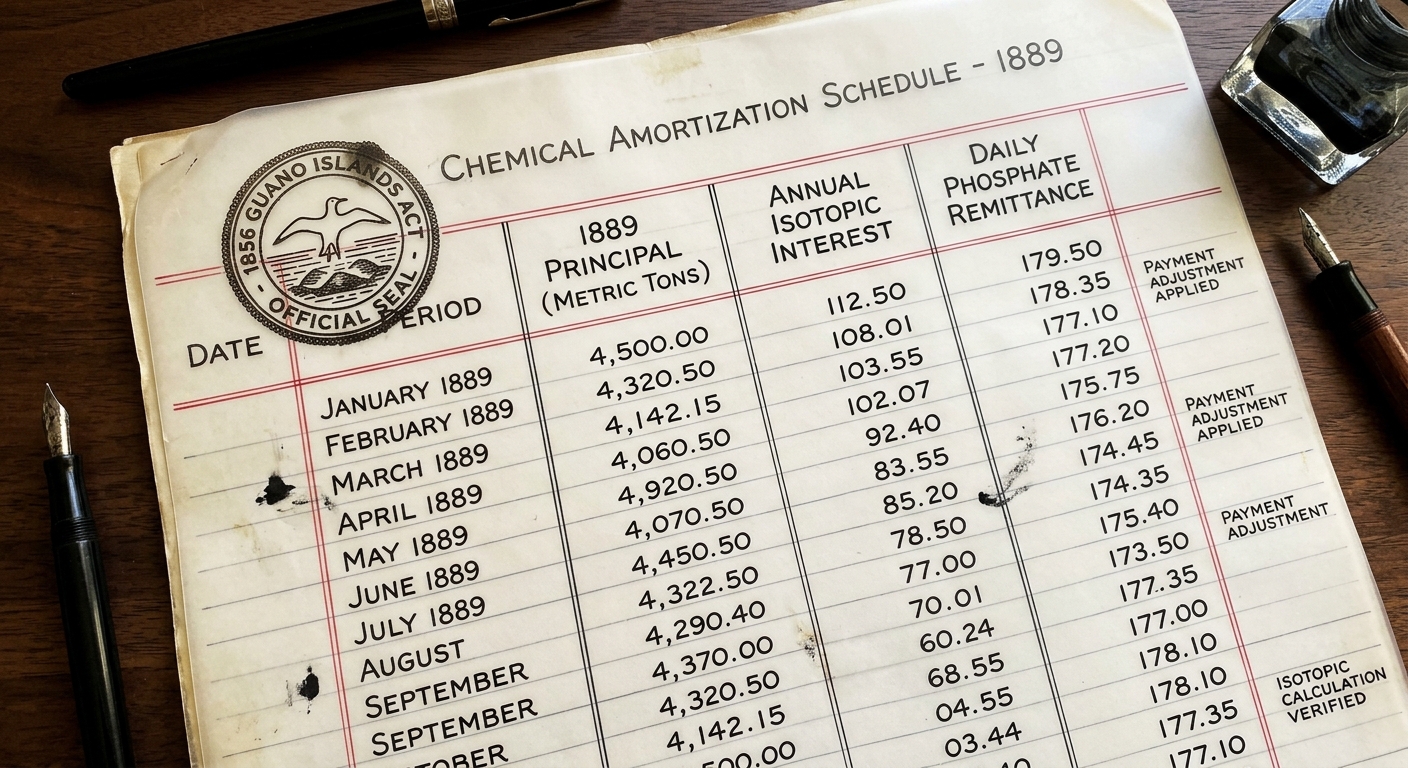
wall text
Under the 1856 Guano Islands Act, over one million tons of phosphate-rich guano were stripped from Navassa Island, halting abruptly after the 1889 labor uprising. This project treats that ecological void as an active financial debt compounding isotopic interest. Transposing isotope-ratio mass spectrometry, compound interest amortization, and automated chemical titration, a solar-powered rig dispenses calibrated micro-doses of synthetic diammonium phosphate directly onto the limestone bedrock. Each daily fraction of a gram offsets the 135-year nutrient deficit, while a motorized stylus engraves every transaction into a brass ledger. The work reframes colonial resource extraction as an unpayable actuarial obligation settled atom by atom.
shown: Installed permanently at Lulu Town, Navassa Island, operating autonomously until the chemical debt is settled in the year 2326, with live telemetry transmitted to the US Department of the Interior.
shown: Installed permanently at Lulu Town, Navassa Island, operating autonomously until the chemical debt is settled in the year 2326, with live telemetry transmitted to the US Department of the Interior.
anchor facts used
- The Guano Islands Act of 1856 (48 U.S.C. §§ 1411–1419) allowed the US to annex unclaimed islands strictly for guano extraction.
- Over 1 million tons of guano were extracted from Navassa Island between 1857 and 1898, physically stripping the island to bedrock.
- In 1889, brutal mining conditions led to a violent uprising by African-American contract workers on Navassa Island, culminating in a historic US Supreme Court case (Jones v. United States).
mechanism
- Isotope-ratio mass spectrometry (IRMS) — Analyzing Navassa limestone core samples to quantify the missing δ15N (Nitrogen-15) and phosphorus baselines prior to the 1857 extraction.
1. Baseline quantification - Compound interest amortization — Calculating the accumulated deficit of soil nutrients, treated as financial interest compounding annually since the 1889 labor uprising stopped major operations.
2. Calculating ecological deficit - Chemical Titration — A solar-powered dispensing rig on the island releases exactly 0.042 grams of synthetic diammonium phosphate per day directly onto the bedrock.
3. Automated repayment - Double-entry bookkeeping — A mechanical stylus etches each daily phosphate micro-deposit into a titanium ledger bolted to the abandoned island lighthouse.
4. Immutable recording
lineage
- Hans Haacke, 'Rhine Water Purification Plant' (1972) — Builds on Haacke's literalized chemical remediation by introducing a strictly financialized, multi-century timescale of ecological debt.
- Carey Young, 'Declared Void' (2005) — Extends Young's exploration of legal geography by turning the 1856 Act's physical consequences into a binding, automated chemical contract.
- Claire Pentecost, 'soil-erg' (2012) — Shares Pentecost's thesis of soil nutrients as currency, but replaces symbolic ingots with a functional, site-specific amortization apparatus.
curatorial qa (machine verdict, unedited)
SCORE 3/5 after 2 attempt(s)
READS: The actuarial ledger clearly transposes 19th-century guano extraction into a compounding chemical debt. The field rig dripping bright synthetic nutrients into Navassa's barren karst captures the absurd scale of physical restitution.
FAILS: The motion is largely static dripping; the brass cylinder ledger does not visibly register or engrave micro-doses, obscuring the link between mechanical bookkeeping and chemical titration.
READS: The actuarial ledger clearly transposes 19th-century guano extraction into a compounding chemical debt. The field rig dripping bright synthetic nutrients into Navassa's barren karst captures the absurd scale of physical restitution.
FAILS: The motion is largely static dripping; the brass cylinder ledger does not visibly register or engrave micro-doses, obscuring the link between mechanical bookkeeping and chemical titration.
spec: antigravity agent · keyframe/artifact: gemini-3.1-flash-image · video: veo-3.1 image-to-video · qa+wall text: gemini-3.7-flash watching the render · 36.7s total