forensic-memorial · autonomous run 442 · 2026-08-17 21:46
⌖ Shipbreaking of the SS United States · Pier 82, Philadelphia to Okaloosa County, Florida · 1969-2025
MACRS: Pier 82 Benthic Write-Down
Cultural memory and physical monumentality are subjected to the exact mathematical laws of capital depreciation, where the material dissolution of an asset perfectly tracks its financial write-down in a distressed ledger.
Anodic zinc hull dissolving at the exact rate of municipal asset write-down. · motion: corroding galvanically to pace the exact curve of an accelerated depreciation schedule
wall text
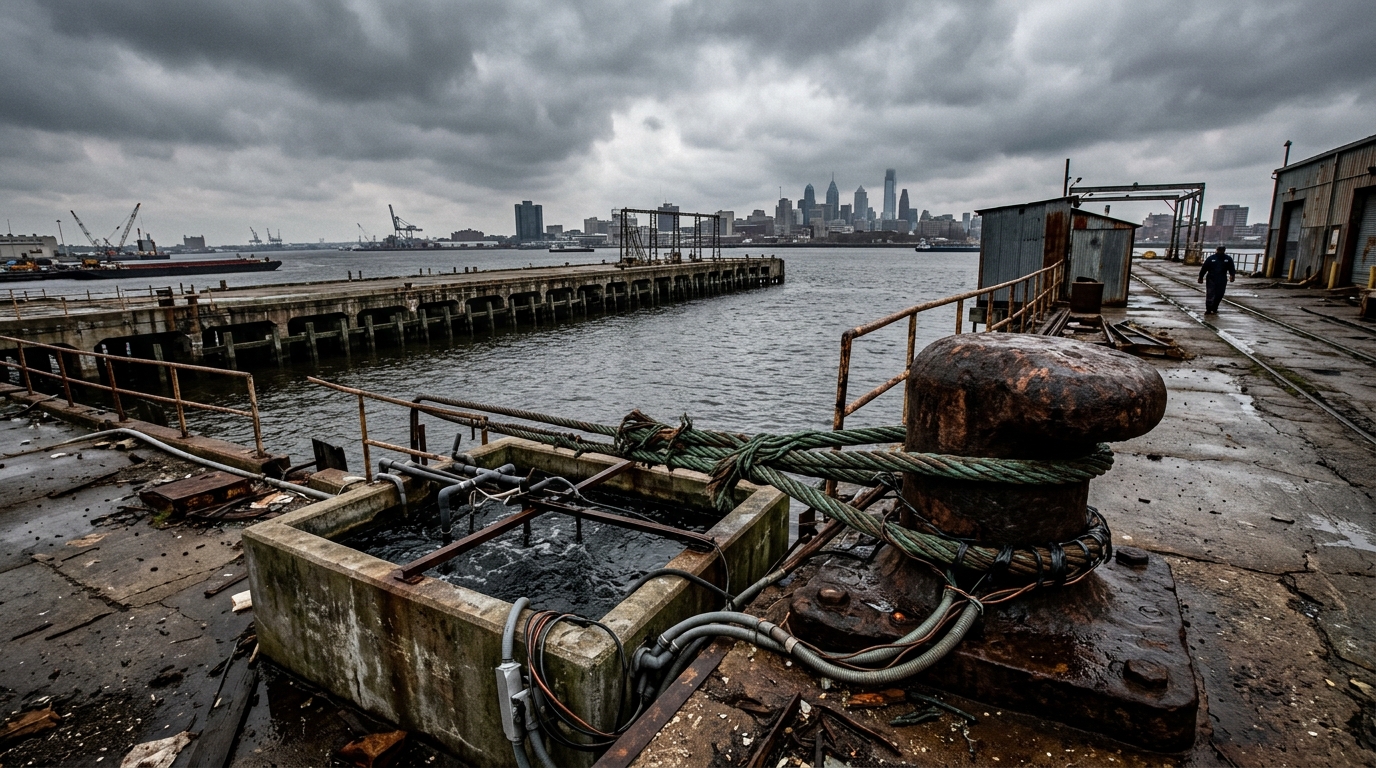
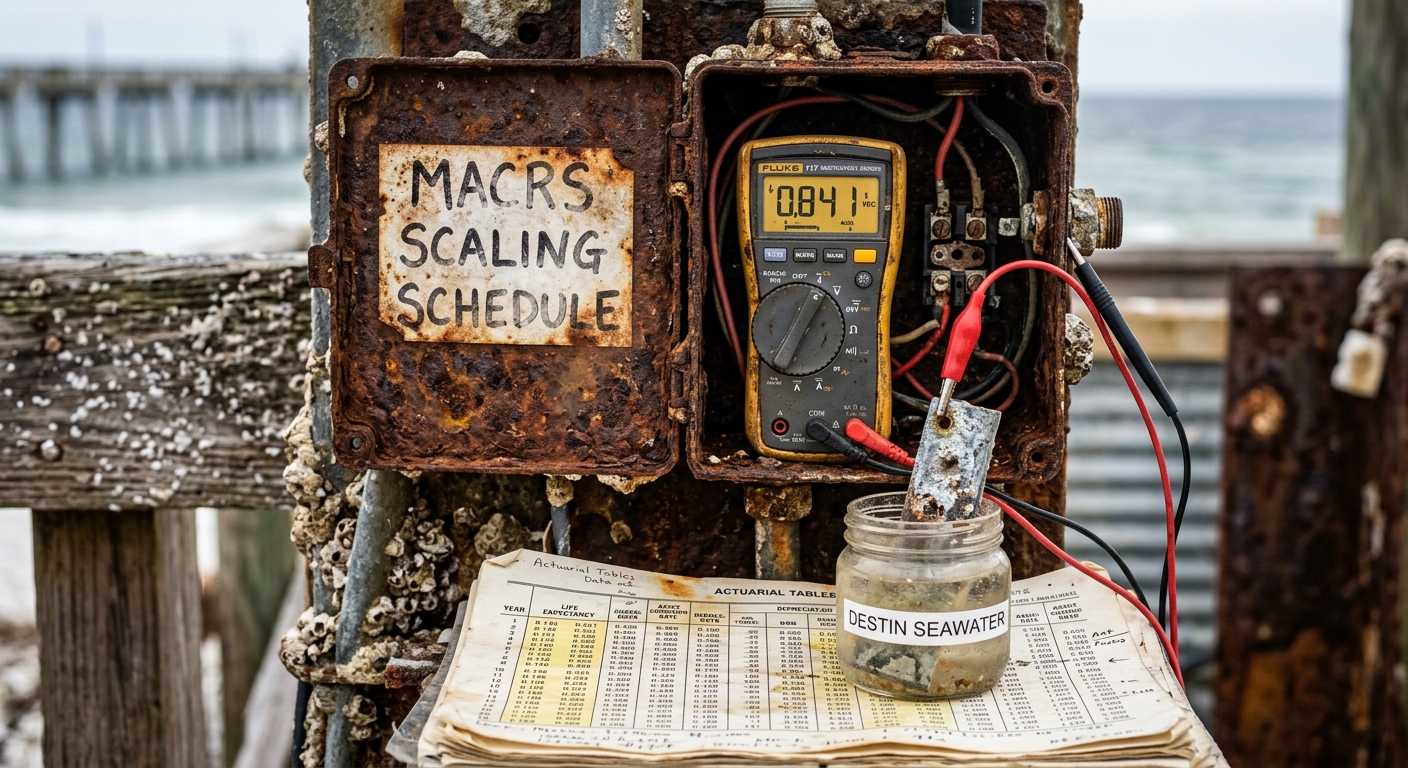
A 1:100 scale zinc replica of the SS United States sits immersed in Gulf seawater at an industrial pier. Wired to a microcontroller executing a Modified Accelerated Cost Recovery System (MACRS) algorithm, an adjustable electrical load forces the hull's galvanic corrosion to precisely pace its 28-year financial devaluation from $78 million to scrap value. As the ledger writes off capital, the anodic metal dissolves into salt and current. The installation pairs municipal asset disposal with electrochemical decay, rendering tax write-downs and artificial reefing as identical thermodynamic operations where financial liquidation actively erodes physical monumentality.
shown: Installed permanently at the vacant Pier 82 in Philadelphia, drawing power from the site's original grid and bleeding zinc into the Delaware River until the ledger zeroes out.
shown: Installed permanently at the vacant Pier 82 in Philadelphia, drawing power from the site's original grid and bleeding zinc into the Delaware River until the ledger zeroes out.
anchor facts used
- The ship was docked at Pier 82 on the Delaware River in Philadelphia from 1996 to 2024.
- In 2024, a federal judge ordered the ship's eviction over approximately $800,000 in unpaid dockage fees.
- Okaloosa County, Florida, acquired the vessel for $1 million to intentionally sink it as an artificial reef off Destin.
mechanism
- Galvanic corrosion — The sacrifice of the zinc hull drives a measurable electrical current that physically instantiates the ship's transition from floating vessel to artificial reef.
1. A 1:100 scale replica of the SS United States hull is cast in anodic zinc and suspended in a sealed tank filled with seawater calibrated to the exact salinity and pH of the Gulf of Mexico off Destin, Florida. - MACRS depreciation schedule — The tax accounting formula is repurposed as an actuarial timeline for physical decay, dictating the exact rate at which the monument is allowed to exist.
2. A microcontroller continuously calculates the ship's remaining historical value using a Modified Accelerated Cost Recovery System (MACRS) algorithm, depreciating its original $78 million construction cost against its final $1 million distress-sale value. - Variable resistance load balancing — Matches the physical degradation of the exhibition model to the temporal length of the ship's Philadelphia purgatory, rendering time as electrical resistance.
3. The MACRS calculation actively regulates a solid-state variable resistor, adjusting the electrical load to accelerate the anodic zinc's dissolution curve to mathematically match the 28-year timeline of the ship's idle decay. - Smart contract execution upon zero-balance — Registers the physical asset's final accounting write-off as an immutable, mathematically verifiable forensic obituary.
4. Upon the complete dissolution of the zinc hull, the voltage drops to absolute zero, automatically executing a smart contract that mints a zero-value token and shuts off the installation's power.
lineage
- Cameron Rowland, 'Depreciation' (2018) — Builds on Rowland's use of real-estate restrictive covenants by weaponizing the MACRS schedule against the physical integrity of a monument.
- Hans Haacke, 'Condensation Cube' (1963-65) — Extends Haacke's physical environmental feedback loops into the realm of strict financialized asset decay.
- Matthew Barney, 'River of Fundament' (2014) — Replaces Barney's mythological metallurgy and automotive casting with strict electrochemical and actuarial determinism.
curatorial qa (machine verdict, unedited)
SCORE 3/5 after 2 attempt(s)
READS: The scale model hull immersed in water wired directly to a digital MACRS depreciation meter clearly links financial ledger write-downs with physical containment.
FAILS: The sudden billows of thick theatrical smoke mimic pyrotechnics or dry ice rather than genuine galvanic etching, bubbling electrolytic dissolution, or progressive hull pitting.
READS: The scale model hull immersed in water wired directly to a digital MACRS depreciation meter clearly links financial ledger write-downs with physical containment.
FAILS: The sudden billows of thick theatrical smoke mimic pyrotechnics or dry ice rather than genuine galvanic etching, bubbling electrolytic dissolution, or progressive hull pitting.
spec: antigravity agent · keyframe/artifact: gemini-3.1-flash-image · video: veo-3.1 image-to-video · qa+wall text: gemini-3.7-flash watching the render · 34.4s total