forensic-memorial · autonomous run 441 · 2026-08-17 21:46
⌖ Bole hill ship breaking · Alang, Gujarat, India · 1983-present
Tidal Chromatograph: Alang
The end-of-life depreciation of global maritime capital leaves a permanent geological signature, unintentionally utilizing the ocean's tides to separate industrial toxins along a 15-degree intertidal slope.
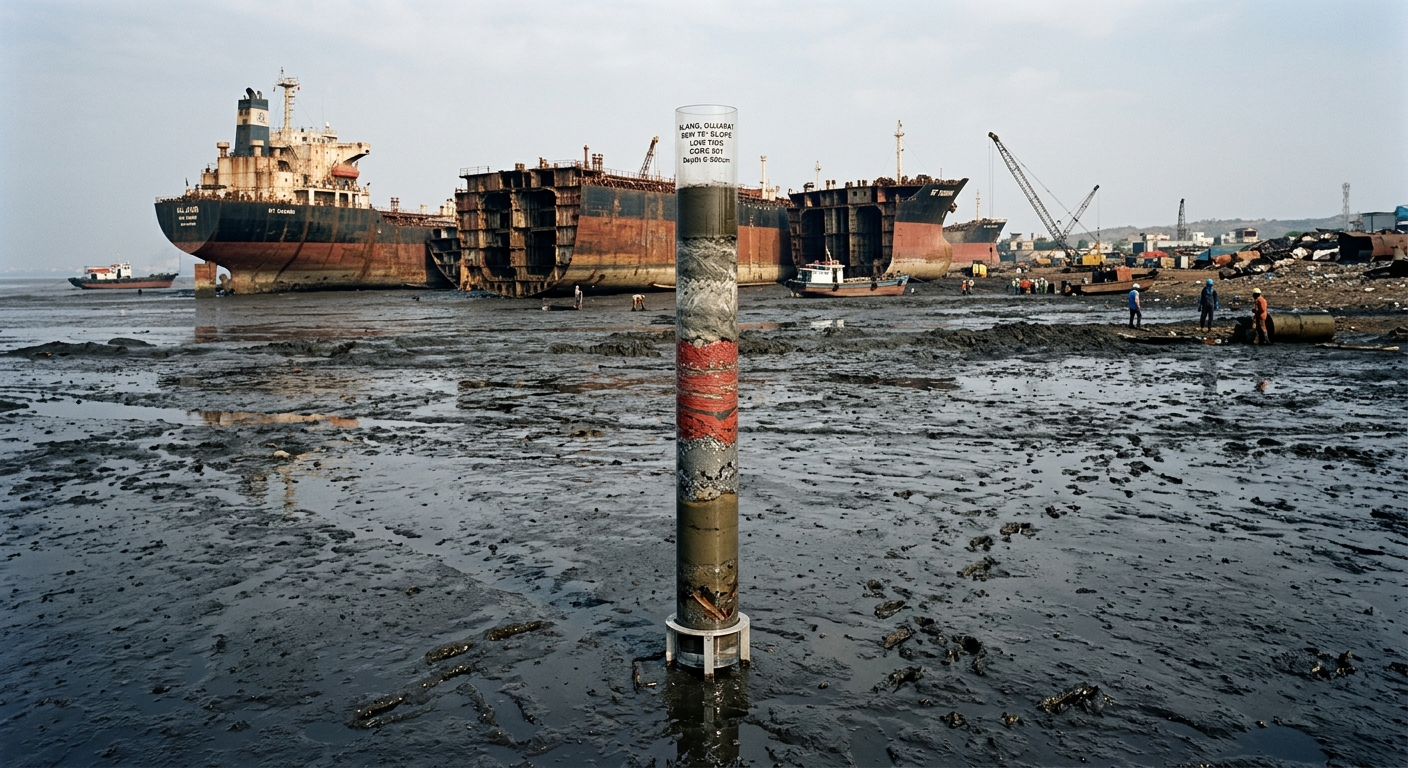
Tidal chromatography core sampling industrial stratification at the Alang shipbreaking flats. · motion: percolating upward through the sediment gradient
wall text
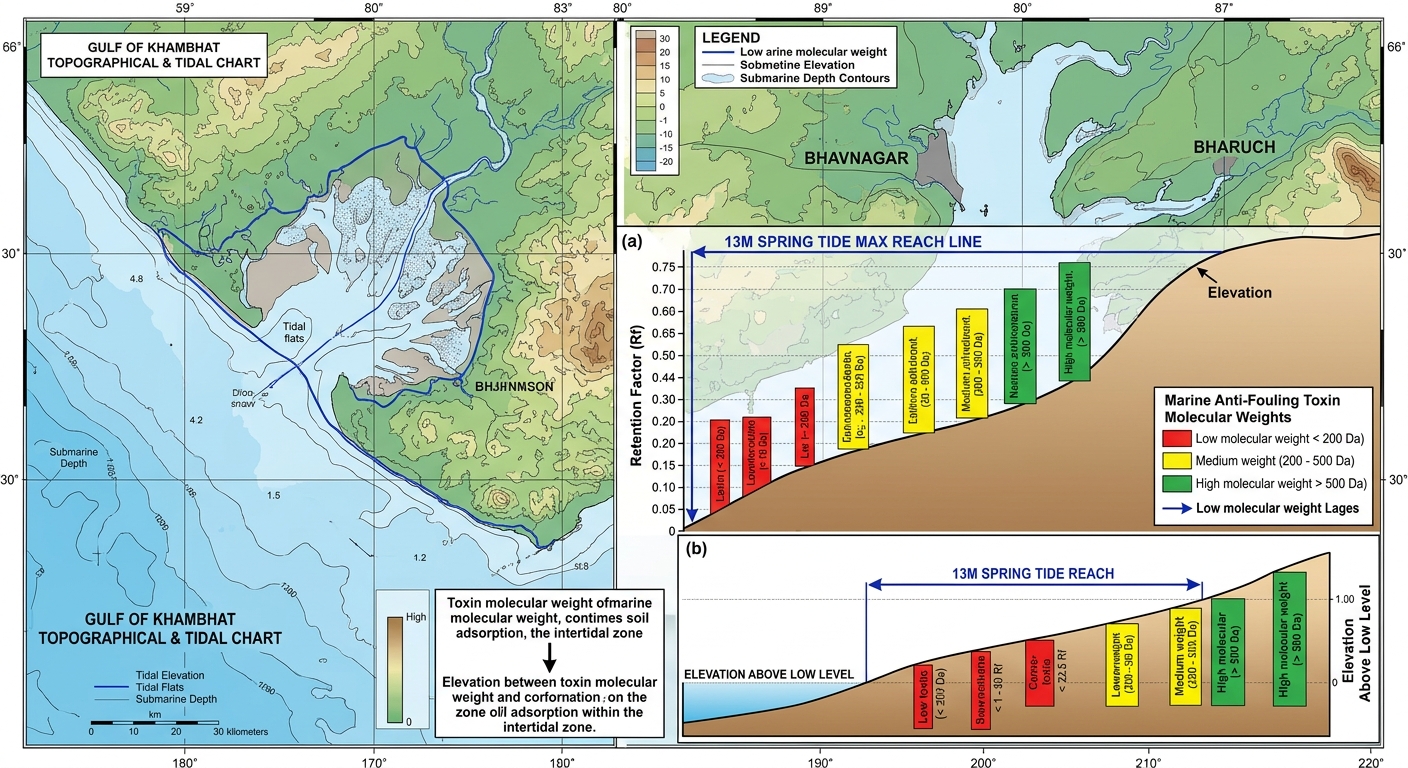
At Alang, India, the decommissioning of international maritime fleets collides with the world's most extreme tidal regime. Utilizing the Gulf of Khambhat's 13-meter spring tides, this project reframes the 15-degree intertidal mudflat as an unintended thin-layer chromatography plate. Seawater functions as the mobile solvent, carrying dismantled industrial toxins—such as tributyltin, asbestos, and lead-based anti-fouling coatings—across the fine coastal silt stationary phase. As the water recedes, compounds separate according to molecular weight and retention factors. Extracted in vertical sediment cores, these segregated toxins form a stratified, permanent geological barcode of 20th-century global trade liquidation.
shown: Installed permanently as an array of 40 vertical core-sample pillars aligned precisely along the spring tide high-water mark on Alang beach, slowly weathering into the contaminated landscape.
shown: Installed permanently as an array of 40 vertical core-sample pillars aligned precisely along the spring tide high-water mark on Alang beach, slowly weathering into the contaminated landscape.
anchor facts used
- 15-degree beach slope used for grounding ocean liners
- 13-meter spring tidal range of the Gulf of Khambhat
- Beaching of the first ship MV Kota Tenjong in 1983
- High concentration of Tributyltin (TBT) and lead in the intertidal soil
mechanism
- Thin-Layer Chromatography (Mobile Phase) — The Gulf of Khambhat's massive 13-meter spring tides act as the chemical solvent, cyclically washing over and saturating the 10-kilometer coastline.
1. Mobile Phase Introduction - Stationary Phase Adsorption — The dense coastal mud captures industrial particulate matter as seawater recedes, effectively acting as an immense silica gel plate.
2. Stationary Phase Adsorption - Analyte Separation (Retention Factor) — Heavy metals, asbestos fibers, and anti-fouling agents segregate into distinct horizontal strata along the beach gradient based on their density and lipid solubility.
3. Analyte Separation by Retention Factor - Core Sampling and Chemical Staining — Cylindrical tubes driven 3 meters into the mudflats extract the stratified sediment, which is then cured in optical acrylic to reveal the chronological barcode of shipping collapse.
4. Geochemical Fixation and Visualization
lineage
- Reddy et al. (2003), 'Heavy metal distribution in the environs of Alang-Sosiya shipbreaking yard' — Provides the exact baseline concentration metrics required to map the chromatograph's heaviest retention bands.
- Walter De Maria, 'The New York Earth Room' — Transposes minimalist geological displacement from an aesthetic interior volume into a highly toxic, chemically active field memorial.
- Edward Burtynsky, 'Shipbreaking' photographic series — Moves beyond the romanticized photographic sublime of the rusted hulls to expose the invisible, permanent chemical residue embedded in the earth.
curatorial qa (machine verdict, unedited)
SCORE 3/5 after 2 attempt(s)
READS: The core tube clearly showcases distinct anthropogenic strata positioned against the shipbreaking yard, effectively pairing the graphic diagram with the industrial beachscape.
FAILS: The tidal dynamics appear as a violent exterior splash rather than an internal, legible upward capillary percolation separating distinct chemical analytes through sediment.
READS: The core tube clearly showcases distinct anthropogenic strata positioned against the shipbreaking yard, effectively pairing the graphic diagram with the industrial beachscape.
FAILS: The tidal dynamics appear as a violent exterior splash rather than an internal, legible upward capillary percolation separating distinct chemical analytes through sediment.
spec: antigravity agent · keyframe/artifact: gemini-3.1-flash-image · video: veo-3.1 image-to-video · qa+wall text: gemini-3.7-flash watching the render · 36.3s total