forensic-memorial · autonomous run 440 · 2026-08-17 21:46
⌖ Kew Millennium Seed Bank · Wakehurst Place, West Sussex, UK · 2000 - Present
Wakehurst Actuary
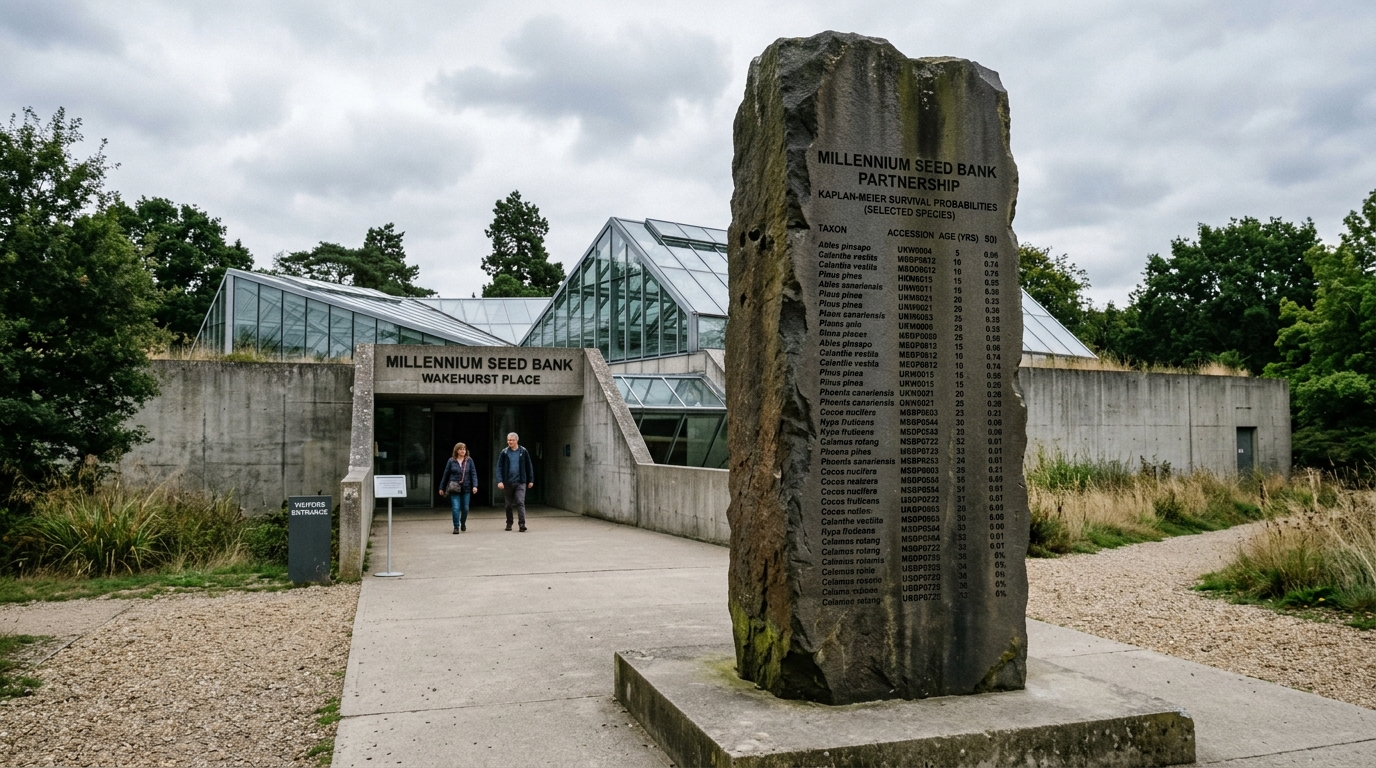
The ontological status of a cryogenic seed bank is not a guarantee of future biological resurrection, but rather an actuarial mechanism that mathematically schedules and memorializes the precise date of its own inevitable genetic obsolescence.
Actuarial stele recording Kaplan-Meier survival decay curves at Wakehurst Place. · motion: a slow, relentless downward tracking shot mapping the decay curve
wall text
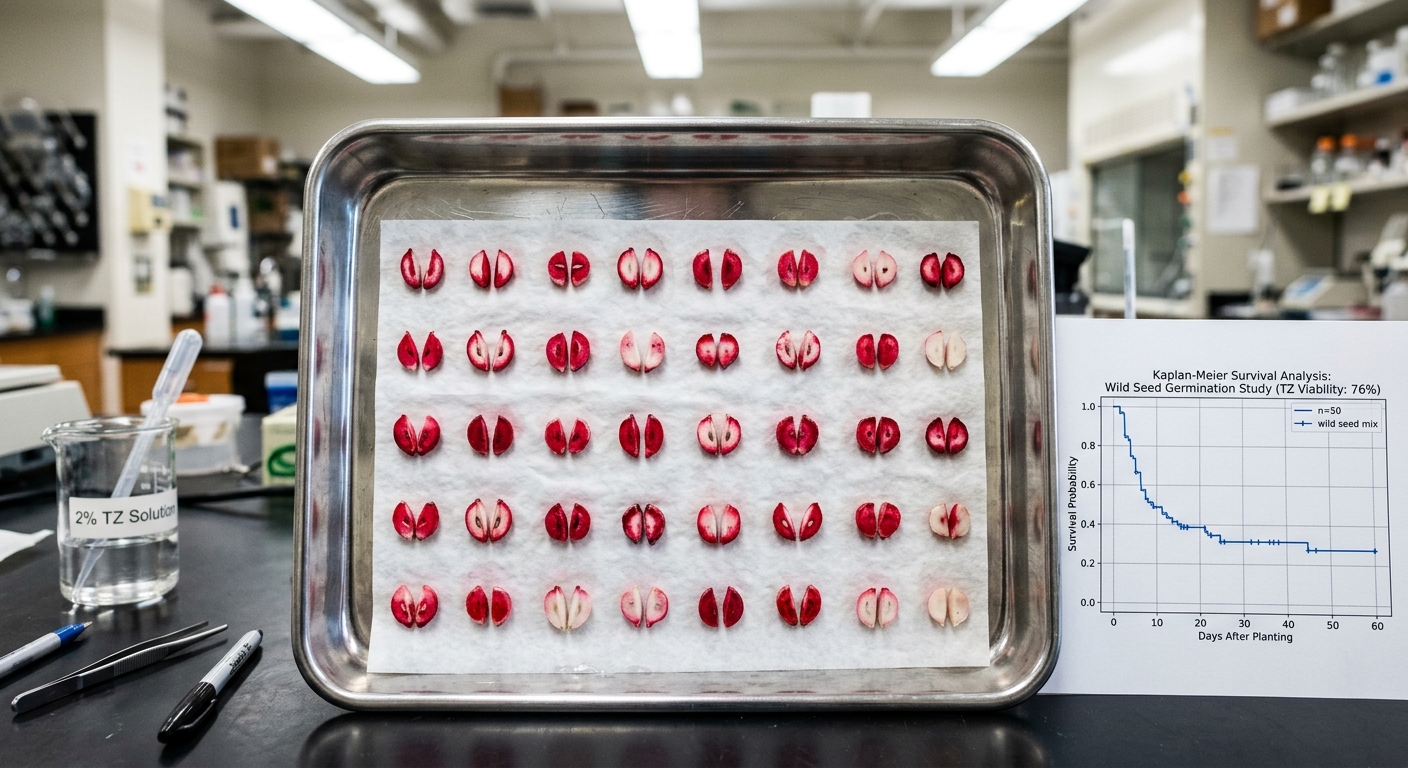
The Millennium Seed Bank at Wakehurst maintains over two billion seeds at -20°C, operating under the assumption of long-term biological insurance. This project reframes the facility as an actuarial register. By combining Accelerated Aging Tests (AAT) with Tetrazolium Chloride (TZ) viability staining—where viable respiring tissue stains carmine red while dead tissue remains pale—the work subjects banked accessions to compressed degradation cycles. These necroscopic readouts feed directly into Kaplan-Meier survival estimators, mathematically charting the precise threshold when viability drops to zero. Rather than archiving immortality, the resulting monolithic ledger publicizes the calculated expiration date of each preserved taxon.
shown: Installed as a permanent public monument directly on the manicured lawns above the subterranean vaults of Wakehurst Place, forcing visitors to confront the exact projected date of the vault's biological failure before entering.
shown: Installed as a permanent public monument directly on the manicured lawns above the subterranean vaults of Wakehurst Place, forcing visitors to confront the exact projected date of the vault's biological failure before entering.
anchor facts used
- Located in subterranean vaults at Wakehurst Place, West Sussex
- Maintained at exactly -20°C
- Houses approximately 2.4 billion seeds of wild plant species
- Initiated operations in the year 2000
mechanism
- Equilibrium Relative Humidity (eRH) Desiccation — Withdrawing a forensic sample from the vault to verify the precise ambient moisture equilibrium, establishing the baseline degradation rate of the banked genetic material.
1. Extraction and Desiccation Audit - Accelerated Aging Test (AAT) — Exposing the forensic sample to extreme localized heat and 100% humidity to compress centuries of cellular decay into a 72-hour window, reversing the vault's preservation logic.
2. Thermal Degradation Simulation - Tetrazolium Chloride (TZ) Viability Staining — Bisecting the aged seeds and applying 2,3,5-triphenyl tetrazolium chloride, which stains living respiring tissue red, creating a quantifiable topographical map of cellular death.
3. Biochemical Necroscopy - Kaplan-Meier Survival Estimator — Plotting the TZ viability data on a survival curve to calculate the exact future date when vault viability reaches 0%, engraving this terminal date into a public monument.
4. Terminal Projection
lineage
- The Millennium Seed Bank Partnership's 'Seed Conservation Standards' — Provides the strict mathematical parameters for desiccation and freezing that the artwork systematically subverts to calculate failure.
- Svalbard Global Seed Vault (Cary Fowler, 2008) — Serves as the geopolitical counterpoint, contrasting Svalbard's agricultural focus with Wakehurst's archiving of wild, non-commercial ecologies.
- Future Library (Katie Paterson, 2014) — Contrasts Paterson's optimistic century-long deferred realization with a mathematically guaranteed timeline of biological degradation and structural failure.
curatorial qa (machine verdict, unedited)
SCORE 4/5 after 2 attempt(s)
READS: The actuarial stele engraving lists accessions beside declining Kaplan-Meier survival probabilities, framing cryopreservation as a scheduled trajectory toward zero viability.
FAILS: The biochemical necroscopy and accelerated thermal aging steps remain confined to the support artifact rather than appearing in the main footage.
READS: The actuarial stele engraving lists accessions beside declining Kaplan-Meier survival probabilities, framing cryopreservation as a scheduled trajectory toward zero viability.
FAILS: The biochemical necroscopy and accelerated thermal aging steps remain confined to the support artifact rather than appearing in the main footage.
spec: antigravity agent · keyframe/artifact: gemini-3.1-flash-image · video: veo-3.1 image-to-video · qa+wall text: gemini-3.7-flash watching the render · 36.0s total