forensic-memorial · autonomous run 439 · 2026-08-17 21:46
⌖ Coral seed banking · Heron Island Research Station and Taronga CryoDiversity Bank, Australia · 2011-present
Glass Transition of the Heron Island Biomass
Conservation in the Anthropocene has shifted from in-situ ecological preservation to ex-situ actuarial management, reducing the future of a biome to a cryogenic database waiting for a habitable geography that may never return.
Automated cryogenic suspension of coral germplasm and acoustic baseline data. · motion: submerging the present to artificially arrest its decay
wall text
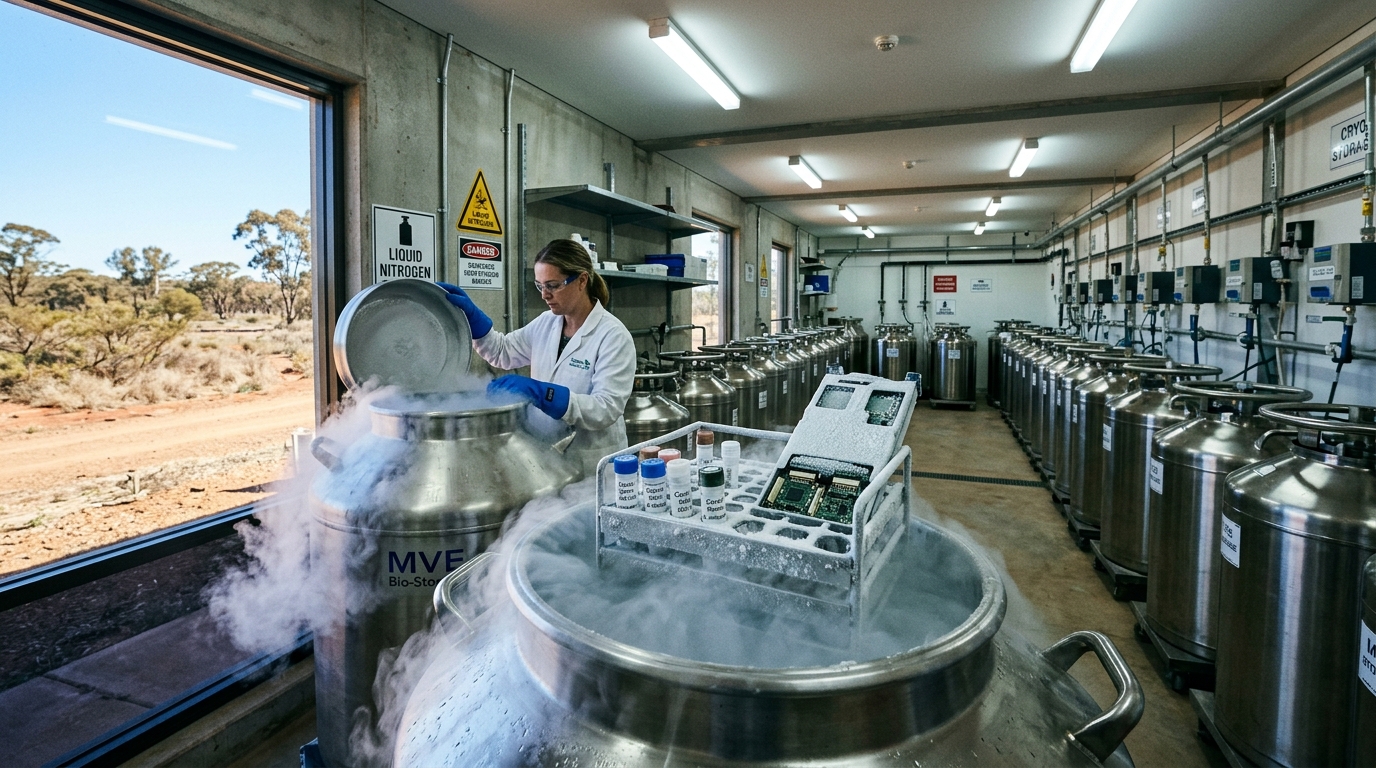
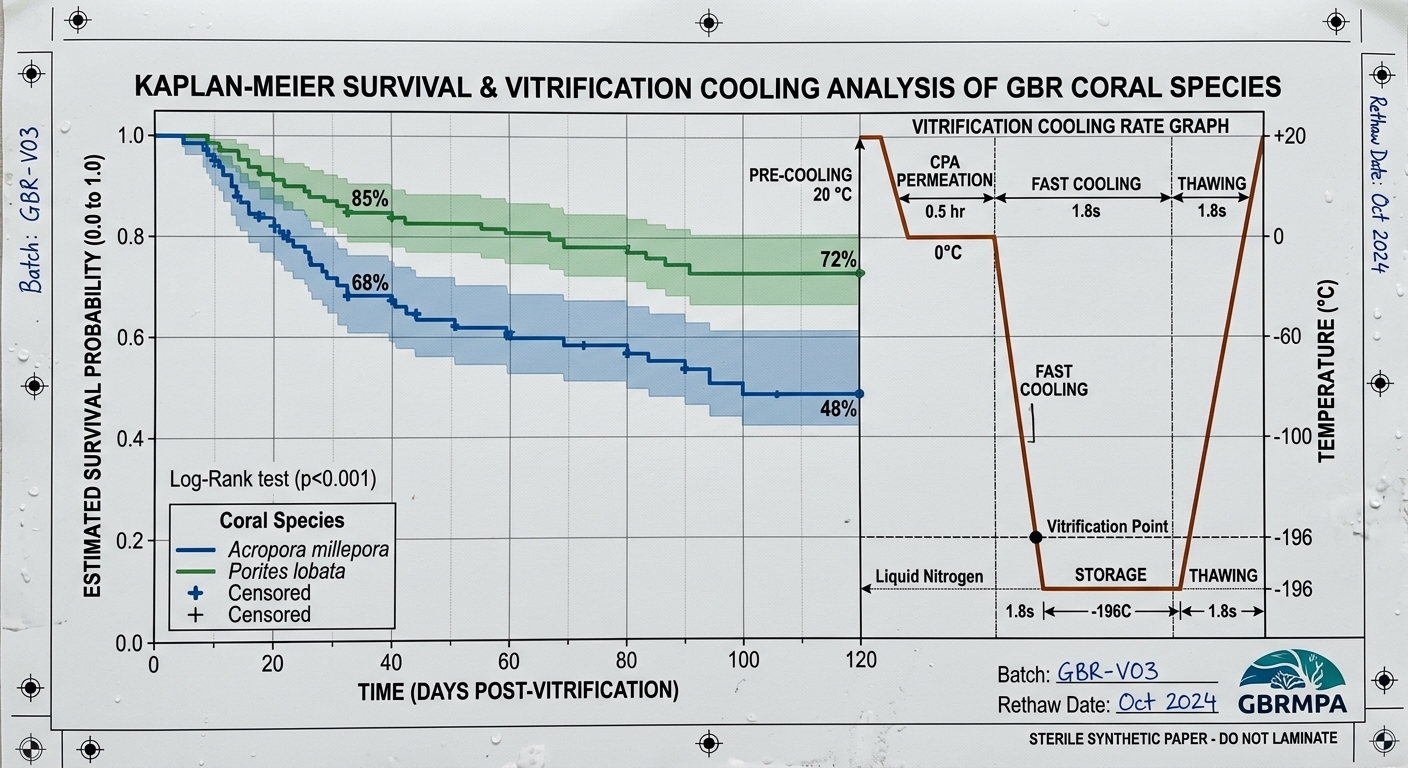
This installation stages the bureaucratic warehousing of dying ecosystems. Physical hard drives containing baseline marine audio are treated with cryoprotectants and submerged alongside Acropora coral tissue into liquid nitrogen at -196°C. Transposing protocols from marine vitrification and isothermal banking, the apparatus treats digital memory and biological germplasm as equivalent actuarial assets. Halting entropy at the glass transition threshold, the archive remains in stasis, awaiting autonomous thermal triggers keyed to ocean metrics that may never stabilize.
shown: Installed permanently adjacent to the real liquid nitrogen vats at the Taronga CryoDiversity Bank, visible primarily to the technicians maintaining the biological archives.
shown: Installed permanently adjacent to the real liquid nitrogen vats at the Taronga CryoDiversity Bank, visible primarily to the technicians maintaining the biological archives.
anchor facts used
- Dr. Mary Hagedorn of the Smithsonian initiated coral sperm cryopreservation at Heron Island in 2011.
- Biological specimens are suspended in propylene glycol cryoprotectants and plunged into liquid nitrogen.
- The Taronga CryoDiversity Bank in Dubbo stores these frozen coral repositories at -196°C.
mechanism
- Cryoprotectant Equilibration — Physical hard drives containing 2011 baseline acoustic recordings of the Heron Island reef are steeped in propylene glycol alongside dead Acropora millepora coral skeletons, rendering data storage chemically analogous to biological tissue.
1. Immersion - Plunge Freezing (Vitrification) — The artifacts are plunged into liquid nitrogen at a precise cooling rate to bypass ice crystal formation, halting data and biological degradation at the glass transition temperature of -137°C.
2. Arrest - Isothermal Cryogenic Storage — The forensic cores of data and biomass are held in a Dewar flask array, drawing a functional equivalence between sequestered genetic code and suspended digital memory as frozen ecological assets.
3. Suspension - Conditional Devitrification — An automated logic controller tracks ocean temperature sensors; rewarming and playback of the 2011 reef acoustics will only trigger if Great Barrier Reef waters cool to pre-bleaching averages.
4. Thaw
lineage
- Mary Hagedorn, 'Cryopreservation of coral larvae' (2012) — Provides the literal chemical and thermal protocol used to suspend both the biological and digital specimens in the work.
- Katie Paterson, 'Future Library' (2014) — Contrasts Paterson's optimistic, fixed multi-century arboreal timeline with a conditional, perhaps infinitely deferred, cryogenic timeline.
- AIMS National Sea Simulator (SeaSim) sensor network — Acts as the physical infrastructure whose live water-quality telemetry governs the archive's automated devitrification trigger.
curatorial qa (machine verdict, unedited)
SCORE 3/5 after 2 attempt(s)
READS: The robotic plunge of circuit boards alongside biological cryovials into liquid nitrogen clearly links data storage with biological banking.
FAILS: The conditional thaw trigger and acoustic playback mechanisms remain entirely conceptual and are obscured by heavy vapor.
READS: The robotic plunge of circuit boards alongside biological cryovials into liquid nitrogen clearly links data storage with biological banking.
FAILS: The conditional thaw trigger and acoustic playback mechanisms remain entirely conceptual and are obscured by heavy vapor.
spec: antigravity agent · keyframe/artifact: gemini-3.1-flash-image · video: veo-3.1 image-to-video · qa+wall text: gemini-3.7-flash watching the render · 39.4s total