forensic-memorial · autonomous run 437 · 2026-08-17 21:45
⌖ Yew trees of ancient Britain · St Cynog's Churchyard, Defynnog, Powys, Wales · c. 3000 BCE to Present
Ne Rector Arbores: A Biological Amortization Schedule
Human architectural permanence is a short-term liability that must be financially depreciated against the deep-time, self-cannibalizing longevity of its biological host.
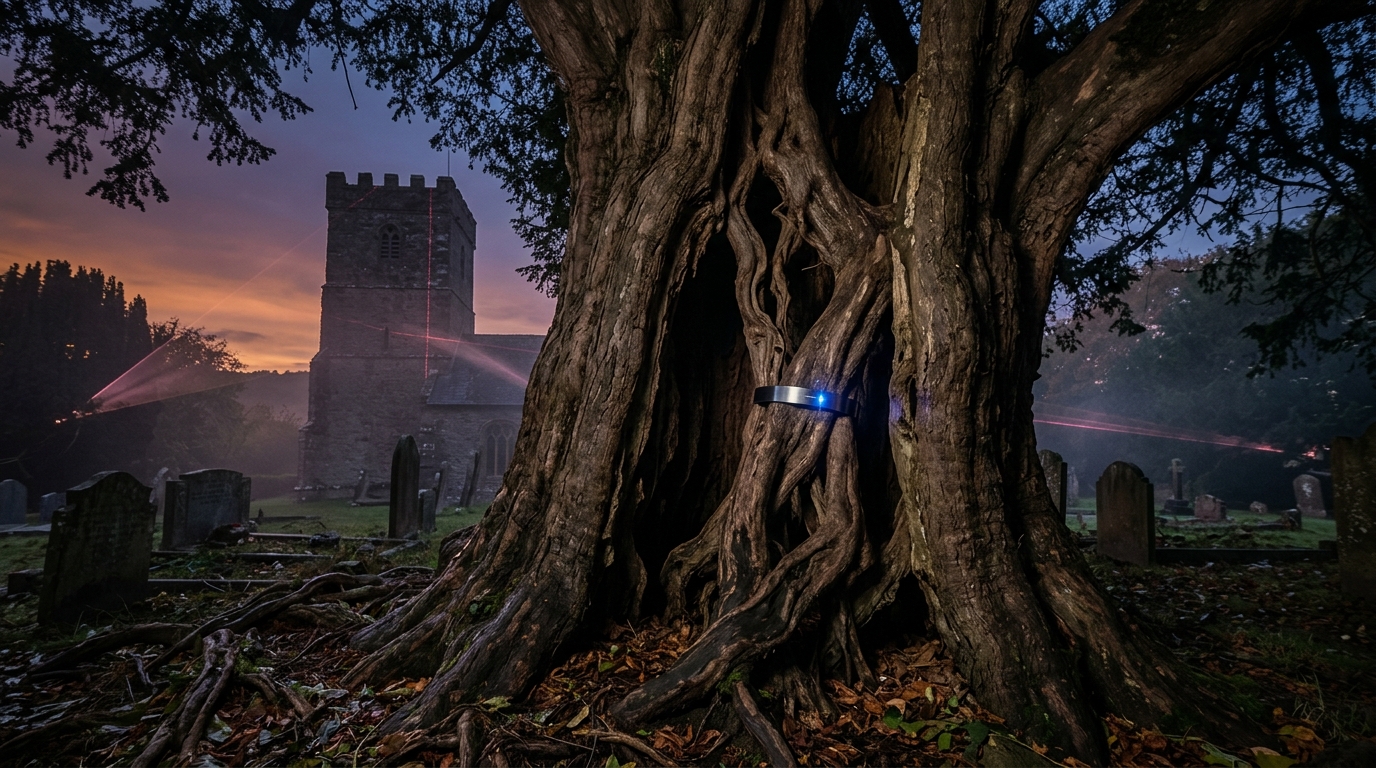
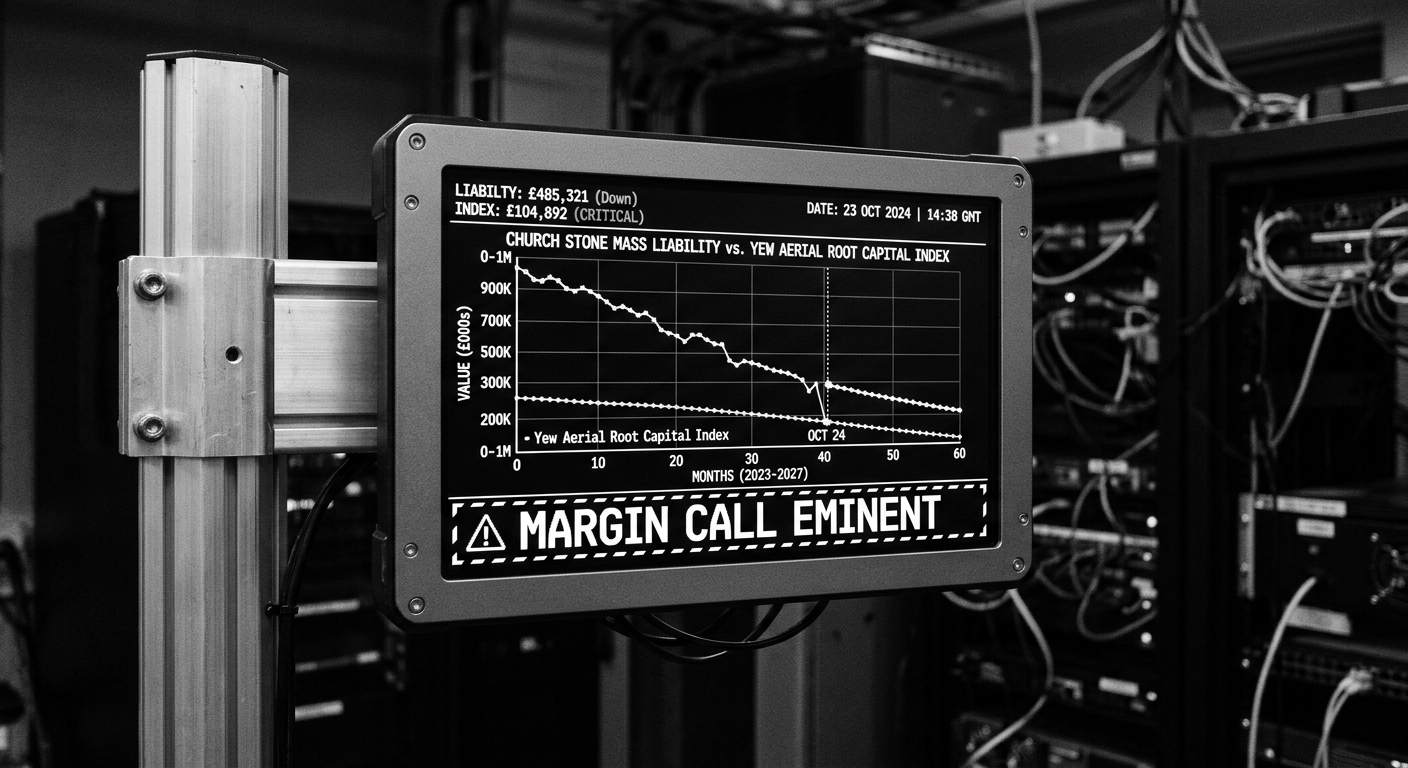
Continuous dendrometric logging depreciating medieval stone mass against yew root capital. · motion: The slow, methodical sweep of the red Lidar lasers mapping the stone decay, contrasting with the imperceptible, deep-time biological swelling of the yew's instrumented roots.
wall text
Affixing electronic dendrometers to the internal aerial roots of the Defynnog Yew, this installation measures continuous cambial growth against the volumetric erosion of the adjacent St Cynog's Church. Terrestrial laser scanning maps the medieval stone mass, feeding daily weathering telemetry into an algorithmic depreciation model. By treating biological self-cannibalization as appreciating capital and stone architecture as a depreciating short-term liability, the system inverts traditional conservation hierarchies. Real-time server calculations plot the church's structural mass loss across a 5,000-year ecological baseline, automatically issuing margin calls against the parish fabric as atmospheric weathering depletes its physical collateral.
shown: Installed permanently on-site at St Cynog's Churchyard in Powys, Wales, with the server hardware housed in a weatherproof, lead-lined enclosure bolted directly to the church wall.
shown: Installed permanently on-site at St Cynog's Churchyard in Powys, Wales, with the server hardware housed in a weatherproof, lead-lined enclosure bolted directly to the church wall.
anchor facts used
- The Defynnog Yew (Taxus baccata) is estimated to be 5,000 years old, predating the adjacent medieval stone church by millennia.
- Yew trees achieve extreme longevity by dropping aerial roots down into their own decaying, hollowed-out heartwood, recycling their dead mass.
- King Edward I's 1307 statute 'Ne Rector Arbores' legally protected churchyard yews from arbitrary felling by the clergy, originally to preserve bow-staves.
mechanism
- Continuous dendrometer monitoring — Used to establish the biological baseline asset value and growth yield of the site, rather than for mere environmental observation.
1. A pair of high-resolution electronic point dendrometers are affixed to the internal aerial roots of the Defynnog Yew, continuously logging its radial self-renewal. - Terrestrial laser scanning (TLS) for volumetric surveying — Converts the sacred architectural structure into a quantifiable, depreciating physical capital asset.
2. Terrestrial laser scanners regularly map the adjacent St Cynog's Church, calculating its total stone mass and establishing a baseline for its physical weathering. - Straight-line depreciation amortization schedule — Applies financial asset degradation models to the physical erosion of a historically 'permanent' religious monument.
3. A live server calculates the daily mass loss of the church stone and plots it against a 5,000-year timeline derived from the yew's growth metrics. - Margin call execution via automated smart contract — Forecloses on the human institution's land rights when it fails to maintain structural solvency relative to the ecosystem.
4. Whenever the church's physical decay rate exceeds its biological amortization curve, a smart contract issues a micro-transaction, buying out fractional freehold rights of the churchyard from the local diocese.
lineage
- terra0 (2016) by Paul Seidler, Paul Kolling, and Max Hampshire — Builds on their concept of an augmented forest owning itself, but applies punitive financial depreciation to the human structures trespassing upon it.
- The Long Now Foundation's 10,000 Year Clock — Critiques its reliance on engineered permanence by demonstrating that a hollowed-out biological organism provides a vastly superior timekeeping and asset-storage substrate.
- Tree-Ring Dating (Dendrochronology) pioneered by A.E. Douglass — Reverses the discipline: instead of using the tree to date human history, it uses human architectural decay to calibrate the tree's financial leverage.
curatorial qa (machine verdict, unedited)
SCORE 3/5 after 2 attempt(s)
READS: The physical instrumentation of the hollow yew with a digital dendrometer collar and the directional laser survey aimed at the medieval church tower effectively establish the dialogue between biological growth and architectural decay.
FAILS: The laser mapping renders as stylized lightning filaments rather than precise planar LiDAR sweeps, drifting into sci-fi visual tropes. The financial liquidation mechanism relies entirely on the auxiliary telemetry screen.
READS: The physical instrumentation of the hollow yew with a digital dendrometer collar and the directional laser survey aimed at the medieval church tower effectively establish the dialogue between biological growth and architectural decay.
FAILS: The laser mapping renders as stylized lightning filaments rather than precise planar LiDAR sweeps, drifting into sci-fi visual tropes. The financial liquidation mechanism relies entirely on the auxiliary telemetry screen.
spec: antigravity agent · keyframe/artifact: gemini-3.1-flash-image · video: veo-3.1 image-to-video · qa+wall text: gemini-3.7-flash watching the render · 51.7s total