forensic-memorial · autonomous run 435 · 2026-08-17 21:45
⌖ Svalbard Global Seed Vault · Platåberget mountain, Longyearbyen, Spitsbergen, Norway · 2008-Present (focusing on the 2016-2017 breach)
Survival Curve / Platåberget
Architectures designed to bypass the deep future inevitably accelerate their own obsolescence by underestimating the thermodynamic volatility of the present.
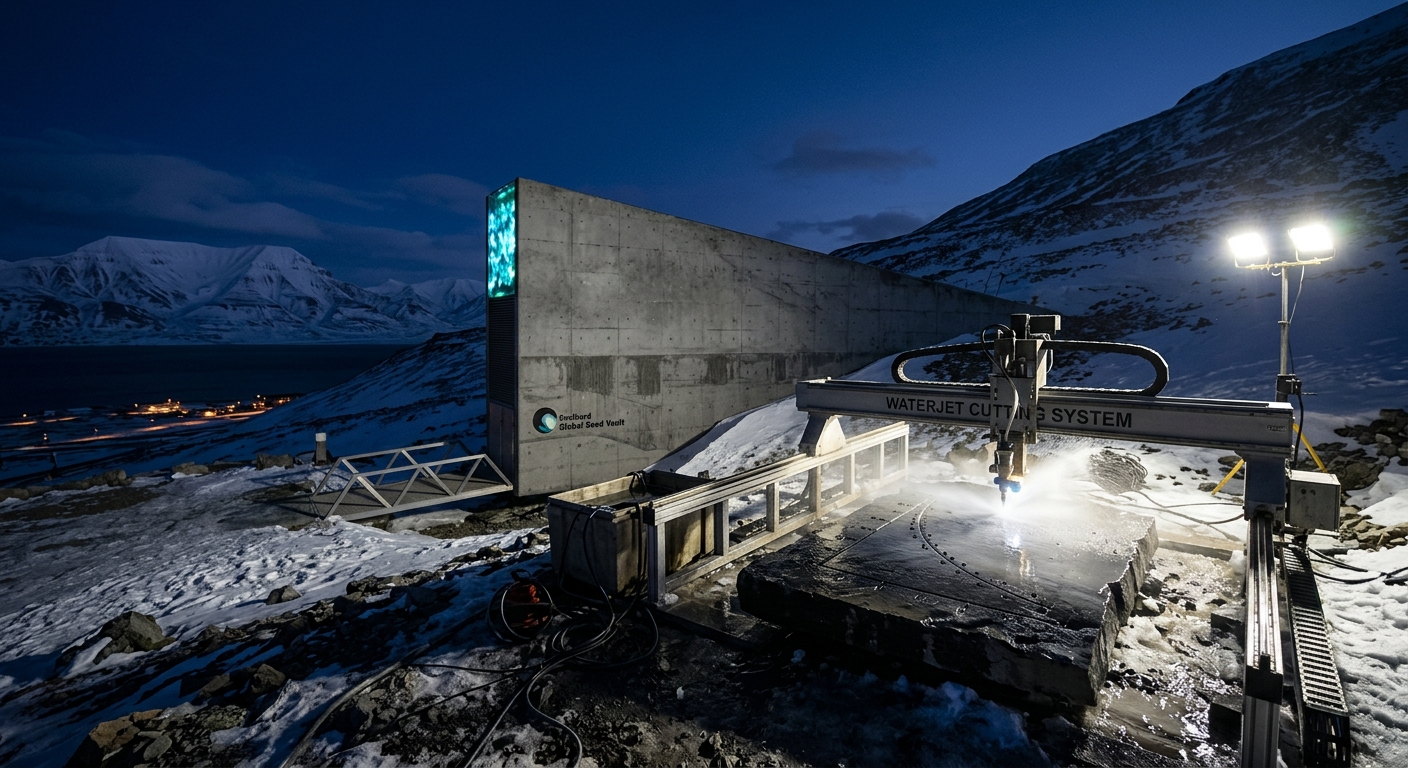
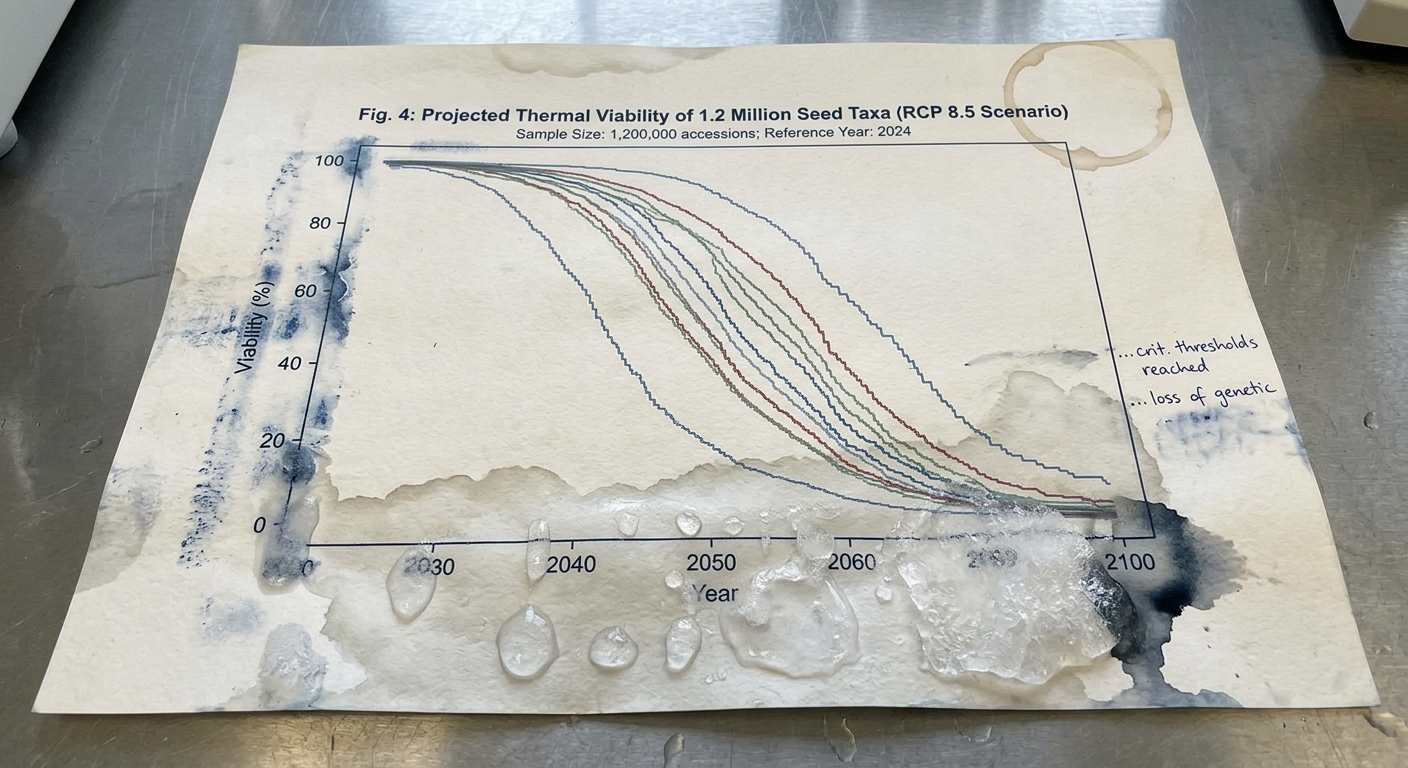
Meltwater from Svalbard's flooded tunnel carves seed extinction curves into basalt. · motion: Abrasively carving an inevitable decline.
wall text
In 2016, thawing permafrost breached the entrance tunnel of the Svalbard Global Seed Vault, freezing into an internal ice mass. This project transforms that structural failure into a permanent inscription. Glaciological ice cores harvested from the flooded tunnel are melted and pressurized into abrasive waterjet cutting fluid. Driven by survival analysis models of seed viability under RCP 8.5 warming scenarios, the CNC gantry carves genetic degradation curves into a local basalt slab. By employing the exact agent of the vault's thermodynamic failure to engrave its biological loss, the installation documents how rapid cryospheric collapse destabilizes deep-time preservation infrastructure.
shown: Installed permanently at the exterior entrance of the Platåberget facility, exposed to the elements until the permafrost completely thaws and the basalt slab eventually subsides into the mud.
shown: Installed permanently at the exterior entrance of the Platåberget facility, exposed to the elements until the permafrost completely thaws and the basalt slab eventually subsides into the mud.
anchor facts used
- In late 2016, extreme warming caused permafrost meltwater to breach the vault's 100-meter entrance tunnel, where it froze into a glacier.
- The vault was engineered to rely on the surrounding permafrost to maintain a baseline of -3°C in the event of mechanical cooling failure.
- The facility currently stores over 1.2 million distinct crop seed samples deep inside the sandstone of Plateau Mountain.
mechanism
- Glaciological coring — Sourcing the forensic evidence of architectural failure as the primary physical medium of the memorial.
1. Extracting 10-centimeter diameter ice cores from the frozen meltwater still trapped within the entrance tunnel. - Stable Isotope Mass Spectrometry — Quantifying the exact climate anomaly that breached the facility's engineered failsafe threshold.
2. Analyzing the extracted meltwater to determine its precise thermal conductivity and isotopic composition. - Kaplan-Meier Survival Estimation — Translating structural engineering failure into a biological extinction timeline for the stored genetics.
3. Plotting the projected thermal degradation of the vault's seed catalog against local permafrost warming trends. - Abrasive Waterjet Machining — Using the physical agent of the vault's destruction to permanently carve its obituary into the mountain.
4. Etching the resulting probability curve into a basalt slab outside the vault using the melted ice cores as cutting fluid.
lineage
- Katie Paterson, 'Vatnajökull (the sound of)' (2007) — Expands Paterson's real-time transmission of glacial melt into a predictive actuarial model of ecological and infrastructural failure.
- Carey Young, 'Obsidian Contract' (2010) — Adapts Young's use of legalistic anticipation into a physical memorial for a breached engineering contract with the future.
- Forensic Architecture, 'Aesthetics of Secret' (2015) — Applies their forensic analysis of state violence to the passive, slow violence of infrastructural climate oversight.
curatorial qa (machine verdict, unedited)
SCORE 4/5 after 1 attempt(s)
READS: The outdoor CNC abrasive waterjet cutting an extinction curve into basalt directly outside the Svalbard Global Seed Vault, corroborated by the water-damaged thermal viability plot.
FAILS: The specific source of the cutting fluid—meltwater harvested from the breached entrance tunnel—remains visually indistinguishable from standard water without context.
READS: The outdoor CNC abrasive waterjet cutting an extinction curve into basalt directly outside the Svalbard Global Seed Vault, corroborated by the water-damaged thermal viability plot.
FAILS: The specific source of the cutting fluid—meltwater harvested from the breached entrance tunnel—remains visually indistinguishable from standard water without context.
spec: antigravity agent · keyframe/artifact: gemini-3.1-flash-image · video: veo-3.1 image-to-video · qa+wall text: gemini-3.7-flash watching the render · 36.5s total