forensic-memorial · autonomous run 434 · 2026-08-17 21:45
⌖ Kjeller reactor (JEEP I / JEEP II) · Kjeller, Lillestrøm municipality, Norway · 1951-2019
Isotope Greenfield: JEEP II
Bureaucratic mandates for a 'greenfield' state following nuclear decommissioning cannot erase atomic signatures; human remediation simply reorganizes localized isotopic architecture into hyper-dispersed, permanent geological strata.
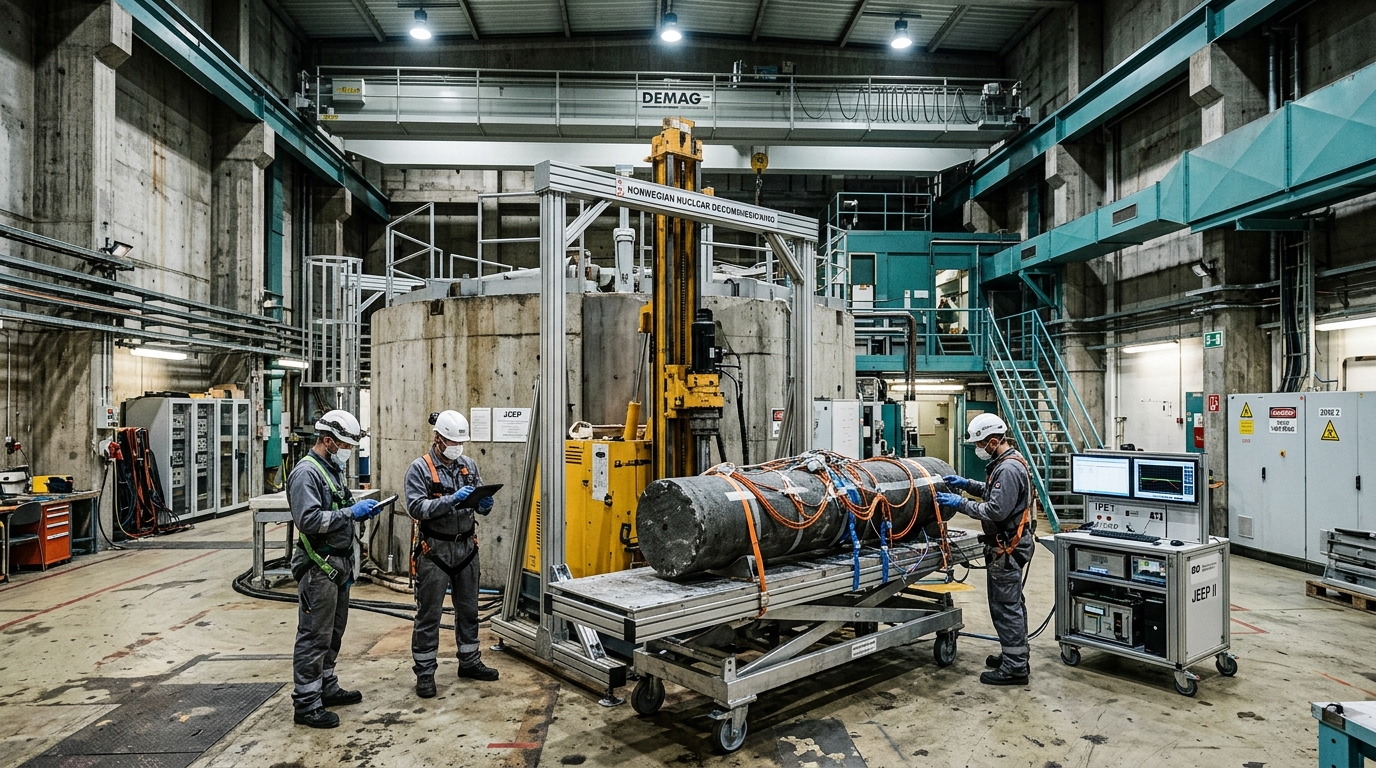
Milling core samples from the JEEP II shield into fine dust. · motion: grinding down extracted concrete cores at a rate continuously calibrated to the 13.5-year half-life of Europium-152
wall text
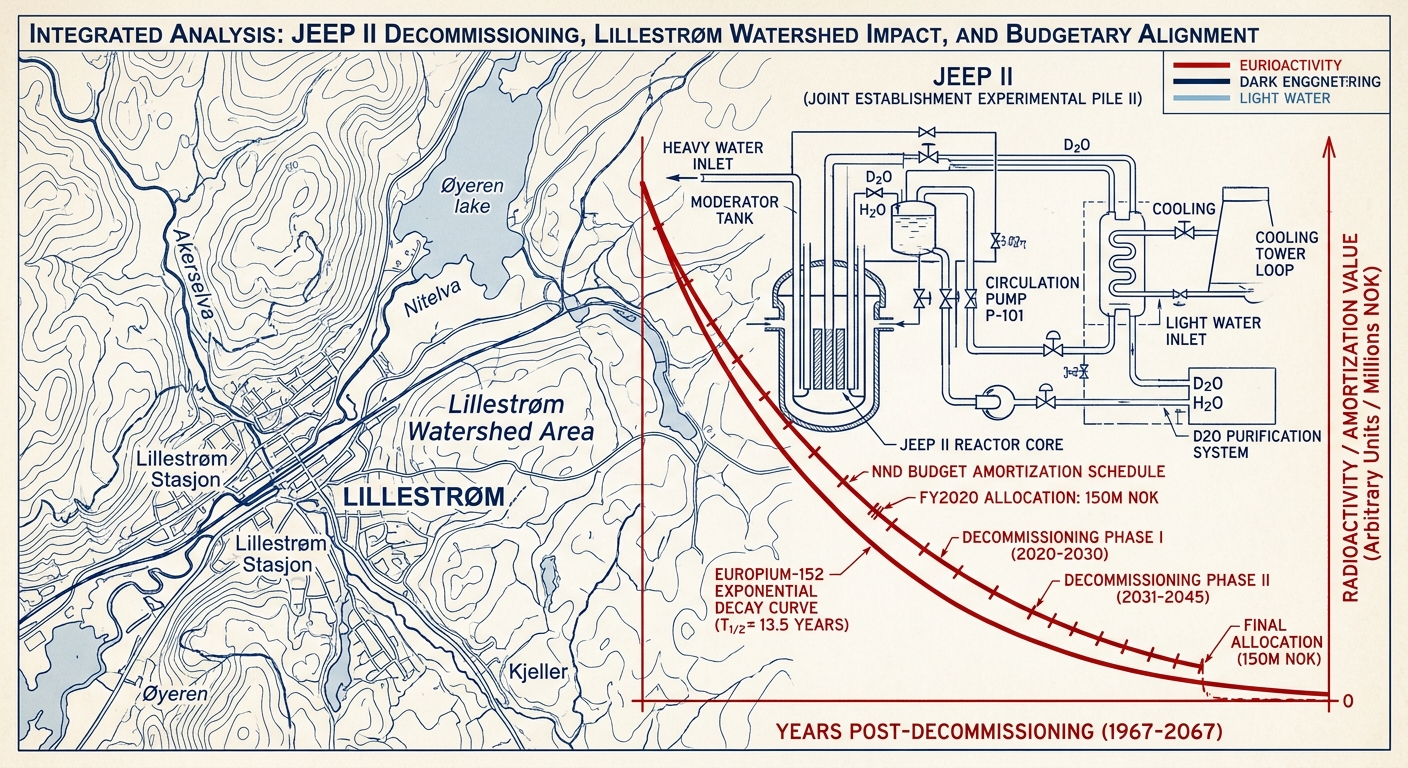
Following the 2019 shutdown of the JEEP II research reactor, decommissioning protocols require returning the Kjeller site to a 'greenfield' baseline. This installation operationalizes the material paradox of nuclear cleanup. Extracted core samples from the irradiated biological shield are mounted beneath an automated milling rig that grinds concrete down according to the 13.5-year half-life of Europium-152. Transposing standard gamma-ray spectrometry and decay modeling into mechanical abrasion, the pulverization process releases particulate matter into simulated watershed flows. Rather than neutralizing the atomic legacy, the apparatus demonstrates how institutional remediation merely converts localized infrastructural radiation into dispersed geological strata.
shown: Installed permanently in a subterranean monitoring vault adjacent to the sealed JEEP II reactor hall, operating continuously until the site achieves official greenfield status.
shown: Installed permanently in a subterranean monitoring vault adjacent to the sealed JEEP II reactor hall, operating continuously until the site achieves official greenfield status.
anchor facts used
- The JEEP II reactor was permanently shut down in April 2019 after severe corrosion was discovered in the reactor tank components.
- The reactor utilized heavy water (deuterium oxide) as both a moderator and coolant.
- The Norwegian Nuclear Decommissioning (NND) agency holds the regulatory mandate to ultimately return the Kjeller site to an unrestricted 'greenfield' status.
mechanism
- Gamma-ray spectrometry — Geological core samples extracted directly from the JEEP II biological shield are scanned to map the precise activation profile and concentration of Europium-152 embedded in the concrete structure.
1. Extraction and Activation Mapping - Secular equilibrium decay calculation — An automated physical chronometer grinds the extracted concrete cores into dust at a continuously calibrated micro-rate inversely proportional to the 13.5-year half-life of the measured Europium-152.
2. Chronometric Milling - Isotope-ratio mass spectrometry (IRMS) — Residual heavy water salvaged from the primary cooling circuit is micro-dosed into a continuously evaporating open-air basin of local rainwater, tracing the slow diffusion of site memory into the Lillestrøm watershed.
3. Hydrological Dispersal - Nuclear waste vitrification — The finely milled concrete dust is fused into standard 'greenfield' geological markers under extreme heat, then buried precisely at coordinates N59° 58′ 26″ E11° 2′ 54″ to await future archaeological discovery.
4. Stratigraphic Re-insertion
lineage
- Trevor Paglen, 'Trinity Cube' — Builds upon the physical capture of irradiated geology, but shifts the focus from the initial moment of creation (the blast) to the bureaucratic erasure of decommissioning.
- James Acord, 'Monstrance for a Grey Horse' — Shares the ambition to sculpt directly with nuclear materials, but replaces Acord's active transmutation with the passive bureaucracy of secular equilibrium.
- Cornelia Hesse-Honegger, 'Heteroptera' — Expands her forensic mapping of biological fallout into the architectural half-life of containment vessels undergoing remediation.
curatorial qa (machine verdict, unedited)
SCORE 3/5 after 2 attempt(s)
READS: The physical extraction and mechanical saw-milling of the core cylinder effectively communicate industrial containment dismantling and physical remediation.
FAILS: The direct connection between the grinding speed, isotopic decay math (Europium-152), and watershed dispersal is not legible without diagrammatic aid.
READS: The physical extraction and mechanical saw-milling of the core cylinder effectively communicate industrial containment dismantling and physical remediation.
FAILS: The direct connection between the grinding speed, isotopic decay math (Europium-152), and watershed dispersal is not legible without diagrammatic aid.
spec: antigravity agent · keyframe/artifact: gemini-3.1-flash-image · video: veo-3.1 image-to-video · qa+wall text: gemini-3.7-flash watching the render · 37.4s total