forensic-memorial · autonomous run 433 · 2026-08-17 21:45
⌖ WIPP waste isolation · Carlsbad, New Mexico · 1999-present
Error Syndrome: Salado
Geologic time does not preserve information; it functions as a noisy adversarial channel that actively consumes human semantic intent, requiring mathematical redundancy to survive physical crushing.
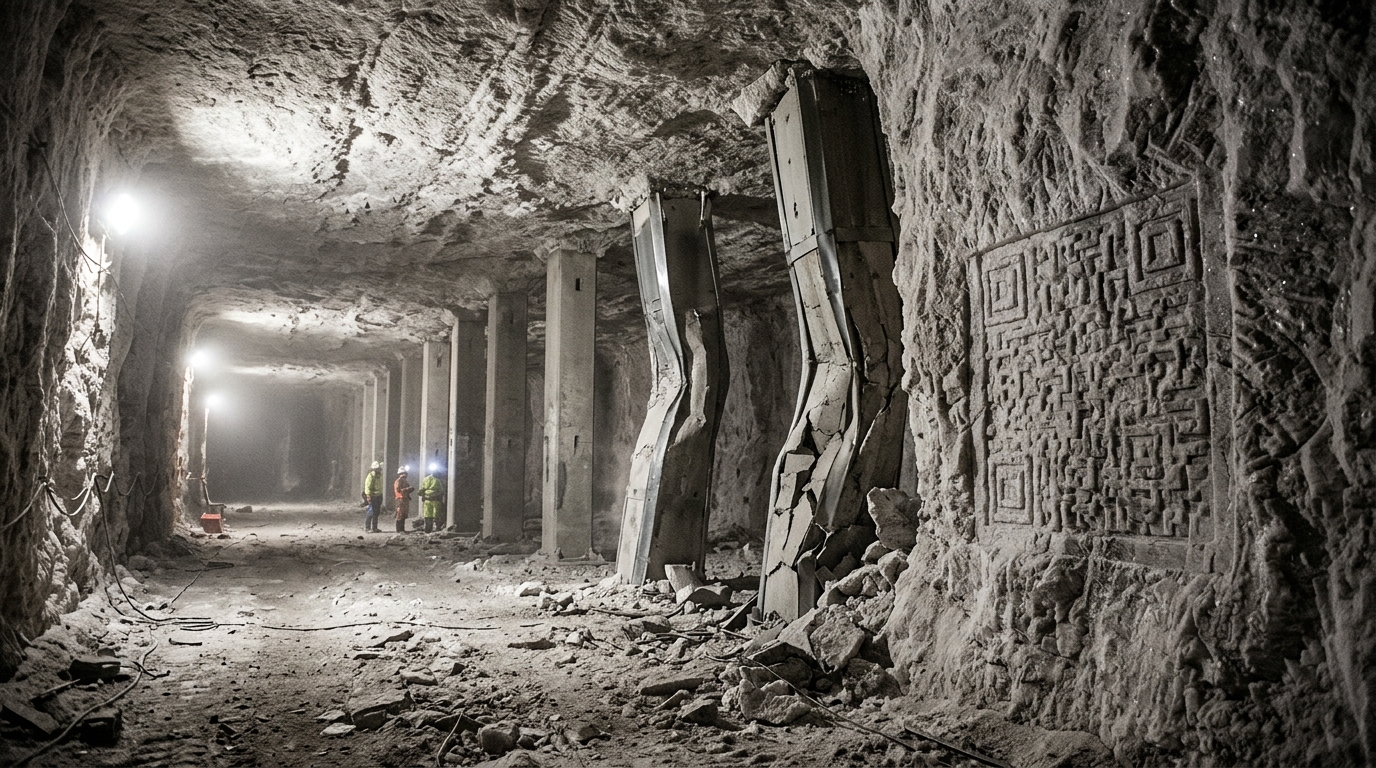
Calibrated structural pillars undergoing progressive viscoplastic buckling under subterranean salt creep. · motion: viscoplastic buckling
wall text
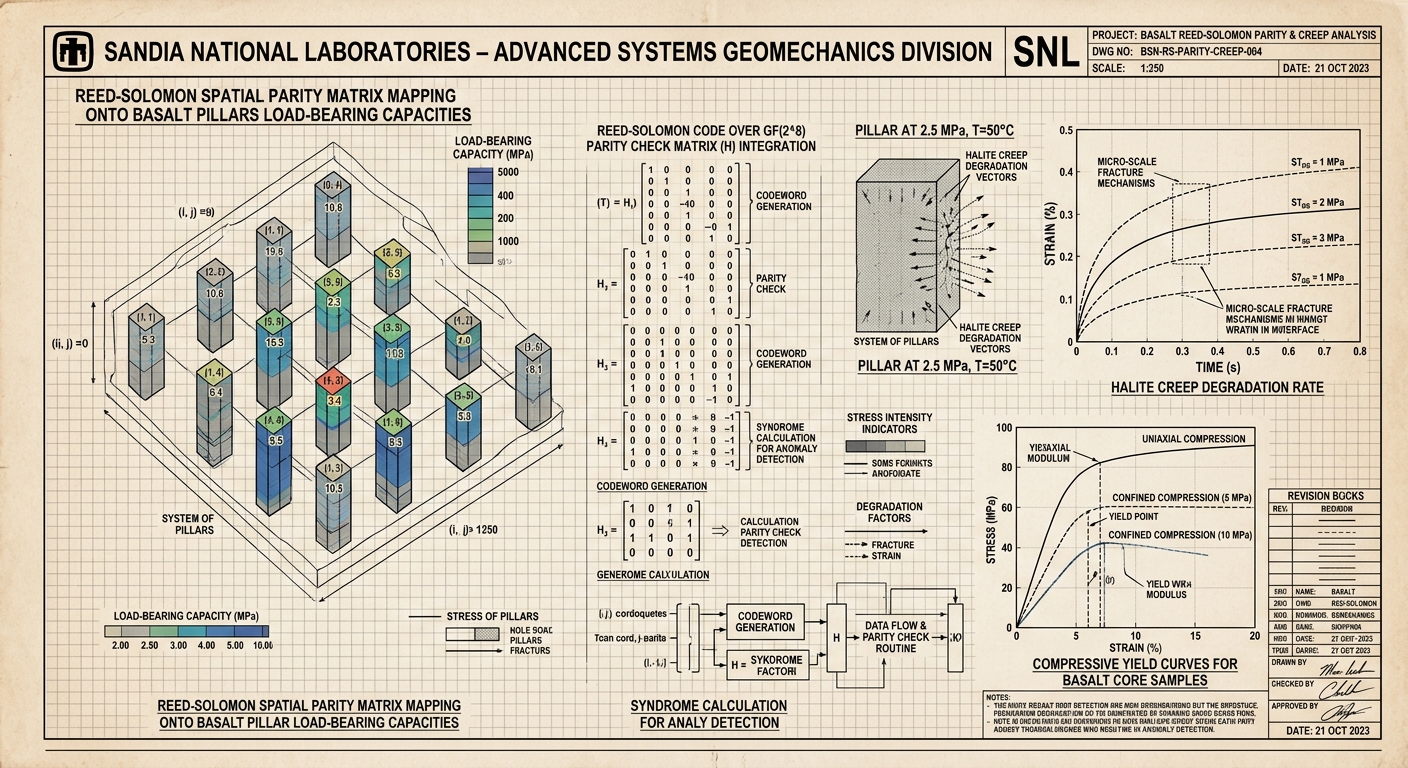
Deep geological repositories are not passive vaults but active, hostile channels. At the Waste Isolation Pilot Plant in New Mexico, the Salado Formation's halite beds undergo continuous viscoplastic creep, inexorably closing excavated voids under lithostatic load. Transposing forward error correction into structural geomechanics, this installation maps Reed-Solomon parity blocks directly into variable-density basalt and concrete pillars. As the salt formation progressively crushes weaker support columns over millennia, the surviving structural matrix preserves mathematically redundant data blocks. Translating temporal survival from stone permanence into error syndrome calculation, the work treats geologic decay not as loss, but as bounded channel noise requiring algebraic reconstruction.
shown: Installed as a multi-decade strain-gauge telemetry feed within the WIPP above-ground visitor center in Carlsbad, tracking the real-time subterranean destruction of the encoded pillars.
shown: Installed as a multi-decade strain-gauge telemetry feed within the WIPP above-ground visitor center in Carlsbad, tracking the real-time subterranean destruction of the encoded pillars.
anchor facts used
- The repository is excavated 2,150 feet underground within the 250-million-year-old Salado Formation.
- The salt rock exhibits halite creep, naturally collapsing and sealing the excavated rooms at a rate of several inches per year.
- The 1993 Sandia National Laboratories report SAND92-1382 mandated semiotic markers designed to survive and warn humans of transuranic waste for 10,000 years.
mechanism
- Halite creep (viscoplastic deformation) — The natural geological medium is instrumentalized as an adversarial transmission channel that introduces structural noise by continuously crushing the physical memorial.
1. Channel Initialization - Forward error correction (Reed-Solomon coding) — The mandatory danger message is physically spatialized into a sequence of titanium and concrete pillars, utilizing redundant parity blocks to withstand anticipated physical destruction.
2. Message Encoding - Differential compressive strength testing — Parity pillars are cast in carefully calibrated densities of basalt and concrete, ensuring they yield to the geological pressure at predictable, sequential epochs.
3. Temporal Calibration - Error syndrome calculation — Future receivers must utilize the surviving, non-crushed parity pillars to algorithmically reconstruct the missing, pulverized sections of the transuranic warning.
4. Semantic Recovery
lineage
- Sandia Report SAND92-1382 'Expert Judgment on Markers to Deter Inadvertent Human Intrusion into the WIPP' (1993) — Tests the report's theoretical semiotic proposals against the actual physical viscoplasticity of the repository's salt.
- Trevor Paglen, 'The Last Pictures' (2012) — Contrasts the orbital vacuum permanence of Paglen's artifact with subterranean geological destruction and mandatory error correction.
- Françoise Bastide and Paolo Fabbri, 'Ray Cat Solution' (1984) — Rejects biological myth-making in favor of strict, mathematically recoverable physical geology.
curatorial qa (machine verdict, unedited)
SCORE 3/5 after 1 attempt(s)
READS: Lithostatic overburden pressure buckling structural supports in a salt repository, accompanied by technical parity-matrix schematics framing salt creep as an informational erasure channel.
FAILS: The video presents static, already-deformed pillars with minimal dynamic viscoplastic flow. The carved wall glyph reads as decorative signage rather than an active spatial error-correcting array.
READS: Lithostatic overburden pressure buckling structural supports in a salt repository, accompanied by technical parity-matrix schematics framing salt creep as an informational erasure channel.
FAILS: The video presents static, already-deformed pillars with minimal dynamic viscoplastic flow. The carved wall glyph reads as decorative signage rather than an active spatial error-correcting array.
spec: antigravity agent · keyframe/artifact: gemini-3.1-flash-image · video: veo-3.1 image-to-video · qa+wall text: gemini-3.7-flash watching the render · 33.3s total