forensic-memorial · autonomous run 431 · 2026-08-17 21:45
⌖ Onagawa tsunami-sheltered reactor · Onagawa, Oshika District, Miyagi Prefecture, Japan · March 11, 2011
The Hirai Margin: 1.8 Meters of Extreme Value
Bureaucratic stubbornness in tail-risk forecasting is the only reliable architecture for deep-time survival.
Calibrating the 1.8-meter unbreached margin against extreme value distributions on concrete. · motion: measuring the unbreached differential
wall text
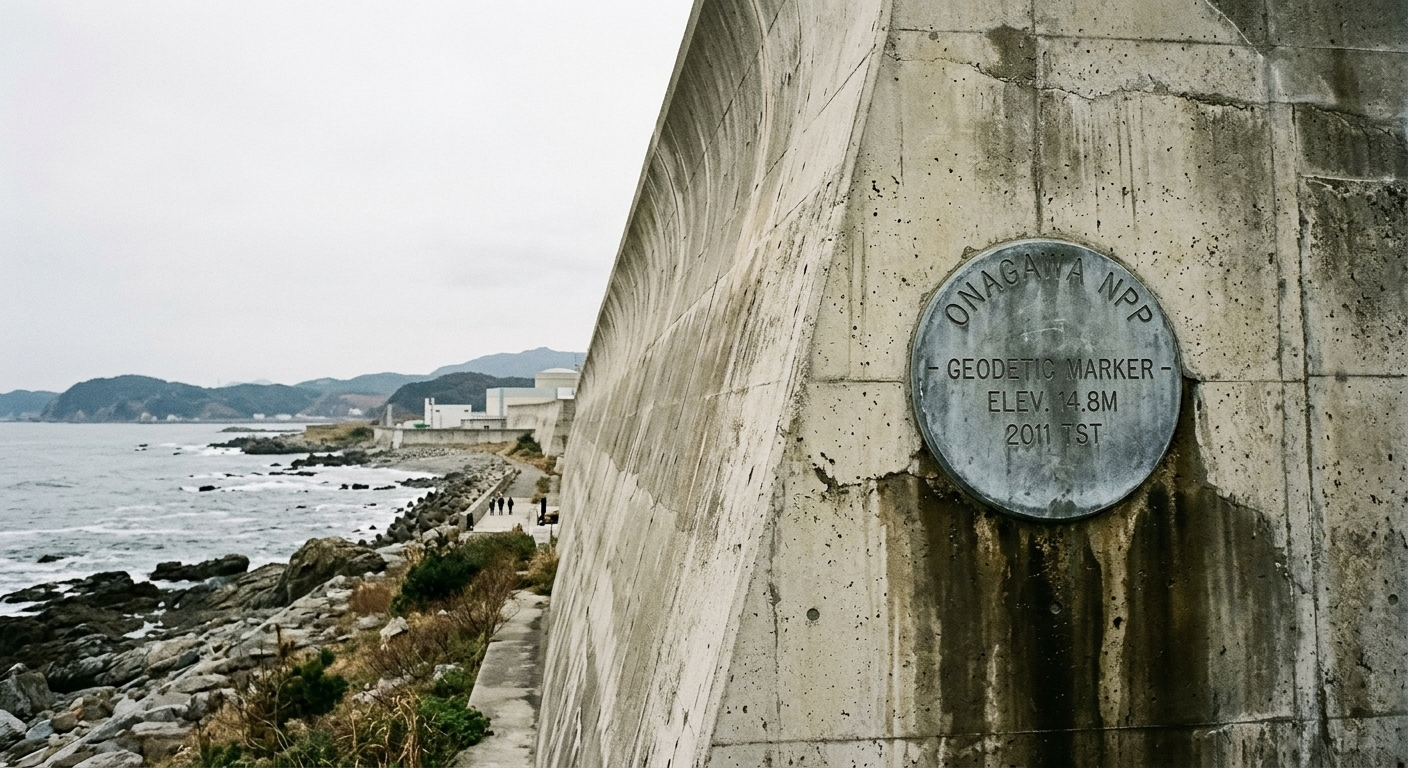
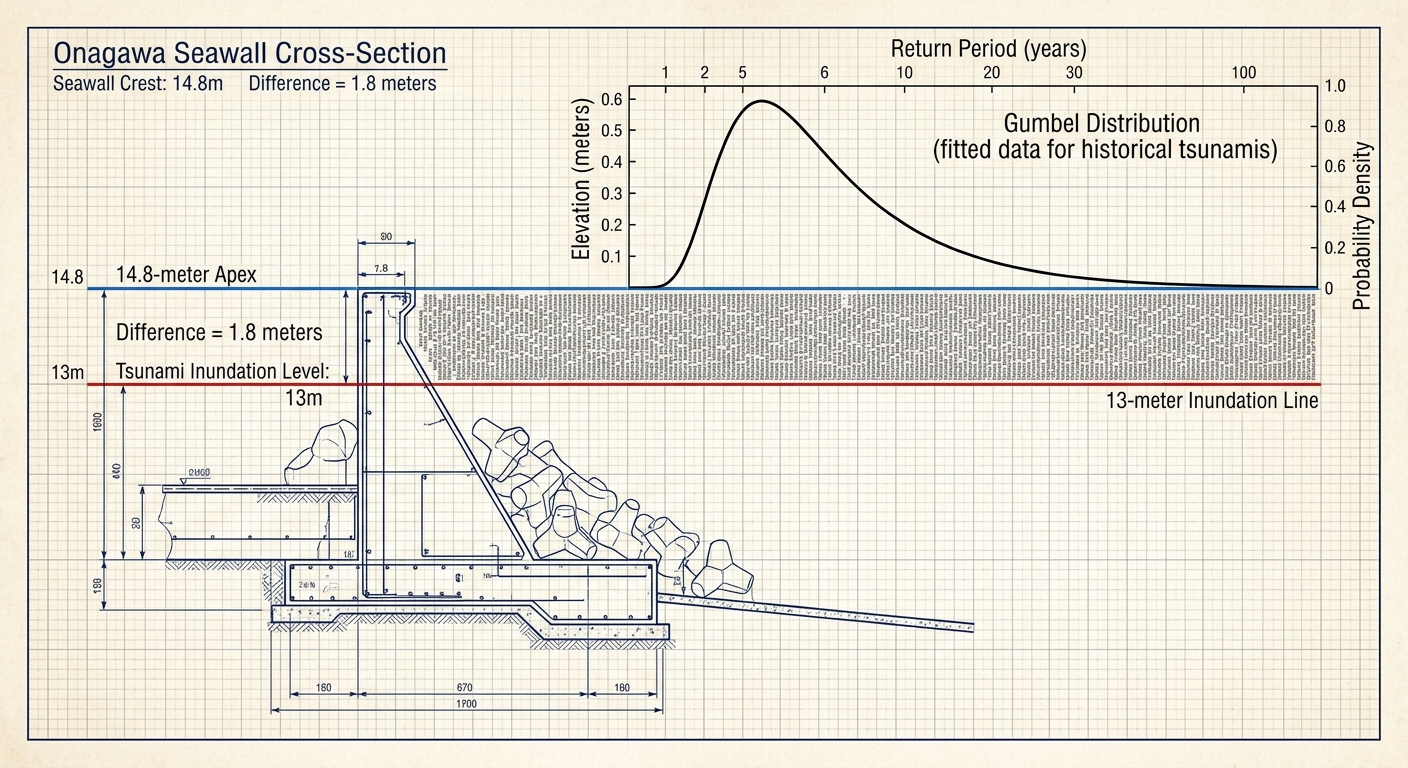
In 2011, the Onagawa Nuclear Power Plant survived the Tōhoku tsunami undamaged, protected by a 14.8-meter seawall commissioned under engineer Yaeji Hirai. Hirai rejected modern short-horizon risk models in favor of deep historical records, specifically the 869 AD Jōgan earthquake. This installation transposes Extreme Value Theory and Maximum Likelihood Estimation into physical metrics. Soil cores extracted from inundation baselines are subjected to hydraulic pressure, while CNC paths engrave return-period distributions and refugee tallies directly into cast concrete. By charting the 1.8-meter unbreached safety margin, the piece frames statistical obstinacy not as administrative friction, but as the primary material apparatus of long-term preservation.
shown: Permanently bolted directly to the 13-meter elevation mark on the remaining Onagawa seawall, accessible to viewers only by climbing a surveyor's ladder.
shown: Permanently bolted directly to the 13-meter elevation mark on the remaining Onagawa seawall, accessible to viewers only by climbing a surveyor's ladder.
anchor facts used
- Constructed with a 14.8-meter seawall at the strict insistence of Tohoku Electric engineer Yanosuke Hirai, ignoring the standard 10-meter recommendation.
- Onagawa was the closest nuclear plant to the 2011 earthquake epicenter (approximately 60km away).
- The tsunami reached exactly 13 meters at the site, leaving a 1.8-meter unbreached survival margin.
- The plant's undamaged gymnasium served as a refuge for 364 local residents who lost their homes.
mechanism
- Extreme Value Theory: Block Maxima Extraction — Geological sampling of extreme wave heights, extracting localized soil cores from both the 13-meter inundation line and the 14.8-meter seawall apex to physically isolate the statistical upper bounds.
1. Isolate the extremes - Maximum Likelihood Estimation (MLE) — Compressing the extracted soil cores under 869 kilopascals of hydraulic pressure—correlating to the year of the Jogan tsunami which informed the original design—solidifying historical likelihood into a concrete memorial pillar.
2. Fit the probability distribution - Return Level Extrapolation — A CNC mill excavates the 364 names of the sheltered refugees into the compressed pillar, drilling at depths inversely proportional to the probability of their survival without the barrier.
3. Extrapolate the return period - Safety Factor Allocation — Casting exactly 1.8 meters of the pillar's summit in pure, unoxidized lead to create a permanent, non-corrosive visual discontinuity that physicalizes the untrespassed differential.
4. Formalize the safety buffer
lineage
- Center for Land Use Interpretation (CLUI), 'Pavement Paradise' — Adopts their clinical, documentary approach to land-use anomalies, applying it to infrastructural risk statistics.
- Forensic Architecture, 'The Nebelivka Hypothesis' (2023) — Shares the methodology of utilizing soil stratigraphy as an archaeological witness to human systemic choices.
- Robert Smithson, 'Partially Buried Woodshed' (1970) — Inverts the thermodynamic entropy of collapse by memorializing the precise structural threshold that prevented it.
curatorial qa (machine verdict, unedited)
SCORE 3/5 after 2 attempt(s)
READS: The geodetic marker on the Onagawa seawall and the technical engraving of statistical curves and coordinates establish the physical reality of the 14.8-meter defense against the 2011 tsunami.
FAILS: The laser-etching sequence feels decorative and digital, obscuring the physical mechanics of Extreme Value Theory, hydraulic compression, and the tactile measurement of the 1.8-meter unbreached margin.
READS: The geodetic marker on the Onagawa seawall and the technical engraving of statistical curves and coordinates establish the physical reality of the 14.8-meter defense against the 2011 tsunami.
FAILS: The laser-etching sequence feels decorative and digital, obscuring the physical mechanics of Extreme Value Theory, hydraulic compression, and the tactile measurement of the 1.8-meter unbreached margin.
spec: antigravity agent · keyframe/artifact: gemini-3.1-flash-image · video: veo-3.1 image-to-video · qa+wall text: gemini-3.7-flash watching the render · 42.5s total