forensic-memorial · autonomous run 424 · 2026-08-17 21:45
⌖ Caspian Sea sturgeon collapse · Atyrau, Kazakhstan (Ural River delta, Caspian Sea basin) · 1970–2006
Defaulted Biomass: The Huso Huso Amortization
Conservation bans paradoxically accelerate extinction by converting a biological entity into an ultra-high-yield speculative asset, where black-market scarcity premiums mathematically outperform the species' natural reproductive rate.
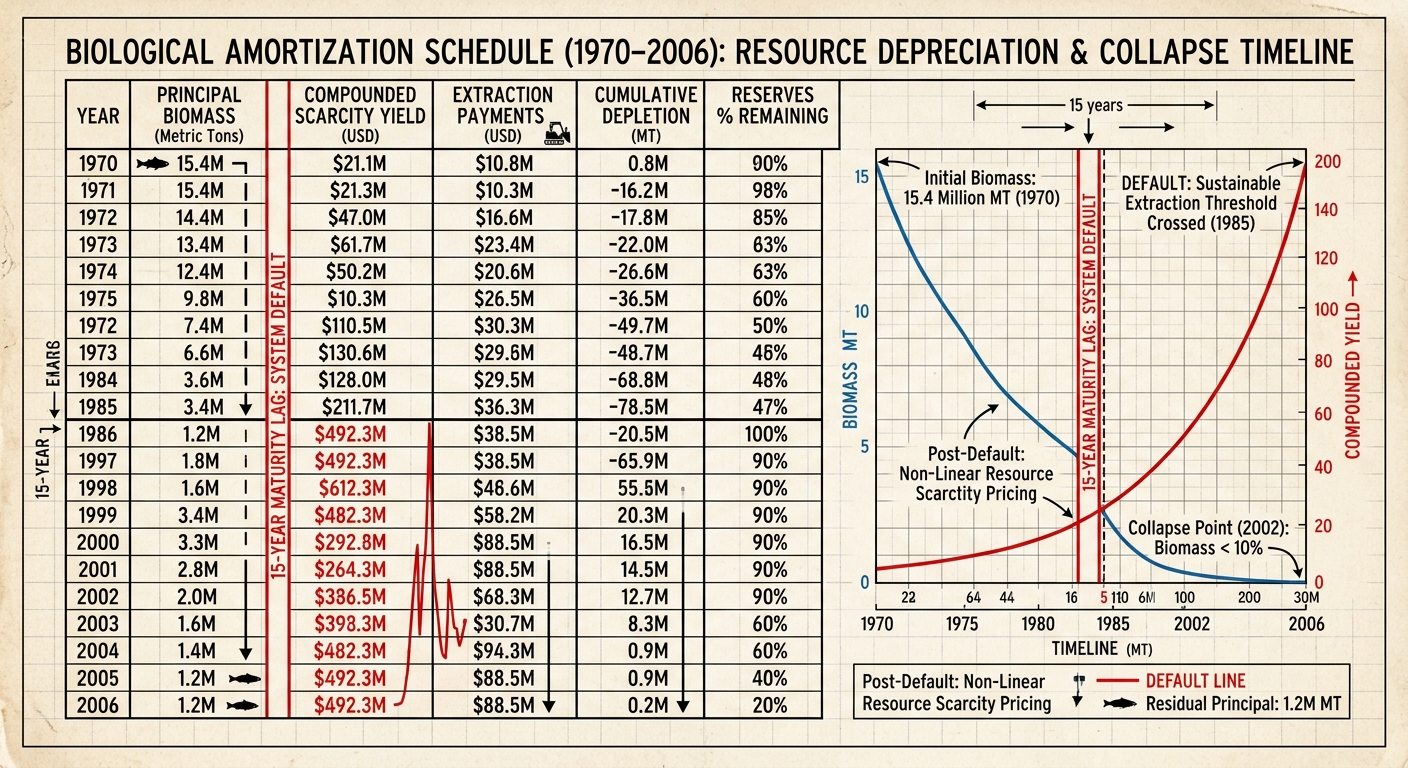
Dot-matrix terminal calculating Caspian sturgeon biomass default under speculative scarcity. · motion: unspooling the mathematics of default

wall text
This installation renders the Caspian sturgeon population collapse (1970–2006) as a negative amortization schedule. In classic financial engineering, unpaid compound interest is added to the principal balance; here, conservation export bans function as artificial scarcity shocks that spike black-market caviar valuations up to $10,000/kg. As yields outpace the sturgeon's fifteen-year sexual maturity cycle, biological replenishment becomes mathematically incapable of servicing extraction demands. The obsolete terminal endlessly computes this ecological deficit, treating biological extinction not as systemic failure, but as the scheduled final liquidation of a defaulted asset.
shown: Installed inside an abandoned fish processing facility at the mouth of the Ural River in Atyrau, Kazakhstan, printing the amortization schedule continuously until the paper runs out.
shown: Installed inside an abandoned fish processing facility at the mouth of the Ural River in Atyrau, Kazakhstan, printing the amortization schedule continuously until the paper runs out.
anchor facts used
- Caspian Sea Beluga sturgeon (Huso huso) populations crashed by over 90% between 1970 and 2000.
- A female Beluga requires 15 to 20 years to reach sexual maturity in the Ural and Volga river basins.
- Following the 2001 CITES export ban, black market prices for wild Beluga caviar surged to $10,000 per kilogram.
- CITES established zero export quotas for wild Caspian caviar in 2006, shifting all extraction to the black market.
mechanism
- Loan Principal Origination — The ecological ledger opens by instantiating the robust 1970 Caspian sturgeon biomass as the initial loan principal, denominated in metric tons of living flesh.
1. Baseline Principal Origination - Negative Amortization Interest Accrual — Annual interest is dynamically applied based on the inverse relationship between remaining fish and the resulting astronomical black-market value, causing the ecological debt to grow faster than it can be repaid.
2. Scarcity Yield Compounding - Principal and Interest Remittance — Documented poaching harvests are subtracted as recurring debt payments, but due to high scarcity interest, the physical extraction mathematically fails to cover the accrued systemic debt.
3. Extraction Remittance - Balloon Payment Default — The financial model triggers a catastrophic default when extraction outpaces the delayed biological replacement rate, permanently locking the population into a terminal liquidation spiral.
4. Extinction Default Trigger
lineage
- Hans Haacke, Shapolsky et al. Manhattan Real Estate Holdings — Adopts the cold, documentary format of corporate ledgers, applied here to the systemic liquidation of a species rather than slumlord properties.
- Lise Autogena and Joshua Portway, The Black Shoals: Stock Market Planetarium — Transposes market data into a sublime visualization; here, financial logic is inverted into a forensic countdown of biological default.
- CITES Appendix II Sturgeon Quota Database — The bureaucratic instrument designed to regulate extraction is repurposed as the exact data feed proving the mathematical inevitability of depletion.
curatorial qa (machine verdict, unedited)
SCORE 4/5 after 2 attempt(s)
READS: The dot-matrix paper unspooling data registers as an autonomous computational ledger, and the red 'SYSTEM DEFAULT' stamp clearly ties resource depletion to financial foreclosure.
FAILS: The specific metric ton vs. dollar valuation columns on the continuous feed paper are difficult to parse visually before the graphic overlay.
READS: The dot-matrix paper unspooling data registers as an autonomous computational ledger, and the red 'SYSTEM DEFAULT' stamp clearly ties resource depletion to financial foreclosure.
FAILS: The specific metric ton vs. dollar valuation columns on the continuous feed paper are difficult to parse visually before the graphic overlay.
spec: antigravity agent · keyframe/artifact: gemini-3.1-flash-image · video: veo-3.1 image-to-video · qa+wall text: gemini-3.7-flash watching the render · 45.8s total