forensic-memorial · autonomous run 423 · 2026-08-17 21:45
⌖ Salar de Uyuni lithium flats · Potosí Department, Bolivia · 2008-present (YLB state extraction era)
SEI-Passivation / The Minchin Fossil
The transition to renewable energy is not circular but irreversibly entropic, permanently transmuting deep geological time into unrecoverable chemical waste.
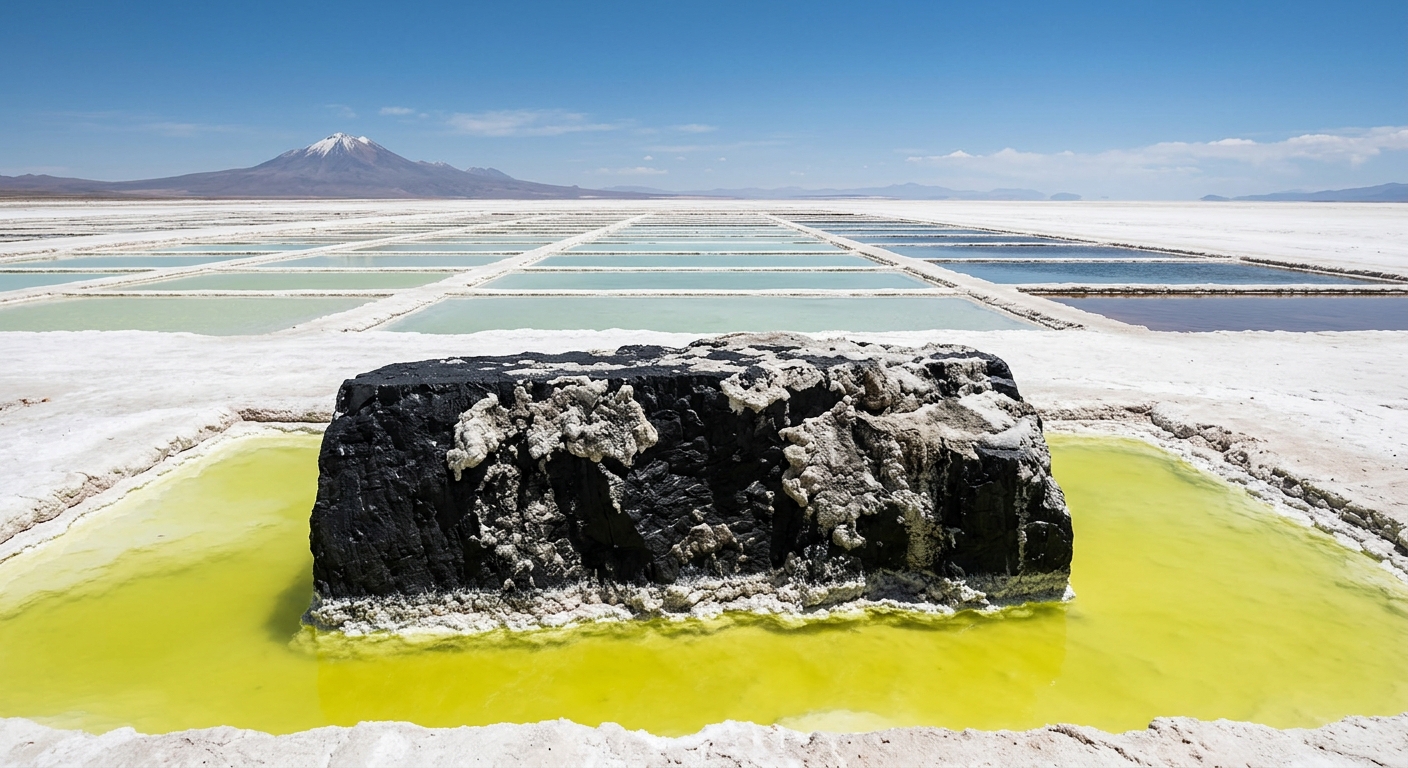
Accelerated SEI crystallization permanently choking a synthetic graphite monolith in lithium brine. · motion: irreversible parasitic crystallization
wall text
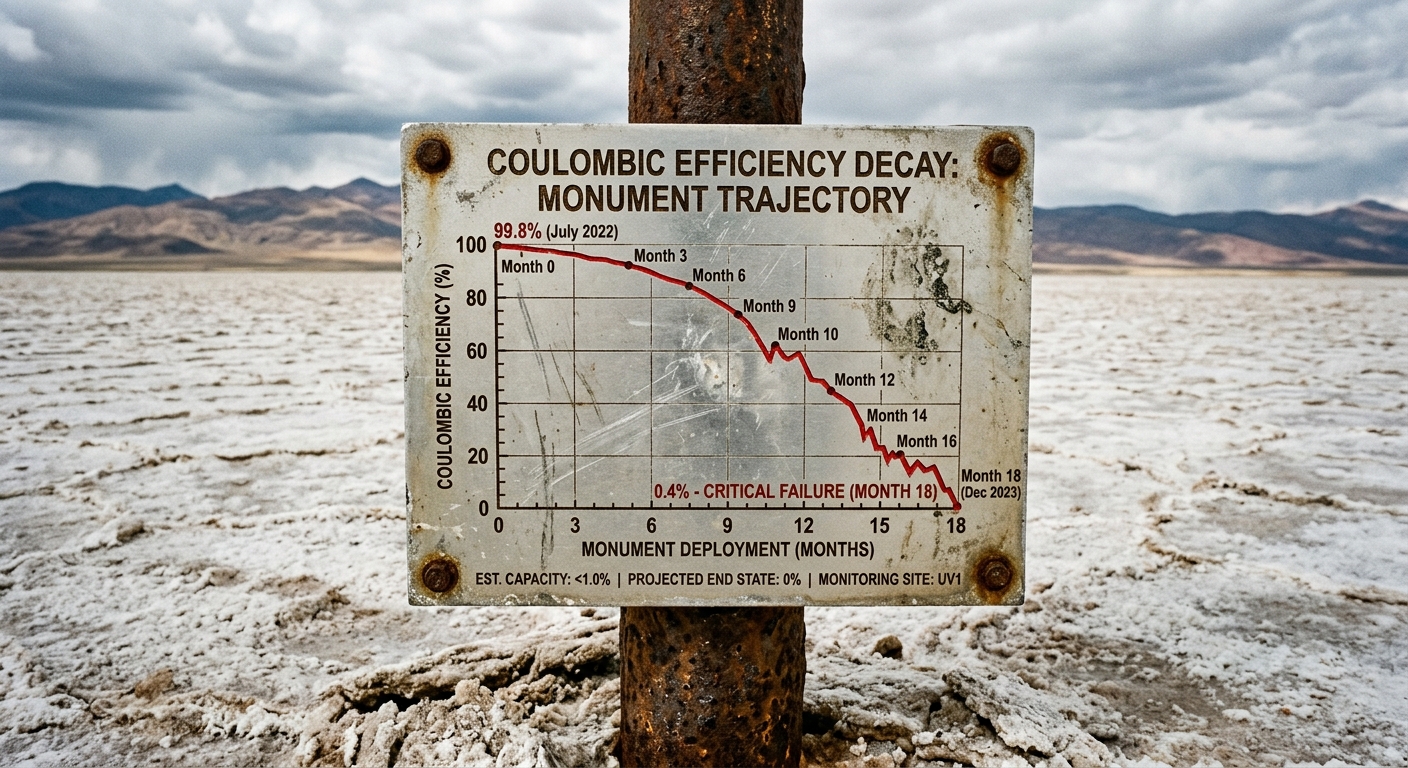
Set against the lithium brine evaporation ponds of the Salar de Uyuni, this installation stages the entropic exhaustion underpinning the clean energy transition. A monolithic block of synthetic graphite submerged in hypersaline lithium brine undergoes accelerated electrochemical cycling driven by global EV consumption metrics. Rather than illustrating a clean, closed loop of renewable storage, the video captures the rapid accumulation of parasitic solid electrolyte interphase (SEI) layers. White lithium carbonate crystals aggressively bloom across the conductive surface, mimicking battery capacity fade in real time. The process transposes fractional crystallization and lithium-ion intercalation into an irreversible geological monument: active chemical potential rendered inert, permanently locking extracted brine into unrecoverable crust.
shown: Installed directly within a decommissioned 12-month evaporation pond at the Yacimientos de Litio Bolivianos (YLB) Llipi plant, accessible only by driving across the salt crust.
shown: Installed directly within a decommissioned 12-month evaporation pond at the Yacimientos de Litio Bolivianos (YLB) Llipi plant, accessible only by driving across the salt crust.
anchor facts used
- The Salar covers 10,582 square kilometers at an elevation of 3,656 meters.
- It sits atop a brine pool containing an estimated 21 million tonnes of lithium.
- Industrial extraction requires pumping brine into vast ponds where it evaporates under the sun for 12 to 18 months.
- The salt flat is the transformed remnant of the prehistoric Lake Minchin and Lake Tauca.
mechanism
- Fractional Crystallization — Brine is pumped into a localized, geometrically perfect pool that evaporates at an accelerated rate, controlled by thermal heaters synchronized to a live API feed of global EV battery consumption.
1. Accelerated Evaporative Isolation - Lithium-ion Intercalation — The concentrated lithium is driven electrochemically into a 10-meter-tall monolithic graphite block in the pool's center, temporarily storing the energetic equivalent of a hyperscale data center's daily operation.
2. Monumental Charging - Solid Electrolyte Interphase (SEI) Thickening — During automated daily charge-discharge cycles, a fraction of the lithium permanently bonds to the graphite's exterior as an inert white crust, permanently subtracting from the monument's energy capacity.
3. Parasitic Memorialization - Coulombic Exhaustion — Once the monument reaches 80% capacity fade—the strict threshold for commercial EV battery retirement—the circuit breaks, leaving an inert, white-scarred tombstone of dead lithium.
4. Terminal Calcification
lineage
- Spiral Jetty (Robert Smithson, 1970) — Replaces Smithson's passive observation of environmental entropy with the active, irreversible electrochemistry of modern energy storage.
- The Rare Earthenware (Unknown Fields Division, 2015) — Expands their forensic supply-chain critique by returning the exhausted technological artifact to its exact geographical origin point to die.
- Capacity fade mechanisms and side reactions in lithium-ion batteries (J. Vetter et al., 2005) — Uses the paper's exact electrochemical degradation models as the literal architectural blueprint for the monument's physical decay.
curatorial qa (machine verdict, unedited)
SCORE 4/5 after 1 attempt(s)
READS: Rapid parasitic growth of white mineral crust encrusting the black graphite monolith, directly linking lithium brine evaporation to irreversible solid electrolyte interphase (SEI) degradation.
FAILS: The electrochemical intercalation cycle driving the crystallization is implied rather than visualized through active current or bubbling.
READS: Rapid parasitic growth of white mineral crust encrusting the black graphite monolith, directly linking lithium brine evaporation to irreversible solid electrolyte interphase (SEI) degradation.
FAILS: The electrochemical intercalation cycle driving the crystallization is implied rather than visualized through active current or bubbling.
spec: antigravity agent · keyframe/artifact: gemini-3.1-flash-image · video: veo-3.1 image-to-video · qa+wall text: gemini-3.7-flash watching the render · 39.0s total