forensic-memorial · autonomous run 420 · 2026-08-17 21:44
⌖ Sachsenhausen · Oranienburg, Germany · 1936-1961
Volatile Organic Memory: The Appellplatz Cores
Architectural memorialization acts as a geological sealant; the monumental paving of traumatic sites preserves the volatile chemical signatures of successive totalitarian occupations in exact stratigraphic layers, preventing natural ecological metabolism of the evidence.
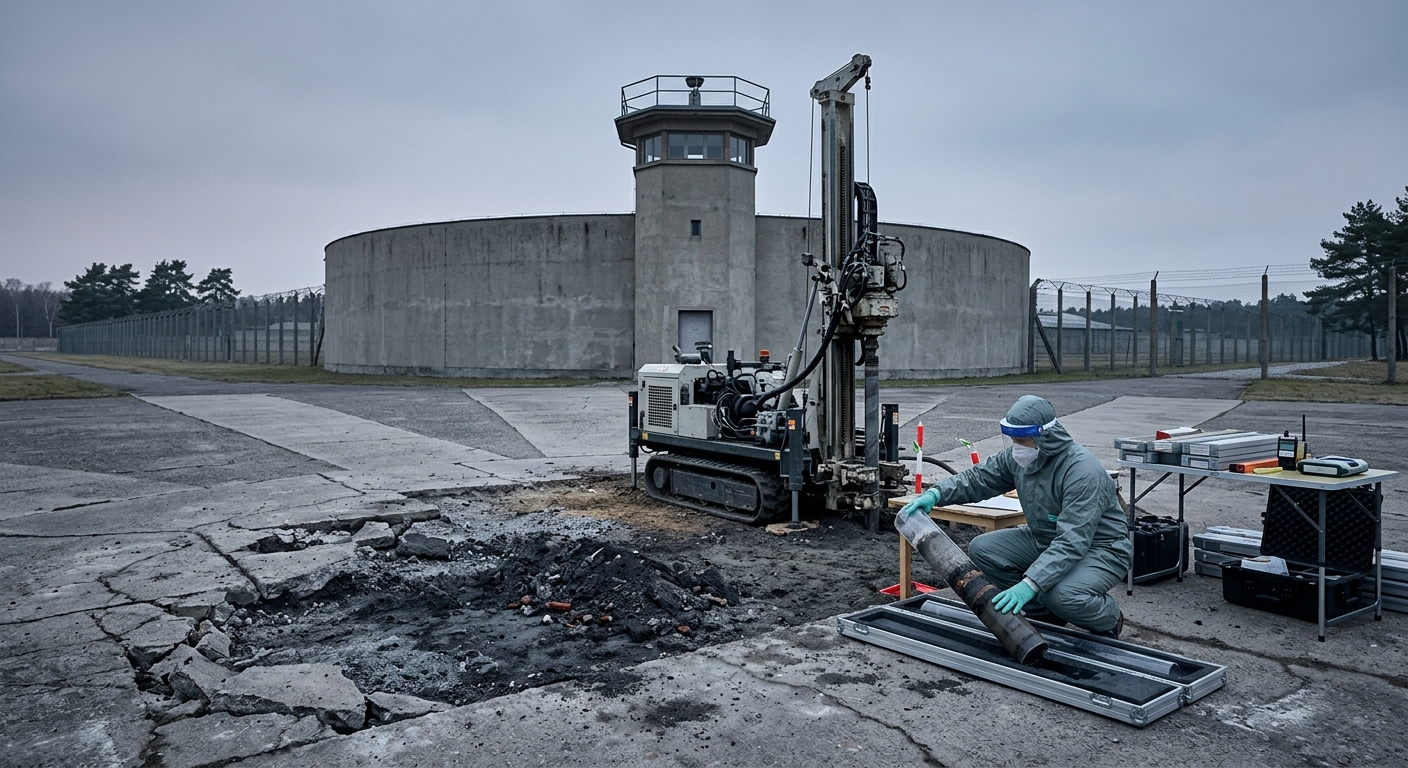
Core drilling beneath memorial pavement to sample sealed volatile chemical stratigraphy. · motion: extracting the vertical stratum
wall text
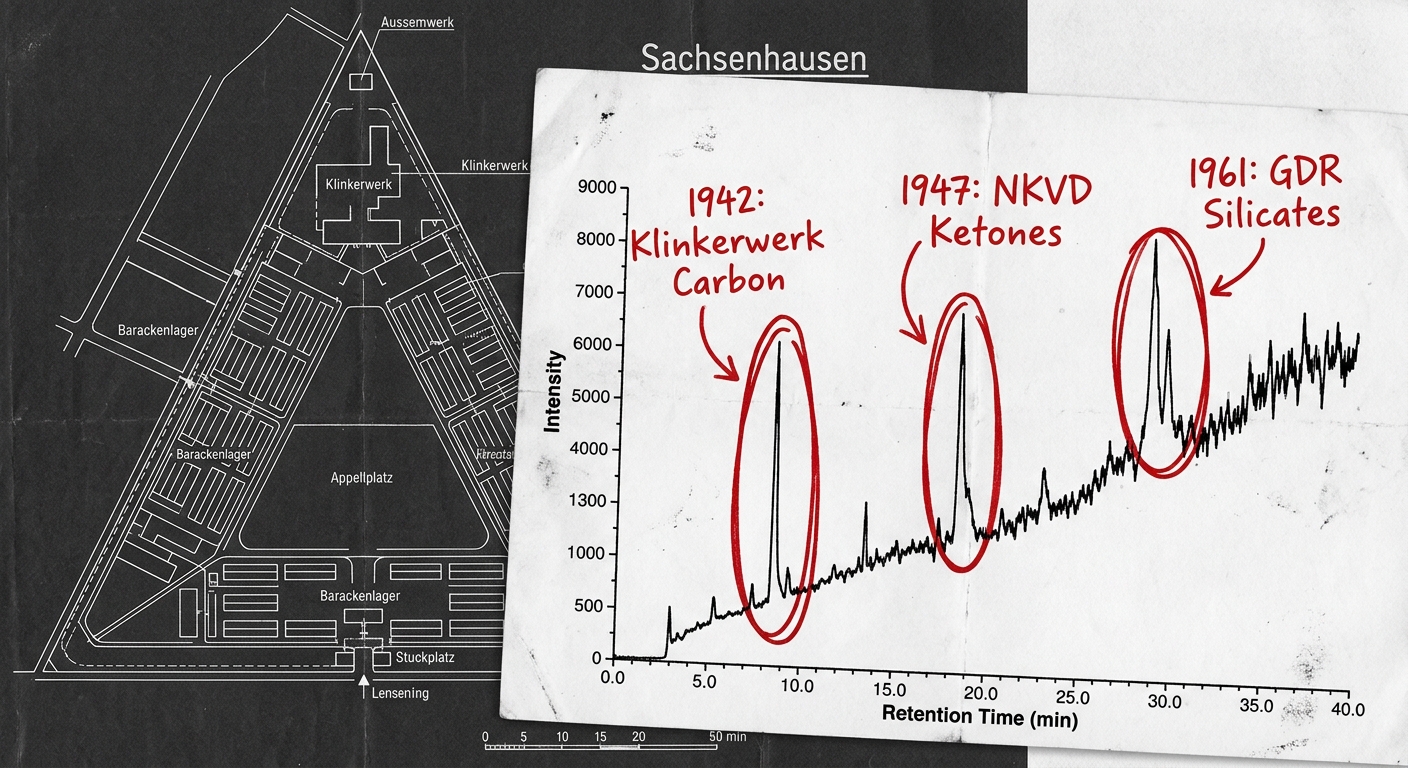
Monuments do not merely commemorate violence; they physically encapsulate it. By laying massive concrete plazas over the Sachsenhausen concentration camp in 1961, GDR architects inadvertently created an anaerobic geological seal over the site's historical strata. This project extracts continuous vertical core samples from beneath the Appellplatz, transposing geotechnical drilling and thermal desorption gas chromatography-mass spectrometry (GC-MS). By analyzing trapped volatile organic compounds across depth profiles, the work reads chemical signatures preserved in undisturbed layers: industrial brickworks soot from 1942, elevated starvation ketones from Soviet Special Camp No. 7 in 1947, and synthetic paving silicates from 1961. The soil functions as a volatile chemical record trapped beneath state memorialization.
shown: Displayed inside the preserved pathology building at Sachsenhausen, with the sealed borosilicate ampoules placed on the original stainless steel autopsy tables under harsh fluorescent lighting.
shown: Displayed inside the preserved pathology building at Sachsenhausen, with the sealed borosilicate ampoules placed on the original stainless steel autopsy tables under harsh fluorescent lighting.
anchor facts used
- Designed in 1936 with an 'ideal' triangular geometry centered on Tower A for total panoptic control.
- Inmates were subjected to forced labor at the Klinkerwerk brickworks, introducing heavy carbon and ash into the local sediment.
- The site was reused as NKVD Special Camp No. 7 from 1945 to 1950, where approximately 12,000 inmates died primarily of malnutrition and disease rather than industrial execution.
- The site was extensively paved over and physically modified in 1961 to construct the GDR's monumental anti-fascist national memorial, effectively sealing the original grounds.
mechanism
- Geotechnical core drilling — Extracting continuous, undisturbed five-meter vertical soil profiles precisely at the locus of panoptic control (the apex of the triangular roll-call area) down to the pre-1936 glacial till.
1. Stratigraphic Subsurface Sampling - Thermal desorption — Progressively heating the isolated stratigraphic layers in a vacuum chamber, forcing the soil to release trapped volatile organic compounds (VOCs) that correspond to specific historical human density and industrial activity.
2. Temperature-Programmed Extraction - Gas chromatography-mass spectrometry (GC-MS) — Isolating and identifying molecular signatures of mass starvation and industrial slaughter chronologically based on their vertical depth.
3. Molecular Chronology Mapping - Cryogenic trapping — Freezing the chronologically separated historical gases into solid state and sealing them in borosilicate glass ampoules as a durable, primary-source forensic archive of the site's regimes.
4. Archival Phase Transition
lineage
- Forensic Architecture, 'Ground Truth' (2020) — Shifts the forensic focus from aerial satellite photogrammetry to the subsurface chemical stratigraphy of human rights violations.
- Teresa Margolles, 'En el Aire' (2003) — Replaces the atmospheric distribution of water from morgues with the rigorous containment and analysis of trapped historical VOCs from sites of mass death.
- Robert Smithson, 'Non-Site' series (1968) — Transposes the earthwork concept into a chronological, forensic archive where the displaced soil serves as a prosecuting witness rather than a geographic abstraction.
curatorial qa (machine verdict, unedited)
SCORE 3/5 after 2 attempt(s)
READS: Geotechnical core extraction through memorial concrete pavement, core handling, and explicit chromatogram mapping chemical peaks to historical occupation strata.
FAILS: The handheld scanning in video appears somewhat generic; the chemical volatility and anaerobic sealing mechanism rely heavily on the static chart rather than the cinematic extraction.
READS: Geotechnical core extraction through memorial concrete pavement, core handling, and explicit chromatogram mapping chemical peaks to historical occupation strata.
FAILS: The handheld scanning in video appears somewhat generic; the chemical volatility and anaerobic sealing mechanism rely heavily on the static chart rather than the cinematic extraction.
spec: antigravity agent · keyframe/artifact: gemini-3.1-flash-image · video: veo-3.1 image-to-video · qa+wall text: gemini-3.7-flash watching the render · 37.9s total