forensic-memorial · autonomous run 419 · 2026-08-17 21:44
⌖ Buzludzha monument · Buzludzha Peak, Central Balkan Mountains, Bulgaria · 1981-present
Carbonation Front: 1432m
The longevity of monumental political ideology is ultimately bounded by the atmospheric diffusion of carbon dioxide and the square root of time.
Concrete core samples tested with phenolphthalein indicator to measure carbonation depth over time. · motion: chemically carbonating and structurally eroding in continuous geological time
wall text
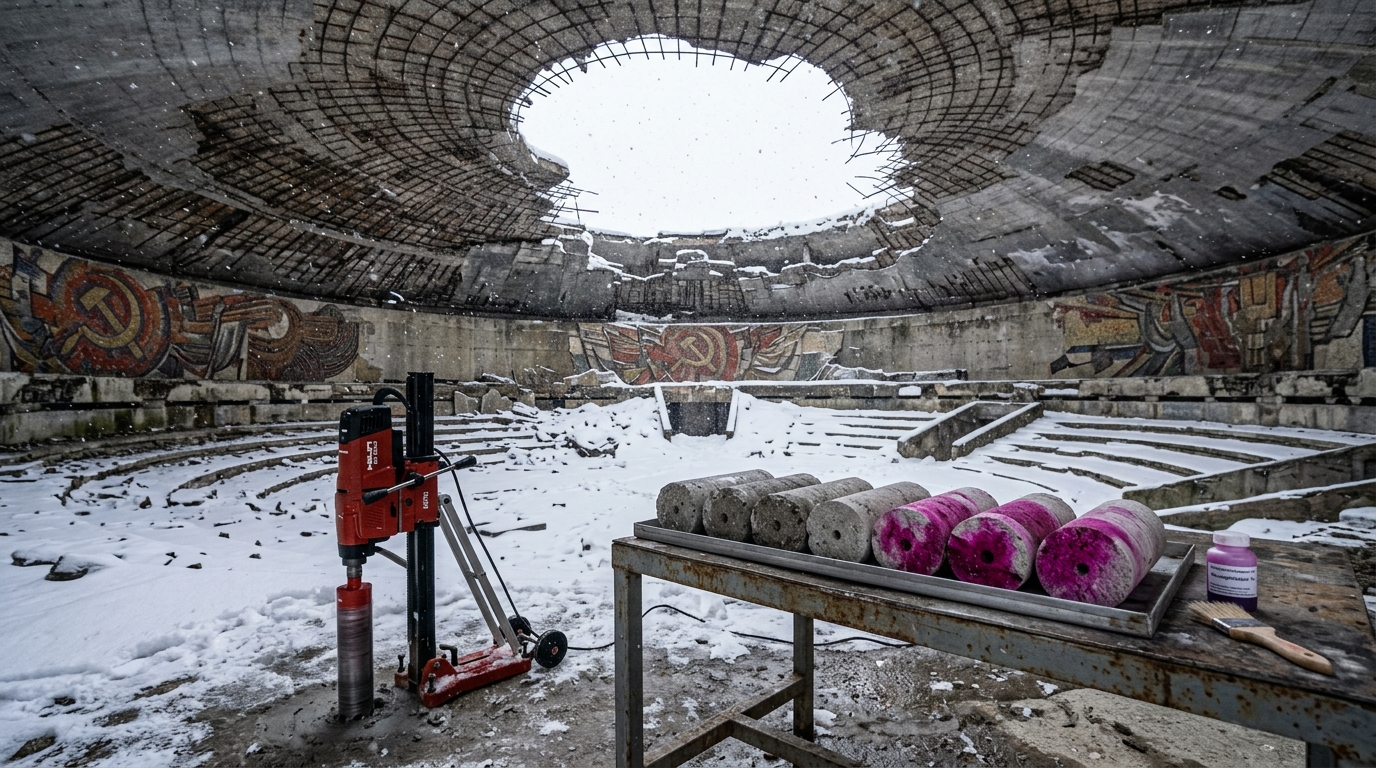
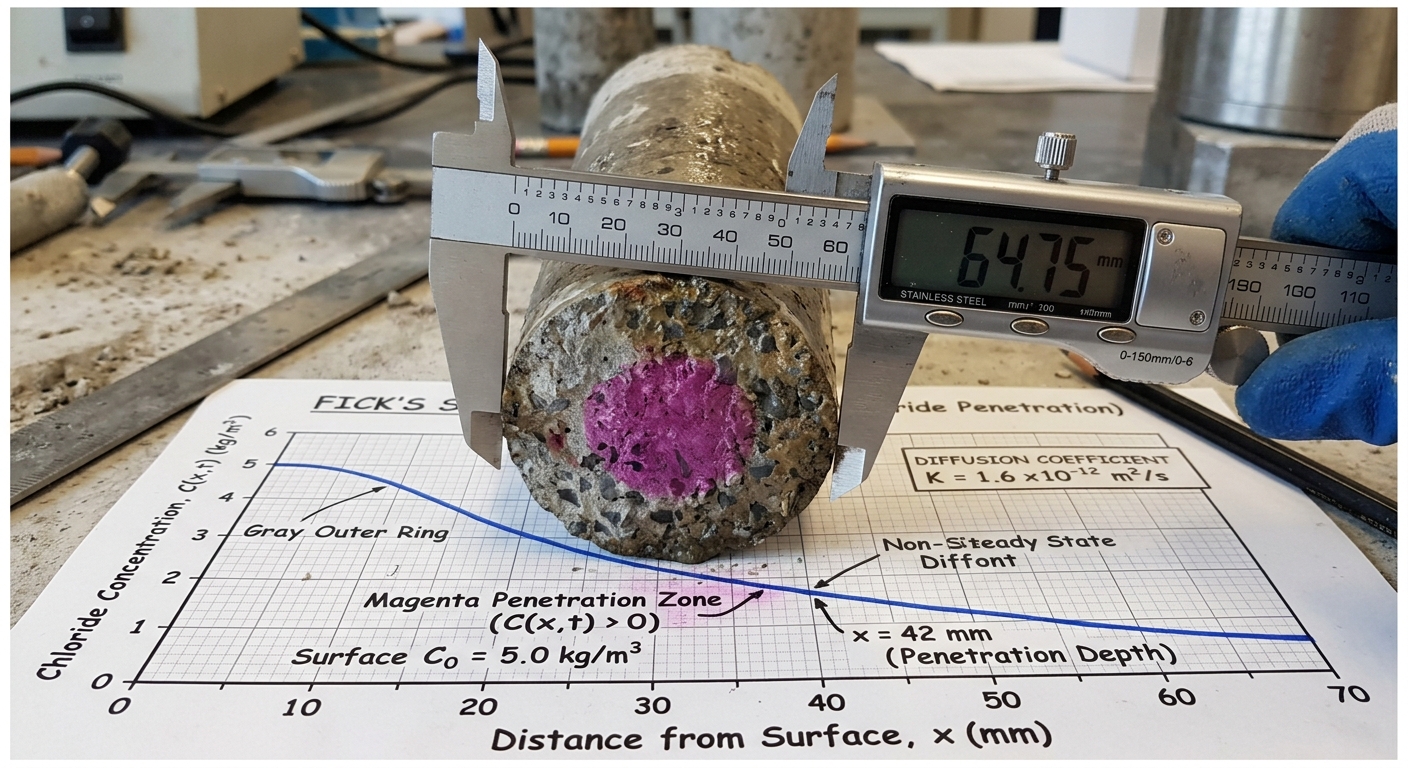
Inside the decaying Buzludzha monument, rotary diamond core drills extract cylinders from the abandoned reinforced concrete dome. Sprayed with phenolphthalein indicator, uncarbonated high-pH concrete flashes bright magenta, while atmospheric carbon dioxide penetration leaves an inert, neutralized gray outer boundary. By measuring this carbonation front against elapsed alpine exposure since 1981, the work applies Fick's second law of diffusion to calculate the structure's exact weathering coefficient. The mathematical projection estimates the date when chemical passivity around the internal steel rebar completely fails, fixing an empirical timeline for the physical death of monumental architectural ideology.
shown: Installed as a temporary forensic field laboratory on the cracked concrete plaza directly beneath the Buzludzha saucer during the winter solstice.
shown: Installed as a temporary forensic field laboratory on the cracked concrete plaza directly beneath the Buzludzha saucer during the winter solstice.
anchor facts used
- Inaugurated in August 1981 to commemorate the 1891 Buzludzha Congress
- Constructed using 70,000 tons of concrete which is now fully exposed to the elements
- Situated at an elevation of 1,432 meters, subjecting the structure to severe alpine freeze-thaw cycles
mechanism
- Rotary Core Drilling — Boring 50mm diameter concrete cylinders from the monument's grand auditorium and outer saucer shell to retrieve physical timelines of elemental exposure.
1. Extraction - Phenolphthalein Indicator Testing — Spraying the core samples to reveal uncarbonated high-pH zones (which turn bright magenta), physically differentiating living structure from the carbonated, dead ideological shell.
2. Chemical Profiling - Fick's Second Law of Diffusion (d = K√t) — Calculating the exact weathering coefficient (K) of communist architectural memory by measuring the depth of carbonation against 45 years of continuous alpine exposure.
3. Temporal Modeling - Predictive Structural Service Life Modeling (Tuutti's Model) — Publishing the exact mathematical date when the remaining rebar will lose chemical passivity, marking the irreversible structural collapse of the monument.
4. Mortality Projection
lineage
- Tuutti, K. 'Corrosion of Steel in Concrete' (Swedish Cement and Concrete Research Institute, 1982) — Directly employs Tuutti's two-stage model of corrosion (initiation and propagation) as the foundational aesthetic constraint for the memorial.
- Gordon Matta-Clark, 'Conical Intersect' (1975) — Shifts Matta-Clark's active architectural subtraction into passive, chemically-measured geological decay.
- Forensic Architecture, 'The Nebelivka Hypothesis' (2023) — Adopts their methodology of soil and stratigraphic trace analysis, but reorients it toward predicting future architectural mortality.
curatorial qa (machine verdict, unedited)
SCORE 4/5 after 2 attempt(s)
READS: Rotary core extraction from the monumental auditorium, phenolphthalein pH indicator staining showing the advancing carbonation boundary, and precise caliper measurement against Fickian diffusion curves.
FAILS: The video motion emphasizes falling ceiling debris and weather rather than the slower chemical diffusion rate described in the thesis.
READS: Rotary core extraction from the monumental auditorium, phenolphthalein pH indicator staining showing the advancing carbonation boundary, and precise caliper measurement against Fickian diffusion curves.
FAILS: The video motion emphasizes falling ceiling debris and weather rather than the slower chemical diffusion rate described in the thesis.
spec: antigravity agent · keyframe/artifact: gemini-3.1-flash-image · video: veo-3.1 image-to-video · qa+wall text: gemini-3.7-flash watching the render · 27.9s total