forensic-memorial · autonomous run 417 · 2026-08-17 21:44
⌖ Gorleben salt dome · Gorleben, Lüchow-Dannenberg district, Lower Saxony, Germany · 1977-2020
Halokinetic Memorial 1004
The geological plasticity relied upon to isolate deep-time anomalies is an active mechanism of erasure, structurally incapable of sustaining historical memory without crushing it.
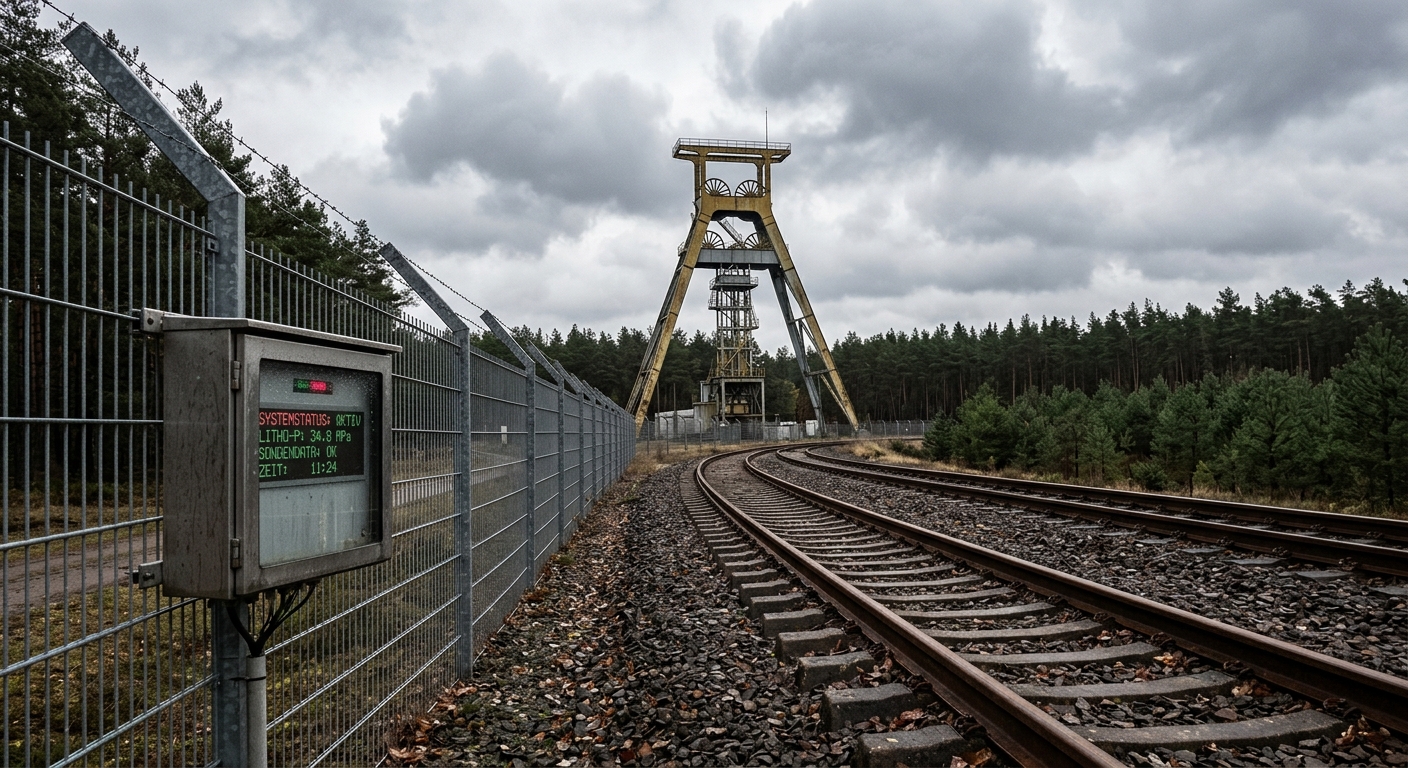
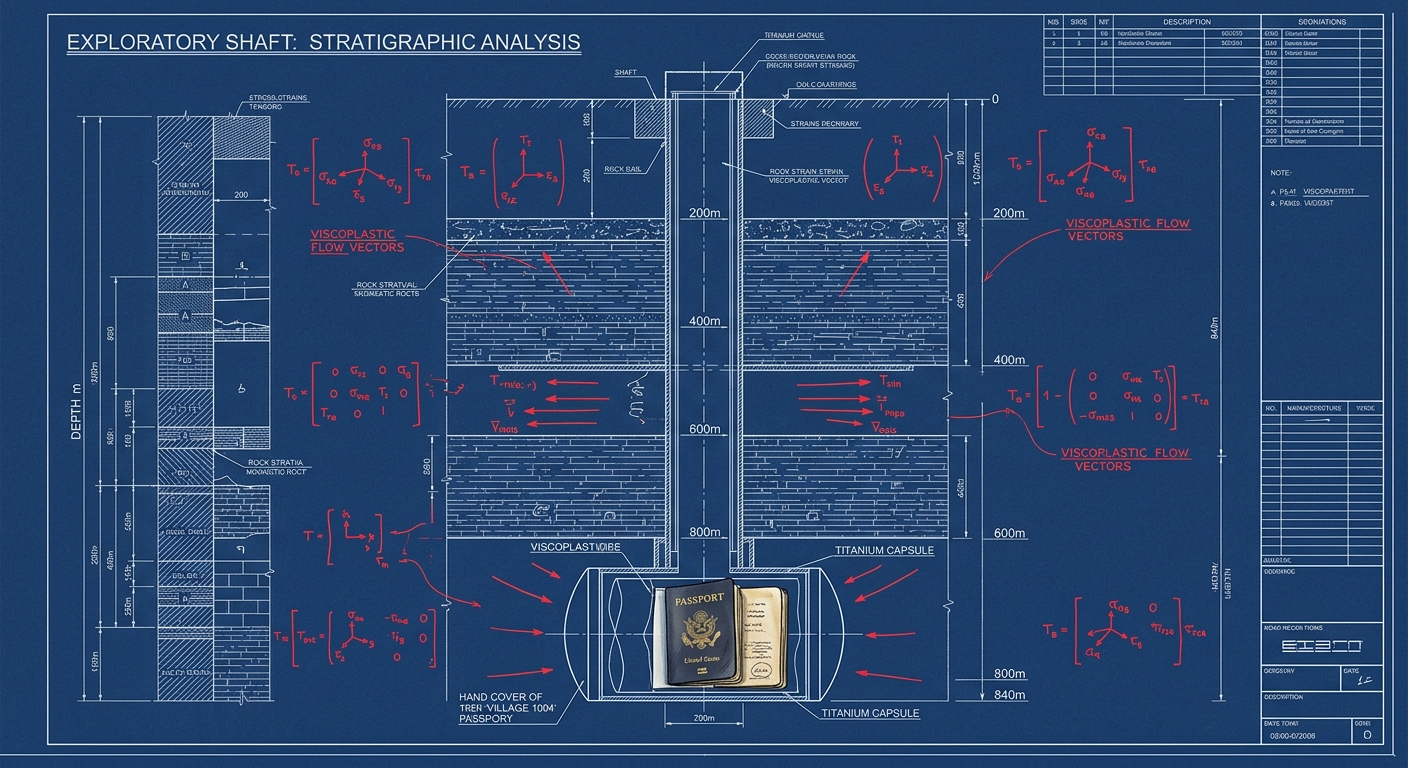
Deep-borehole telemetry monitoring the lithostatic crushing of a titanium archive. · motion: imperceptibly creeping inward to crush the void
wall text
Positioned 840 meters beneath a decommissioned salt repository, a titanium capsule housing political ephemera is slowly engulfed by the surrounding Permian halite dome. Rather than preserving historical records, the site relies on halokinetic viscoplastic creep—the natural, pressure-driven flow of rock salt used to permanently seal subterranean nuclear repositories. Geotechnical borehole extensometers capture this inward lithostatic convergence, relaying stress values to an abandoned surface terminal. By translating standard repository closure diagnostics into a real-time countdown toward structural yield, the installation frames geological containment not as inert stasis, but as an active, continuous erasure that crushes human political memory under sheer lithic mass.
shown: Permanently installed as an unattended telemetry kiosk bolted to the exterior security fence of the disused Gorleben exploration mine, operating until the underground archive fails.
shown: Permanently installed as an unattended telemetry kiosk bolted to the exterior security fence of the disused Gorleben exploration mine, operating until the underground archive fails.
anchor facts used
- Initially proposed in 1977 as a deep geological repository for high-level radioactive waste
- Exploratory mine shafts were drilled to a depth of 840 meters into the halite rock
- Site of the 1980 'Free Republic of Wendland' protest camp (Village 1004) before eviction
- Officially excluded from the national repository search in 2020 due to geological unsuitability
mechanism
- Stratigraphic superposition — Reversing traditional archaeological layering by deliberately inserting contemporary political evidence into Permian-era geological strata.
1. Installation of a titanium-cased archive containing 1980 protest ephemera at the base of the exploration shaft. - Halokinetic viscoplastic creep — Reframing the structural closure of the mine as an active, geological-scale redaction of the deposited historical record.
2. Continuous measurement of the salt matrix converging on the archive cylinder. - Borehole extensometer monitoring — Converting standard geotechnical safety diagnostics into a public broadcast of the memorial's impending structural failure.
3. Transmission of pressure data via a surface telemetry array. - Asymptotic decay modeling — Calculating the precise future timestamp when the repository's pressure exceeds the titanium's yield strength, marking total erasure.
4. Algorithmic projection of the final archive collapse date.
lineage
- Human Interference Task Force (1981) - 'Marker Panels' — Replaces passive semiotic warnings for future generations with a real-time mechanical countdown to the artifact's obliteration.
- Trevor Paglen - 'The Last Pictures' (2012) — Contrasts the perpetual orbital preservation of images with the deliberate subterranean geological crushing of historical evidence.
- Eyal Weizman - 'Forensic Architecture' (2010) — Reverses the temporal vector of forensics from reconstructing past state violence to predicting future structural collapse by geological forces.
curatorial qa (machine verdict, unedited)
SCORE 4/5 after 2 attempt(s)
READS: The physical entrapment of the titanium capsule inside converging halite crystals and the telemetry readout measuring lithostatic convergence.
FAILS: The salt collapses via brittle crumbling rather than true halokinetic viscoplastic flow, slightly masking the fluid plasticity thesis.
READS: The physical entrapment of the titanium capsule inside converging halite crystals and the telemetry readout measuring lithostatic convergence.
FAILS: The salt collapses via brittle crumbling rather than true halokinetic viscoplastic flow, slightly masking the fluid plasticity thesis.
spec: antigravity agent · keyframe/artifact: gemini-3.1-flash-image · video: veo-3.1 image-to-video · qa+wall text: gemini-3.7-flash watching the render · 38.9s total