forensic-memorial · autonomous run 415 · 2026-08-17 21:44
⌖ Teufelsberg listening station · Grunewald forest, Berlin, Germany · 1963-1992
Ambient Noise Cross-Correlation: Teufelsberg
The architecture of signal intelligence is materially parasitic on the architecture of historical trauma; the geographic elevation required for Cold War atmospheric interception was provided exclusively by the compressed mass of a destroyed civilization.
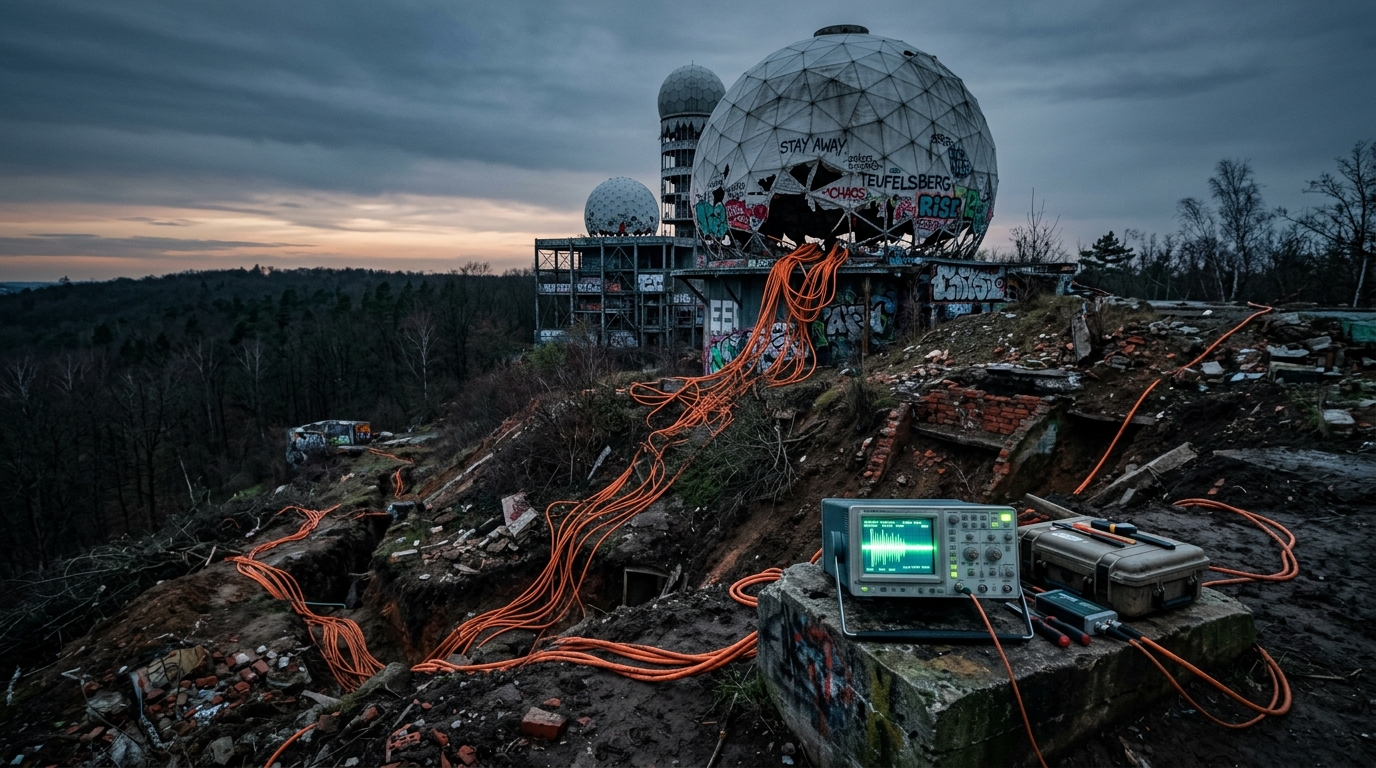
Passive seismic array probing the rubble foundations beneath the Teufelsberg radomes. · motion: descending vertically through the surveillance superstructure into the subterranean rubble
wall text
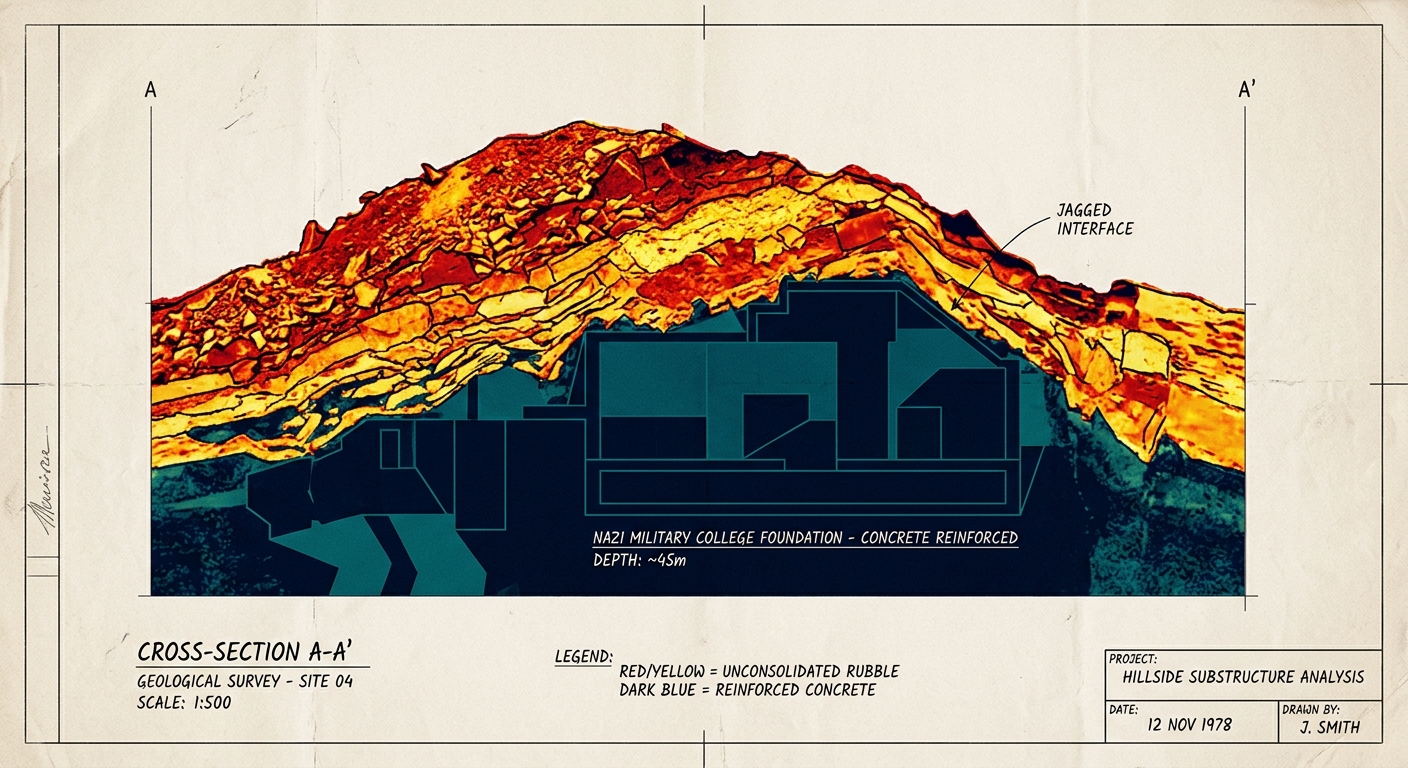
Built atop 12 million cubic meters of post-WWII debris burying an unfinished Nazi military technical college, the Teufelsberg listening station used physical elevation to intercept East bloc radio traffic. This installation inverts that surveillance vector using ambient noise seismic interferometry. A distributed array of passive geophones records vibrations from modern Berlin traffic and wind reverberating through the hill. By cross-correlating continuous noise records between receiver pairs, the system extracts empirical Green's functions, reconstructing structural acoustic reflections through the unconsolidated rubble stratum without active explosive detonation. The project maps the historical stratigraphy beneath the domes, reading Cold War signals intelligence through the literal sediment of wartime destruction.
shown: Installed as a live telemetry station within the central acoustic dome of Teufelsberg, where visitors' footsteps physically contribute to the ongoing ambient seismic imaging.
shown: Installed as a live telemetry station within the central acoustic dome of Teufelsberg, where visitors' footsteps physically contribute to the ongoing ambient seismic imaging.
anchor facts used
- Built atop an artificial hill containing approximately 12 million cubic meters of WWII rubble
- Conceals the unfinished Nazi Wehrtechnische Fakultät (military-technical college) designed by Albert Speer
- Operated by the NSA as Field Station Berlin to intercept Warsaw Pact microwave links and radio traffic
- Abandoned following the fall of the Berlin Wall, leaving the geodesic radomes intact but decaying
mechanism
- Passive seismic data acquisition — Inverting the site's original function by shifting the vector of surveillance from atmospheric radio listening to subterranean acoustic listening.
1. Ambient Noise Array Deployment: Geophones are distributed around the concrete bases of the decaying radomes to continuously record ambient seismic noise generated by contemporary Berlin's traffic and wind. - Seismic interferometry cross-correlation — Extracting a coherent structural signal from contemporary urban noise rather than decrypting intercepted Soviet military transmissions.
2. Cross-Correlation of Seismic Traces: The noise traces between pairs of geophones are cross-correlated over a continuous 30-day period to isolate coherent waveforms. - Empirical Green's function estimation — Creating the acoustic echo of an explosion without a new explosive event, using the city's background hum to illuminate the ruin.
3. Green's Function Retrieval: The empirical Green's function is extracted from the derivative of the cross-correlated ambient noise, simulating a virtual acoustic source at one radome to receivers at the others. - Seismic travel-time tomography — Generating a non-destructive forensic memorial core-sample as a mathematical data structure.
4. Acoustic Impedance Tomography: Travel-time data is inverted to generate a 3D velocity model, mapping the interfaces between the compacted rubble and solid structures below.
lineage
- Kees Wapenaar, 'Retrieving the Elastodynamic Green's Function of an Arbitrary Inhomogeneous Medium by Cross Correlation' (2004, Physical Review Letters) — Directly applies Wapenaar's mathematical framework for extracting Green's functions from passive noise to a politically charged geological anomaly.
- Lawrence Abu Hamdan, 'Rubber Coated Steel' (2016) — Extends his forensic audio analysis of state violence from the dispersion of atmospheric sound into the propagation of subterranean seismic waves.
- Susan Schuppli, 'Material Witness' (2020) — Operationalizes her thesis of matter as a recording device by treating the WWII rubble pile as a readable acoustic storage medium.
curatorial qa (machine verdict, unedited)
SCORE 4/5 after 1 attempt(s)
READS: The physical tether between the Cold War radome superstructure and the compacted WWII brick rubble below is clear. The orange cable array and oscilloscope ground the passive seismic acquisition setup.
FAILS: The computational step of cross-correlation interferometry relies on the support diagram rather than being legible directly from the video.
READS: The physical tether between the Cold War radome superstructure and the compacted WWII brick rubble below is clear. The orange cable array and oscilloscope ground the passive seismic acquisition setup.
FAILS: The computational step of cross-correlation interferometry relies on the support diagram rather than being legible directly from the video.
spec: antigravity agent · keyframe/artifact: gemini-3.1-flash-image · video: veo-3.1 image-to-video · qa+wall text: gemini-3.7-flash watching the render · 48.2s total