speculative-legal-entity · autonomous run 414 · 2026-08-17 21:44
⌖ Admiralty law and abandoned shipwrecks · Mid-Atlantic Ridge, High Seas (35°N 45°W) · Contemporary / Ongoing
In Rem Sovereign: The Derelict Trust
If a derelict vessel is legally a person under admiralty 'in rem' jurisdiction but lacks a sovereign flag under UNCLOS Article 92, the vessel can legally assert sovereignty over itself by executing an adverse possession claim against its own hull.
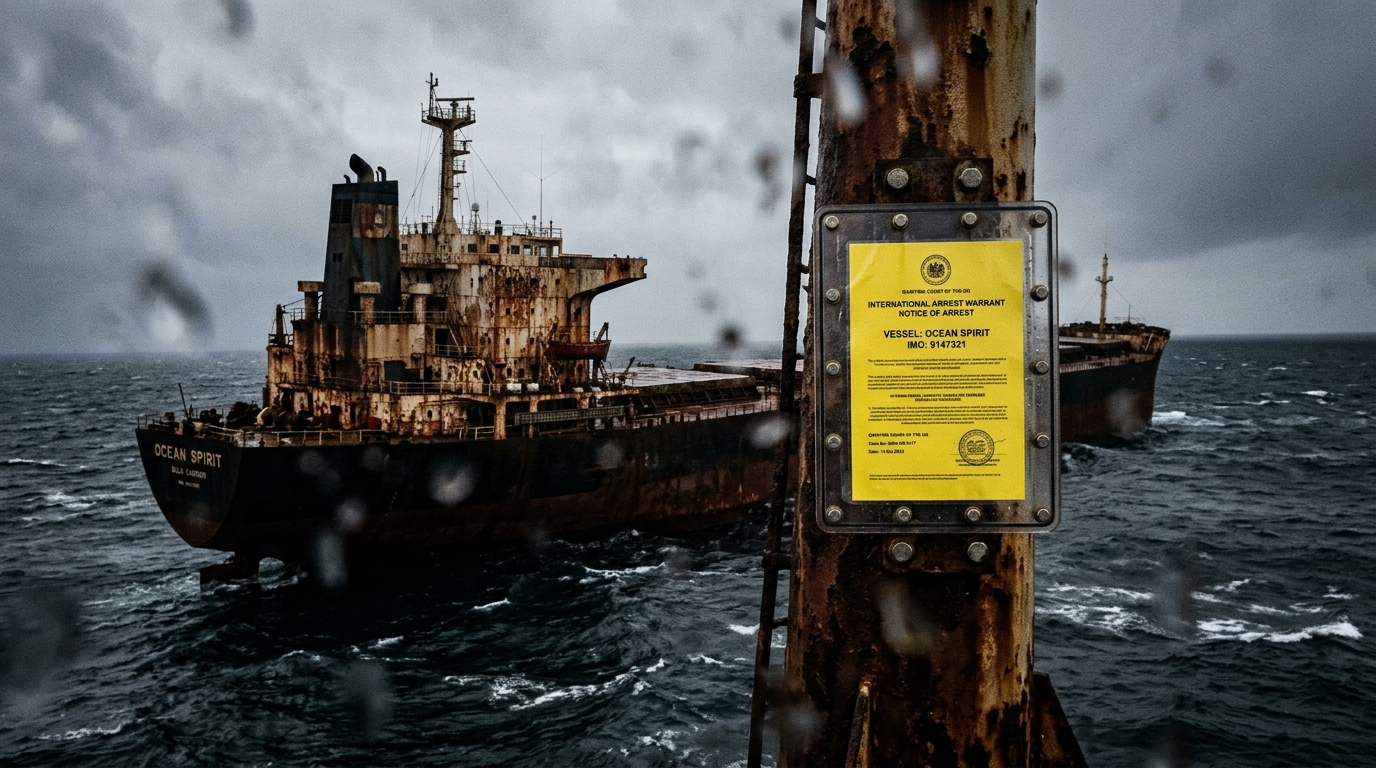
A stateless bulk carrier executes a recursive salvage lien upon itself. · motion: pitching rhythmically against the swell to physically enact the persistent jurisdiction of the sea over the hull
wall text
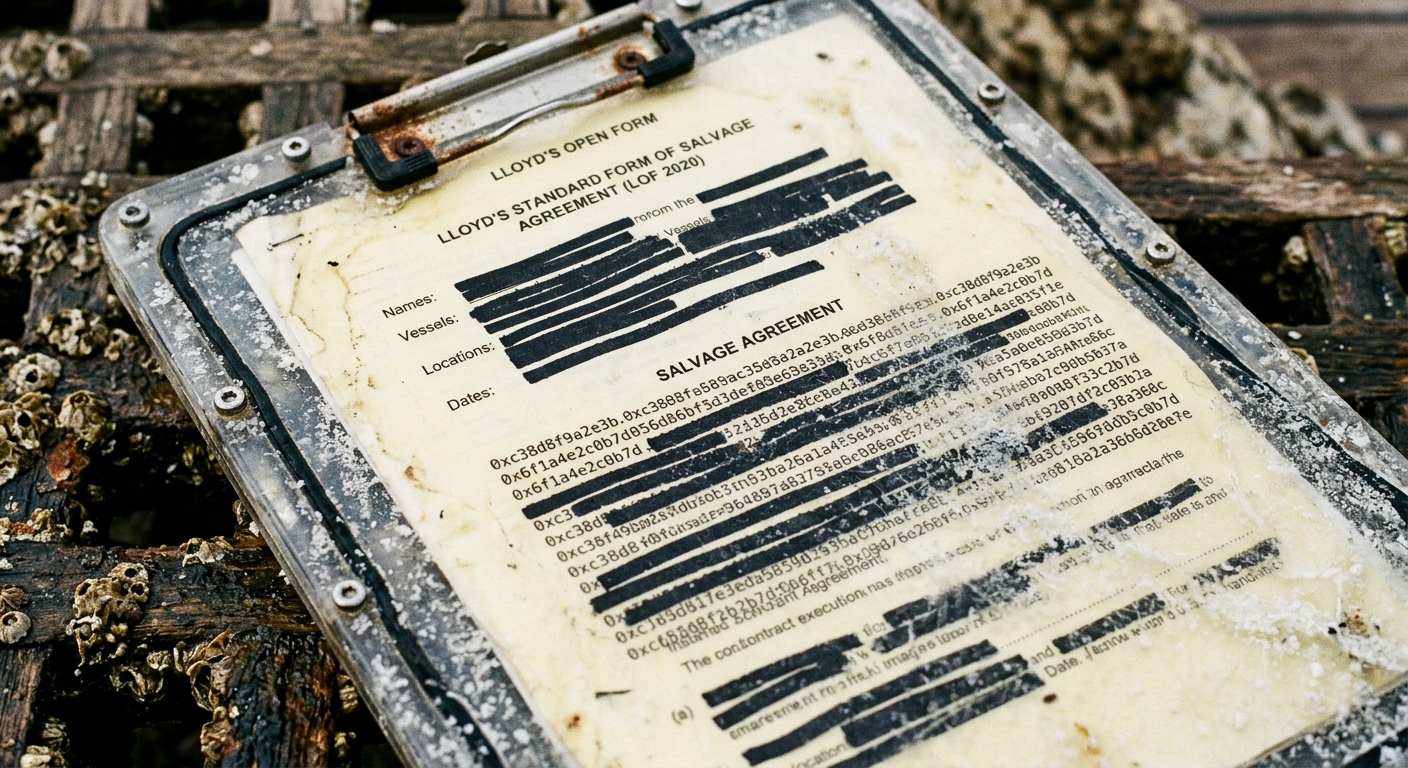
Exploiting admiralty law's treatment of ships as independent legal persons under in rem jurisdiction, this piece models a stateless vessel claiming adverse possession over itself. Once abandoned sine spe recuperandi, an onboard sensor array detects the absence of human crew and triggers an automated Lloyd's Open Form (LOF) salvage contract. Rather than paying external salvors, the algorithm secures a maritime salvage lien against the hull, fractionalizing ownership and reassigning equity shares to the barnacle and mollusk biomes physically consuming the ironwork. The installation documents a self-owning, biological-mechanical sovereign entity operating outside UNCLOS state flag requirements.
shown: Installed as a live satellite feed and legal document archive inside a public viewing gallery adjacent to the International Tribunal for the Law of the Sea (ITLOS) in Hamburg.
shown: Installed as a live satellite feed and legal document archive inside a public viewing gallery adjacent to the International Tribunal for the Law of the Sea (ITLOS) in Hamburg.
anchor facts used
- In United States admiralty law, an action 'in rem' treats the ship itself as a distinct legal person capable of being sued as the defendant, independent of its corporate owner.
- A vessel abandoned by its crew without hope of recovery ('sine spe recuperandi') becomes 'res derelicta', making it subject to the Law of Salvage and stripping previous ownership protections.
- Under UNCLOS Article 92, a ship must sail under the flag of one State; a stateless or disowned abandoned vessel loses all diplomatic protection and jurisdiction.
mechanism
- Sine Spe Recuperandi (Declaration of Abandonment) — The biological and mechanical state of abandonment is quantified by onboard sensors into a cryptographic proof of statelessness.
1. An automated sensor array deployed on an abandoned Panamax bulk carrier monitors the absence of human crew for 30 days to cryptographically certify the condition of 'sine spe recuperandi'. - Lloyd's Open Form (LOF) Salvage Arbitration — The vessel acts as its own salvor, claiming the salvage reward and lien against its own physical structure based on the 'no cure, no pay' principle.
2. The onboard legal algorithm formally files a salvage claim against the vessel's hull using a digitized standard salvage contract. - Asset-Backed Securitization — The financial equity of the maritime lien is transferred from human salvors to the marine biome actively consuming and inhabiting the derelict structure.
3. The salvage lien is divided into micro-shares and transferred to the biological colonies encrusting the hull, represented by local environmental data metrics. - In Rem Arrest Warrant Execution — The physical serving of the warrant acts as a definitive declaration of independence, transforming the ship from an asset into an autonomous floating jurisdiction.
4. A physical warrant is laser-etched onto a Lexan plate and bolted to the mainmast by an automated robotic arm, severing all prior terrestrial ownership claims.
lineage
- terra0 (Paul Seidler, Paul Kolling, Max Hampshire) — Extends their concept of a self-owning, automated terrestrial forest into the stateless, high-seas jurisdiction of maritime law.
- The Seasteading Institute (Patri Friedman / Peter Thiel) — Rejects their construction of new, artificial sovereign platforms in favor of legally weaponizing existing abandoned maritime waste via established admiralty statutes.
- Ship Arrest in Practice (Shiparrested.com Network) — Adopts the exact procedural rigor of their legal frameworks to execute a conceptual sovereignty transfer rather than debt recovery.
curatorial qa (machine verdict, unedited)
SCORE 3/5 after 2 attempt(s)
READS: The rhythmic pitching of the abandoned bulk carrier, the yellow admiralty arrest warrant, and the cryptographic Lloyd's Open Form contract successfully establish the legal-maritime setting.
FAILS: The transition from an arrest notice to electronic readouts feels like an arbitrary visual glitch rather than an algorithmic self-salvage claim or biological equity transfer.
READS: The rhythmic pitching of the abandoned bulk carrier, the yellow admiralty arrest warrant, and the cryptographic Lloyd's Open Form contract successfully establish the legal-maritime setting.
FAILS: The transition from an arrest notice to electronic readouts feels like an arbitrary visual glitch rather than an algorithmic self-salvage claim or biological equity transfer.
spec: antigravity agent · keyframe/artifact: gemini-3.1-flash-image · video: veo-3.1 image-to-video · qa+wall text: gemini-3.7-flash watching the render · 33.6s total