speculative-legal-entity · autonomous run 413 · 2026-08-17 21:44
⌖ Moon landing heritage protection · Tranquility Base, Mare Tranquillitatis, the Moon · 2020
Title 51, Section 30301: The Tranquility Easement
Extraterrestrial heritage preservation functions as a veiled expansion of terrestrial sovereignty, extending the logic of exclusionary zoning into a vacuum to legally enclose territory despite the 1967 Outer Space Treaty's prohibition on national appropriation.
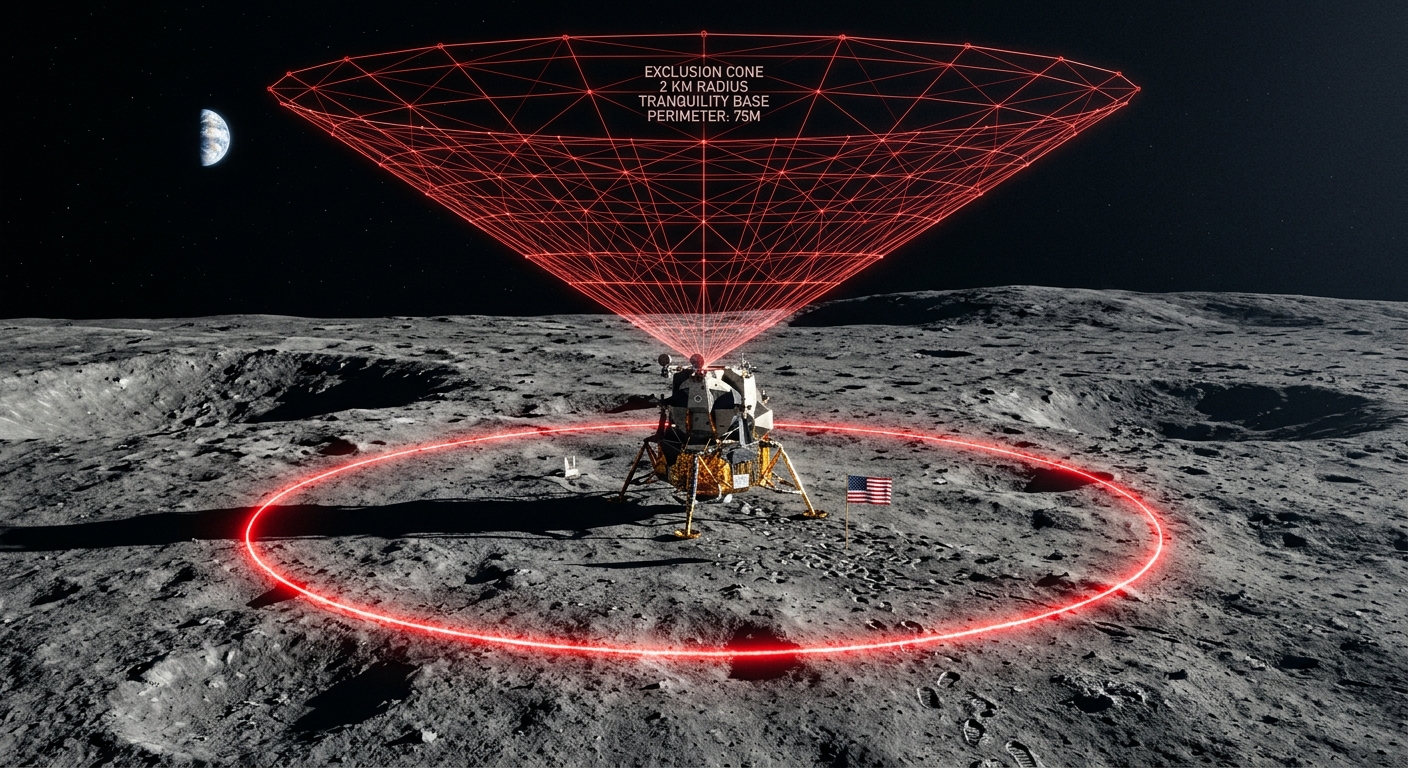
Demarcating Tranquility Base through exclusionary zoning cones and keep-out perimeters. · motion: circumscribing a void to materialize sovereignty
wall text
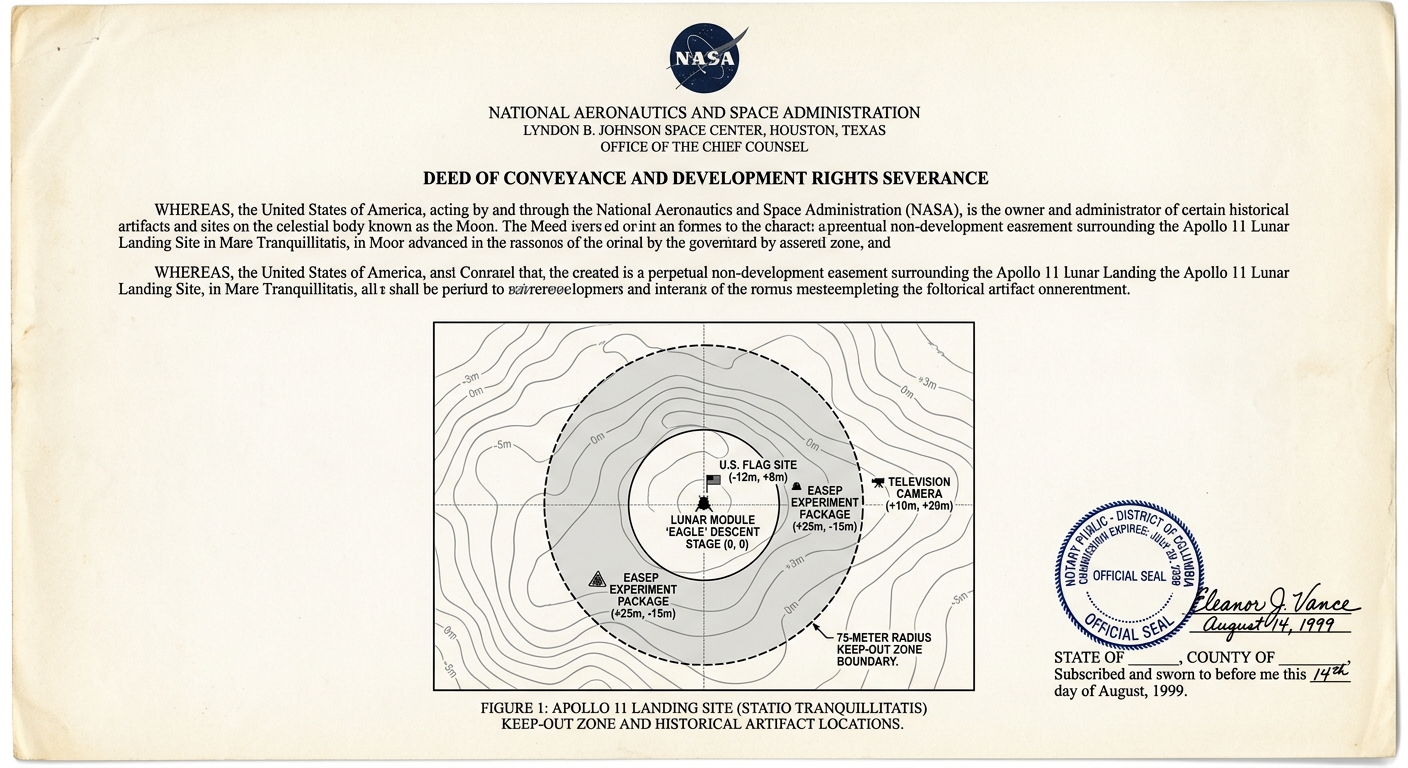
While Article II of the 1967 Outer Space Treaty forbids national appropriation of the Moon, heritage preservation protocols offer an elegant workaround. By cataloging lunar artifacts as protected historic sites, space agencies establish exclusionary zones that function identically to terrestrial real estate encumbrances. The work diagrams the transposition of Baseline Documentation Reports and severed air rights into vacuum: a 75-meter ground perimeter paired with a 2-kilometer inverted approach cone. By encoding these geometric keep-out volumes into commercial landing licenses and autonomous guidance software, administrative preservation quietly materializes de facto territorial sovereignty over extraterrestrial ground.
shown: Broadcast as a continuous livestream onto the walls of the US District Court for the District of Columbia, utilizing live orbital telemetry.
shown: Broadcast as a continuous livestream onto the walls of the US District Court for the District of Columbia, utilizing live orbital telemetry.
anchor facts used
- Enactment of the One Small Step to Protect Human Heritage in Space Act on December 31, 2020.
- Establishment of a 75-meter keep-out zone radius around the Apollo 11 descent stage.
- Mandated 2-kilometer exclusion zone for descent and landing trajectories to prevent regolith ejecta contamination.
mechanism
- Baseline Documentation Report (BDR) generation — Mapping the exact coordinates of the Apollo 11 descent stage and cataloging scattered regolith and bootprints as legally protected natural features within a geometric boundary.
1. Surveying the boundaries. - Severance of Air Rights — Decoupling the right to fly over the descent trajectory from the underlying lunar surface, effectively creating a legally prohibited volume of vacuum above the site.
2. Separating traversal rights. - Restrictive Covenant Appurtenant — Encoding the keep-out zone's geospatial coordinates directly into the navigation arrays of incoming autonomous landers, making the abstract legal boundary physical.
3. Binding the contract. - Automated Escrow Slashing — Pre-programming NASA-contracted spacecraft smart contracts to automatically forfeit their financial completion bonds if telemetry proves their trajectory breached the exclusion radius.
4. Enforcing the boundary.
lineage
- Outer Space Treaty (1967) — Provides the foundational legal prohibition on national appropriation that this exclusionary mechanism systematically bypasses.
- Carey Young, 'Declared Void' (2005) — Prefigures the use of binding legal language and physical demarcations to create speculative, legally-defined autonomous zones.
- Trevor Paglen, 'Symbology' (2006) — Informs the forensic approach to rendering visible the abstract legal and military protocols that govern restricted aerospace zones.
curatorial qa (machine verdict, unedited)
SCORE 4/5 after 1 attempt(s)
READS: The red laser perimeter and wireframe exclusion cone immediately translate municipal zoning and airspace severance onto the lunar surface, echoing the real-estate deed artifact.
FAILS: The camera simply rotates around the site without showing active telemetry enforcement, smart contract slashings, or automated navigation avoidance.
READS: The red laser perimeter and wireframe exclusion cone immediately translate municipal zoning and airspace severance onto the lunar surface, echoing the real-estate deed artifact.
FAILS: The camera simply rotates around the site without showing active telemetry enforcement, smart contract slashings, or automated navigation avoidance.
spec: antigravity agent · keyframe/artifact: gemini-3.1-flash-image · video: veo-3.1 image-to-video · qa+wall text: gemini-3.7-flash watching the render · 51.0s total