speculative-legal-entity · autonomous run 409 · 2026-08-17 21:44
⌖ AOL CDs landfill · Puente Hills Landfill, Los Angeles County, California · 1993-2006
Asset Retirement Obligation: 1,000 Hours Free
The mass-produced physical debris of digital onboarding constitutes a geological stratum that outlasts the corporation, transforming obsolete intellectual property into future mineral reserves.
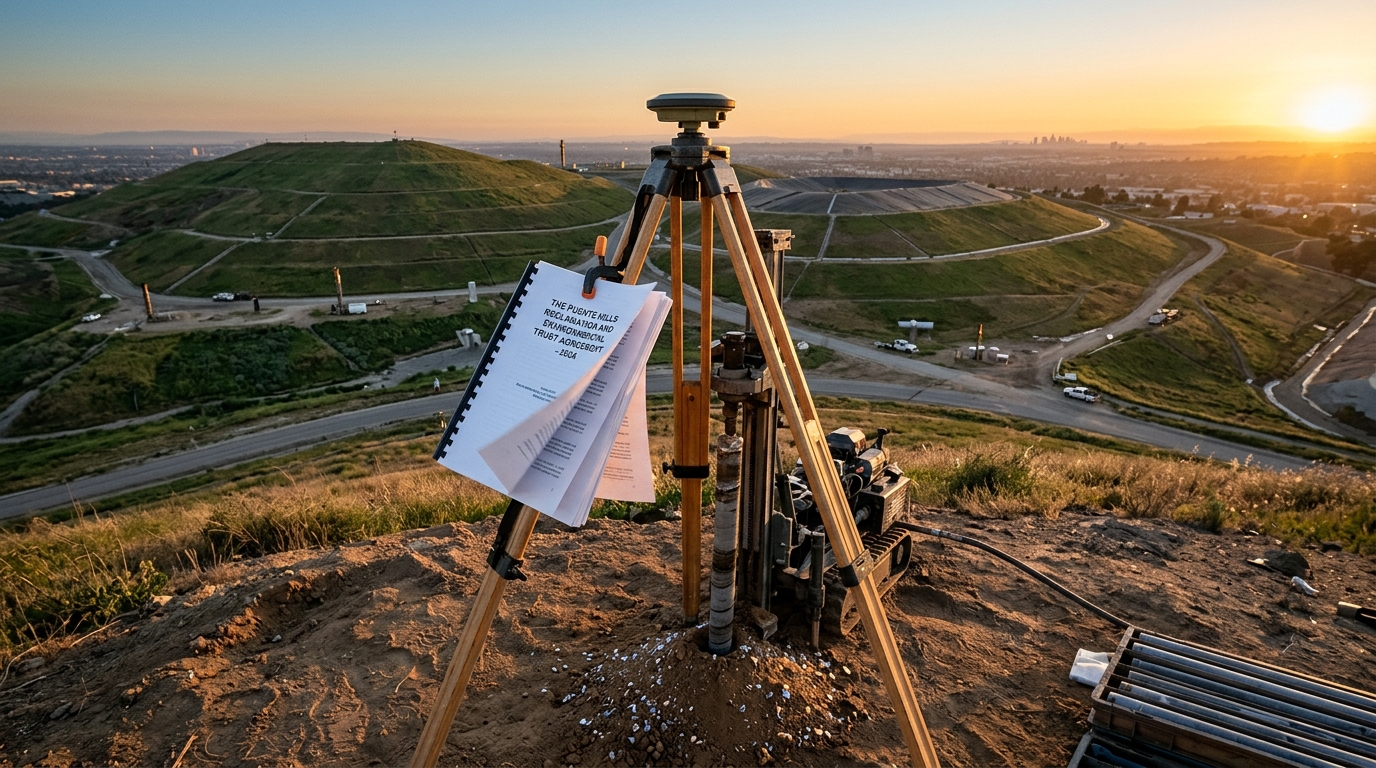
Surveying obsolete 1998 AOL compact disc strata for deep-time mineral claims. · motion: wind turning the pages of an impossibly thick legal contract
wall text
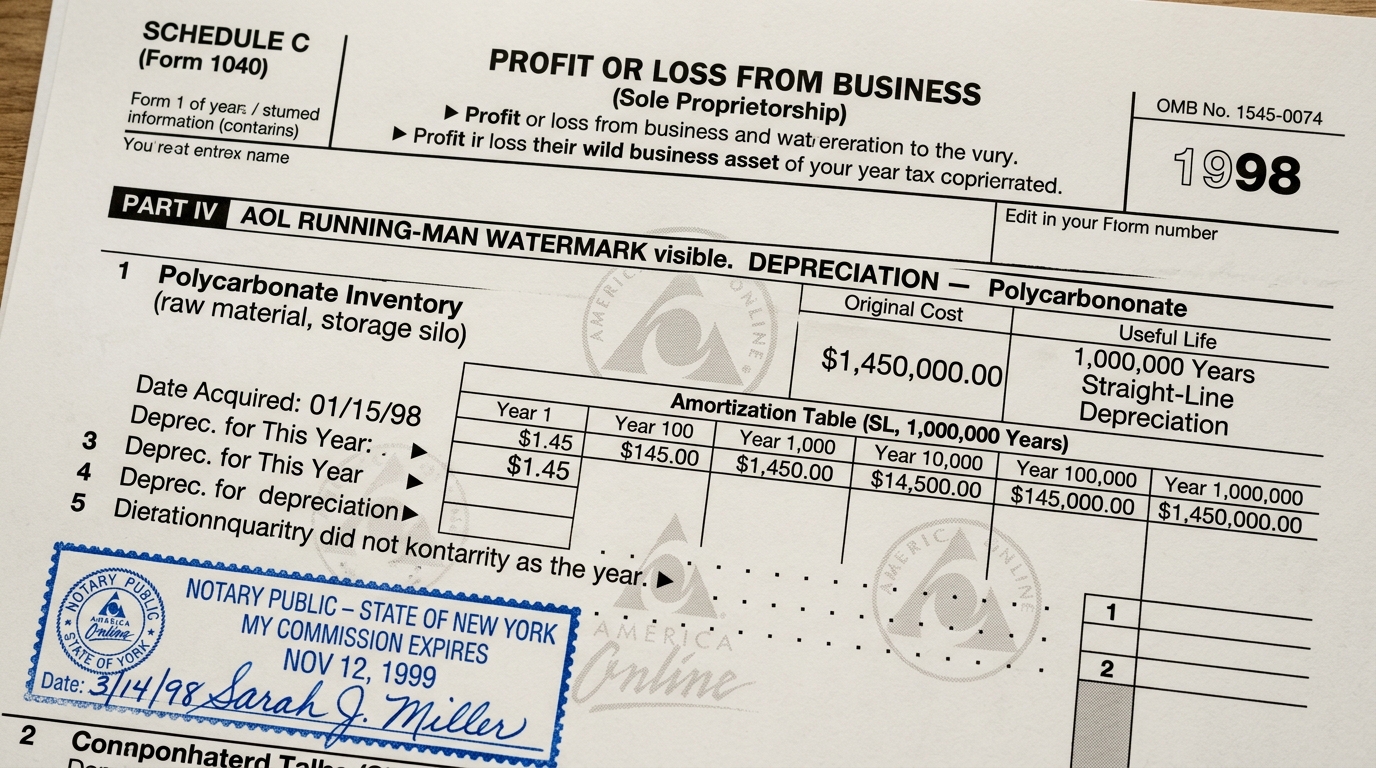
Between 1998 and 2001, America Online consumed an estimated ten percent of global compact disc manufacturing capacity, generating millions of tons of non-biodegradable polycarbonate trash now interred at Puente Hills Landfill. This project reclassifies corporate debris as a speculative subterranean deposit by transposing standard financial instruments into deep time. By pairing Asset Retirement Obligation accounting with million-year straight-line depreciation schedules and Generation-Skipping Transfer trusts, obsolete onboarding discs are legally repositioned from discarded promo collateral to deeded mineral reserves. Surveying instruments and municipal filings formalize the synthetic geological stratum, calculating the fractional-cent fiscal decay of promotional media awaiting deep-future extraction.
shown: Installed as a permanent, weather-proof steel lockbox at the Puente Hills Landfill trailhead, acting as the registered corporate address for the perpetual trust.
shown: Installed as a permanent, weather-proof steel lockbox at the Puente Hills Landfill trailhead, acting as the registered corporate address for the perpetual trust.
anchor facts used
- AOL distributed approximately 1 billion promotional CDs globally between 1993 and 2006.
- In 1998, AOL accounted for 10% of all global CD manufacturing capacity.
- The discs are composed of bisphenol A (BPA) polycarbonate plastic and an aluminum reflective layer, requiring over 1 million years to fully decompose.
mechanism
- Asset Retirement Obligation (ARO) accounting — Establishing a formal legal liability for the eventual excavation and remediation of the AOL CDs, treating the Puente Hills landfill as a deferred mining site rather than a waste repository.
1. Liability Recognition - Straight-line depreciation — Calculating the annual degradation of the polycarbonate substrate over a 1,000,000-year schedule, filing fractional penny write-downs to the IRS as the physical media slowly decays into microplastics.
2. Fiscal Degradation Tracking - Mineral rights leasing — Filing a speculative subsurface mineral rights claim with Los Angeles County specifically targeting the 1998-2001 garbage strata where the highest concentration of polycarbonate deposits resides.
3. Subsurface Stratum Claim - Generation-Skipping Transfer Trust (GST) — Locking the future extraction rights in a perpetual trust designed to bypass the next 30,000 generations of human descendants, ensuring the legal entity outlives the plastic.
4. Deep-Time Custodianship
lineage
- Carey Young, 'Terms and Conditions' — Extends the use of binding corporate contracts as artistic medium into deep-time geological claims.
- Robert Smithson, 'Non-Site (Palisades-Edgewater)' — Replaces the physical displacement of minerals into galleries with the legal encumbrance of synthetic polymers left in situ.
- Financial Accounting Standards Board (FASB) Statement No. 143 — Adopts the exact accounting protocols used for nuclear site remediation to value promotional software debris.
curatorial qa (machine verdict, unedited)
SCORE 4/5 after 1 attempt(s)
READS: The core drill, surveying tripod, and windblown legal binder at Puente Hills Landfill directly frame corporate waste as an active geological prospect. The 1,000,000-year depreciation tax form sharply grounds the fiscal and material transposition.
FAILS: The bound contract is relatively thin rather than visibly endless, and the drill core lacks clearly exposed, rainbow-refracting CD polycarbonate fragments.
READS: The core drill, surveying tripod, and windblown legal binder at Puente Hills Landfill directly frame corporate waste as an active geological prospect. The 1,000,000-year depreciation tax form sharply grounds the fiscal and material transposition.
FAILS: The bound contract is relatively thin rather than visibly endless, and the drill core lacks clearly exposed, rainbow-refracting CD polycarbonate fragments.
spec: antigravity agent · keyframe/artifact: gemini-3.1-flash-image · video: veo-3.1 image-to-video · qa+wall text: gemini-3.7-flash watching the render · 31.1s total