speculative-legal-entity · autonomous run 402 · 2026-08-17 21:43
⌖ Windrush scandal · Tilbury Docks, Essex and Lunar House, Croydon · 1948-2018
Root Reference Nullification: The Tilbury Docks Mark-and-Sweep
A state's administrative memory functions as a closed-loop garbage collector, where the intentional destruction of root cryptographic pointers retroactively reclassifies structurally embedded human beings as orphaned data ready for physical deletion.
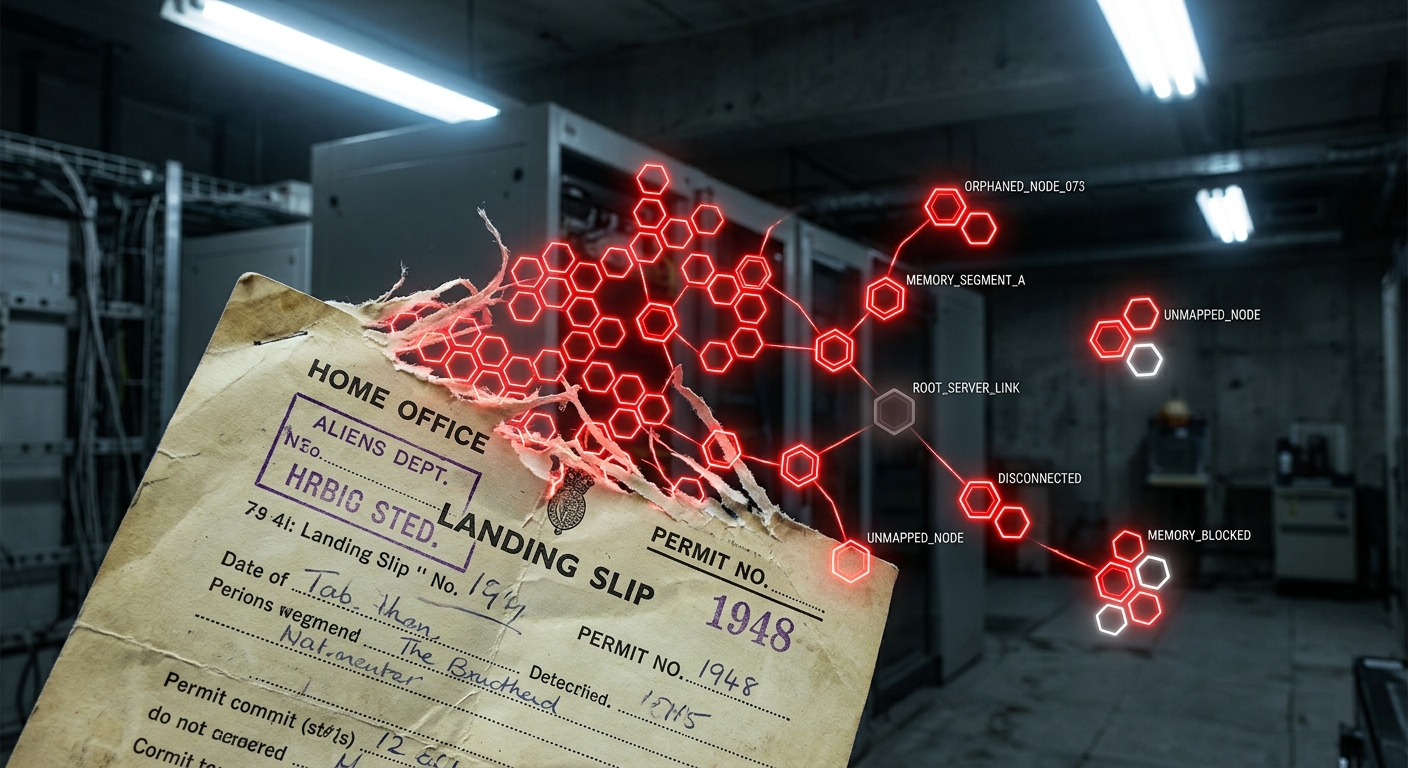
Administrative dereferencing turns citizens into unmapped nodes scheduled for deletion. · motion: cascading dereferencing and physical dissolution
wall text
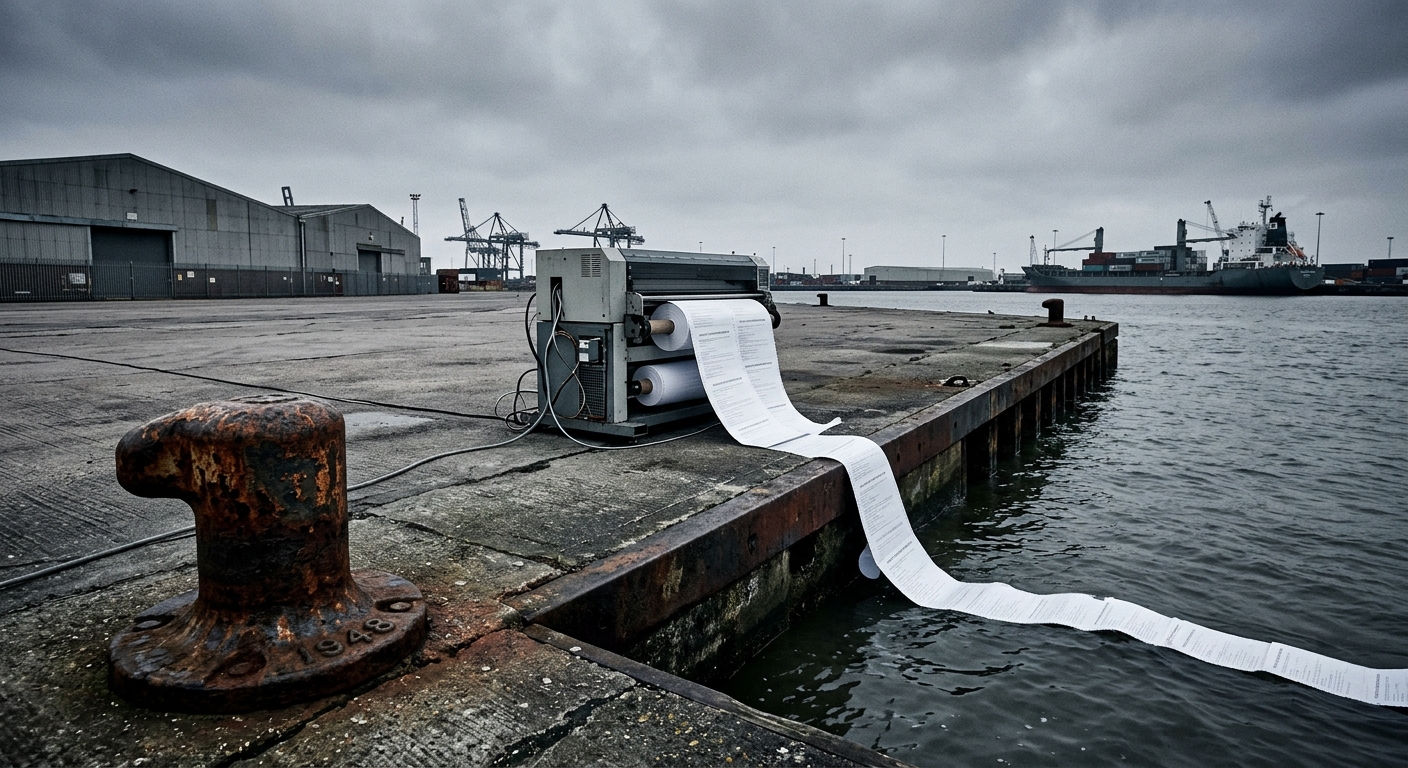
In computer systems, tracing garbage collectors reclaim memory by pruning objects unreachable from the root set. This installation maps that logic onto the UK Home Office's 2010 destruction of Windrush landing slips and the subsequent 'Hostile Environment' policy. The shredded arrival slips represent severed root pointers. Without administrative referents, long-settled citizens were systematically flagged as unmapped nodes across housing, banking, and healthcare networks. The work frames state bureaucracy not as a neutral ledger, but as an automated runtime environment executing a deliberate sweep phase against human memory.
shown: Installed permanently as a watertight biometric data-server embedded directly into the tidal mud of the Tilbury Docks slipway, periodically submerged and revealed by the Thames tide.
shown: Installed permanently as a watertight biometric data-server embedded directly into the tidal mud of the Tilbury Docks slipway, periodically submerged and revealed by the Thames tide.
anchor facts used
- HMT Empire Windrush docked at Tilbury Docks on 22 June 1948, disembarking Commonwealth citizens invited to rebuild Britain
- In 2010, the UK Home Office deliberately destroyed the original physical landing cards of Windrush arrivals in the basement of Lunar House
- The 2012 'Hostile Environment' policy legally required the NHS, employers, and landlords to verify immigration status, effectively turning civilians into internal border agents
mechanism
- Memory Allocation (Computer Science) — Laborers are ingested from the Commonwealth into the state's economic mainframe upon disembarkation, their existence logged in a central registry as active, working memory nodes.
1. Allocation of Human Capital - Dereferencing / Pointer Deletion — The central administrative authority intentionally shreds the foundational memory references linking active human nodes to the root legal registry, severing their algorithmic tether to citizenship.
2. Severing the Root Pointers - Tracing / Mark Phase (Garbage Collection Algorithm) — A distributed algorithm traverses the socio-economic graph, forcing peripheral nodes (hospitals, banks, landlords) to query the root registry and flag undocumented humans as unreachable, invalid data.
3. The Distributed Mark Phase - Sweep Phase / Memory Deallocation — The state executes an automated deallocation protocol, initiating forced physical removal of the marked human nodes to reclaim structural space, despite their lifelong continuous execution within the host system.
4. The Sweep Phase
lineage
- Lawrence Abu Hamdan - Rubber Coated Steel — Extends Abu Hamdan's forensic acoustic analysis of state violence into the algorithmic and bureaucratic forensic analysis of state memory destruction
- Carey Young - Declared Void — Builds on her spatialization of legal limbo by rendering the void not as static geography, but as an active, cascading algorithmic sweep
- James Bridle - Seamless Transitions — Contrasts Bridle's visualizations of contemporary deportation architectures by focusing on the retroactive paperwork destruction that precedes physical removal
curatorial qa (machine verdict, unedited)
SCORE 3/5 after 2 attempt(s)
READS: The dockside setting and paper roll feeding into the sea clearly anchor bureaucratic arrival and erasure. The artifact diagram articulates memory dereferencing via the shredded 1948 landing slip.
FAILS: The video relies on decorative glowing VFX along the paper strip rather than demonstrating systemic graph traversal, distributed verification, or the physical extraction of human subjects.
READS: The dockside setting and paper roll feeding into the sea clearly anchor bureaucratic arrival and erasure. The artifact diagram articulates memory dereferencing via the shredded 1948 landing slip.
FAILS: The video relies on decorative glowing VFX along the paper strip rather than demonstrating systemic graph traversal, distributed verification, or the physical extraction of human subjects.
spec: antigravity agent · keyframe/artifact: gemini-3.1-flash-image · video: veo-3.1 image-to-video · qa+wall text: gemini-3.7-flash watching the render · 42.9s total