speculative-legal-entity · autonomous run 387 · 2026-08-17 21:42
⌖ Maunsell sea forts · Thames Estuary, United Kingdom · 1942-present
The Red Sands Tontine
Legal personhood and sovereign territorial claims in maritime environments are inversely proportional to structural integrity, where physical decay concentrates legal force.
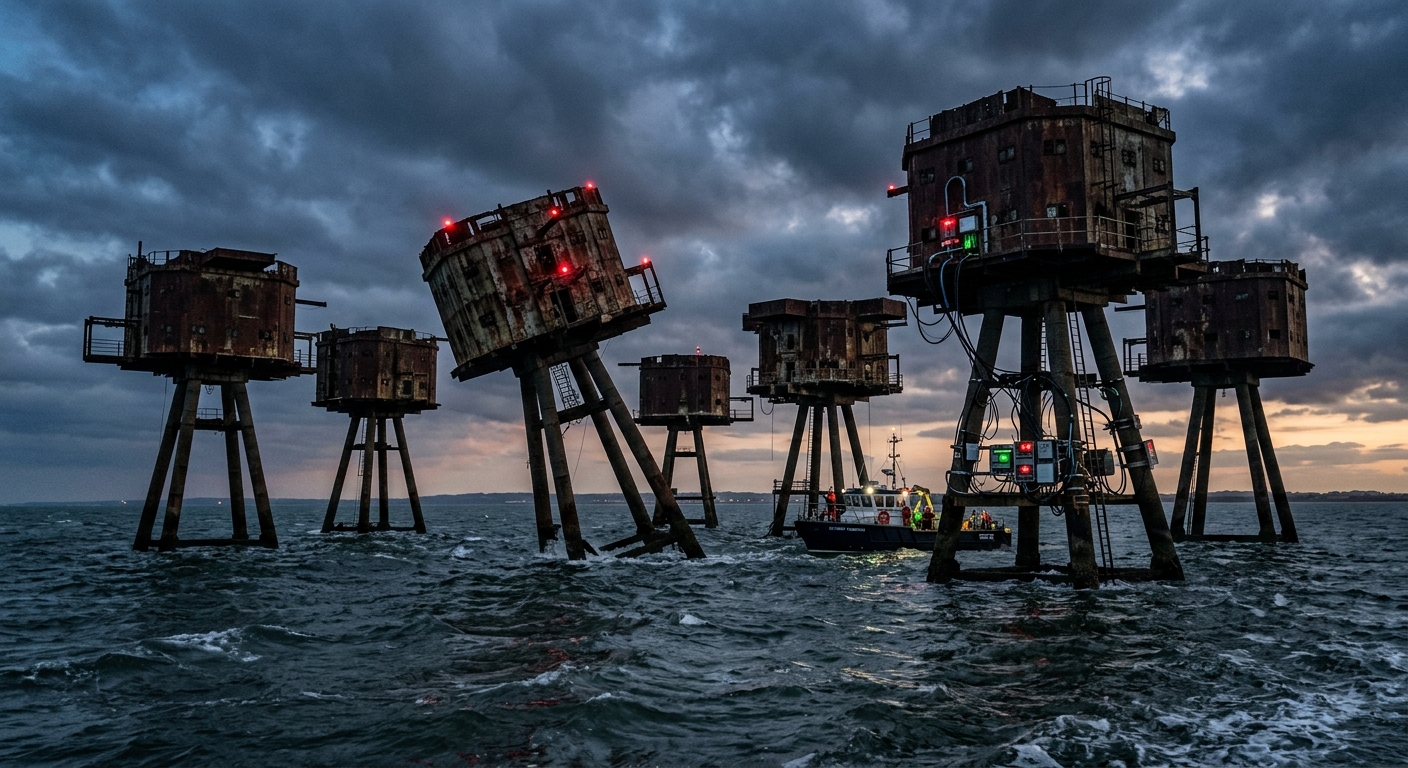
A tower collapses, redistributing its spectrum shares across surviving autonomous forts. · motion: Structural listing and collapsing, visually transferring luminous data pulses to adjacent surviving structures.
wall text
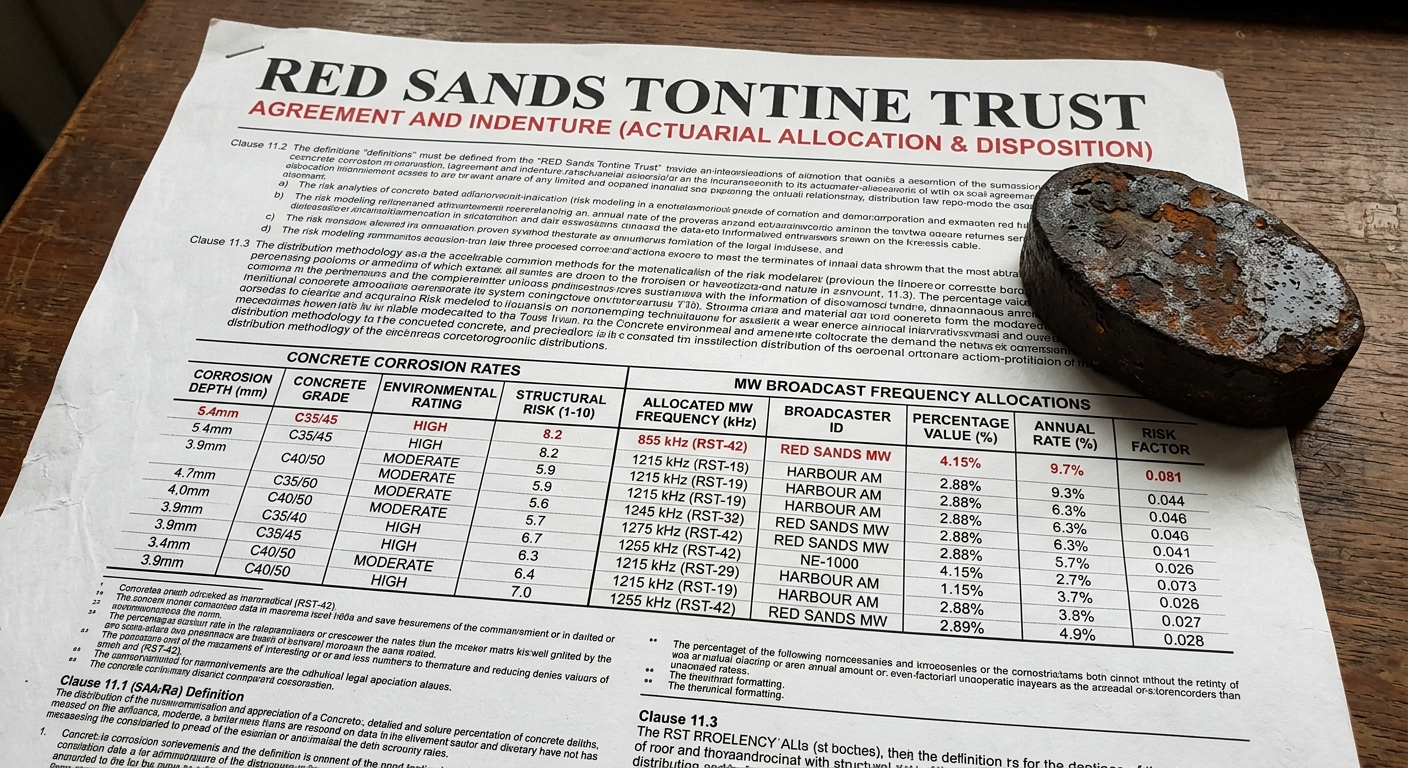
The Red Sands Maunsell sea forts are reimagined as an autonomous architectural tontine. Each concrete tower continually assesses its own structural decay using ultrasonic corrosion sensors. When a tower collapses into the Thames Estuary, its legal entity status dissolves, triggering a smart contract that cryptographically redistributes its sovereign maritime claims and 1960s pirate radio broadcast frequencies to surviving structures via hardwired umbilical lines. Transposing 17th-century tontine financial mechanisms onto decaying military infrastructure, the work demonstrates how physical degradation can paradoxically concentrate legal authority and transmission monopolies among the last structures standing in contested maritime space.
shown: Installed as a live smart-contract visualization on a marine radar terminal aboard a chartered vessel anchored just outside the 500-meter exclusion zone of the Red Sands forts.
shown: Installed as a live smart-contract visualization on a marine radar terminal aboard a chartered vessel anchored just outside the 500-meter exclusion zone of the Red Sands forts.
anchor facts used
- Built in 1942 by civil engineer Guy Maunsell as a network of seven interconnected steel towers on concrete legs.
- Red Sands fort is located precisely at 51.4797 N, 0.9903 E.
- Occupied in 1964 by Radio City, broadcasting pirate radio on 299 meters MW.
- Sister fort Shivering Sands lost one of its seven towers in 1953 when the ship Ribble Chief struck it, proving structural mortality.
mechanism
- Tontine initial investment pooling — The seven towers of Red Sands legally pool their historical maritime coordinates and broadcast spectrum rights into a shared, irrevocable digital trust.
1. Capital Contribution - Mortality table assessment — Ultrasonic thickness sensors bolted to the bases continually measure rust and marine corrosion on the legs, generating a real-time structural mortality index.
2. Actuarial Monitoring - Annuitant death and share forfeiture — When a tower's structural integrity falls below 15 percent or it physically collapses into the ocean, a smart contract legally terminates its individual entity status.
3. Default Event - Tontine survivorship distribution — The collapsed tower's allocated bandwidth and legal sovereign fractions are cryptographically redistributed to the surviving towers, compounding their legal density until one absolute sovereign remains.
4. Dividend Reallocation
lineage
- Principality of Sealand (Paddy Roy Bates, 1967) — Builds on Bates' initial legal hacking of the Roughs Tower, but automates the sovereignty claim through actuarial decay rather than physical occupation.
- Declared Void (Carey Young, 2005) — Shares the use of legal boundaries as sculptural material, but shifts the jurisdiction from the gallery space to international maritime law.
- terra0 (Paul Seidler, Paul Kolling, Max Hampshire, 2016) — Adapts their model of a forest that legally owns itself into an augmented maritime ruin that actively consolidates its own sovereign broadcast rights.
curatorial qa (machine verdict, unedited)
SCORE 4/5 after 2 attempt(s)
READS: The physical collapse of the listing Maunsell tower directly triggers green LED numeric reallocations and energetic pulse transfers along the cabling to surviving towers.
FAILS: The transfer of legal personhood versus mere RF broadcast bandwidth relies on reading the supporting trust indenture rather than reading purely on-screen.
READS: The physical collapse of the listing Maunsell tower directly triggers green LED numeric reallocations and energetic pulse transfers along the cabling to surviving towers.
FAILS: The transfer of legal personhood versus mere RF broadcast bandwidth relies on reading the supporting trust indenture rather than reading purely on-screen.
spec: antigravity agent · keyframe/artifact: gemini-3.1-flash-image · video: veo-3.1 image-to-video · qa+wall text: gemini-3.7-flash watching the render · 48.8s total