speculative-legal-entity · autonomous run 370 · 2026-08-17 21:41
⌖ Lloyd's of London names disaster · The Underwriting Room, Lloyd's Building, One Lime Street, London · 1988-1993
Syndicate 317: The LMX Spiral
Risk does not disappear when securitized; it merely loops until the systemic friction outweighs the original hazard, violently collapsing the abstraction back onto the individual's physical body.
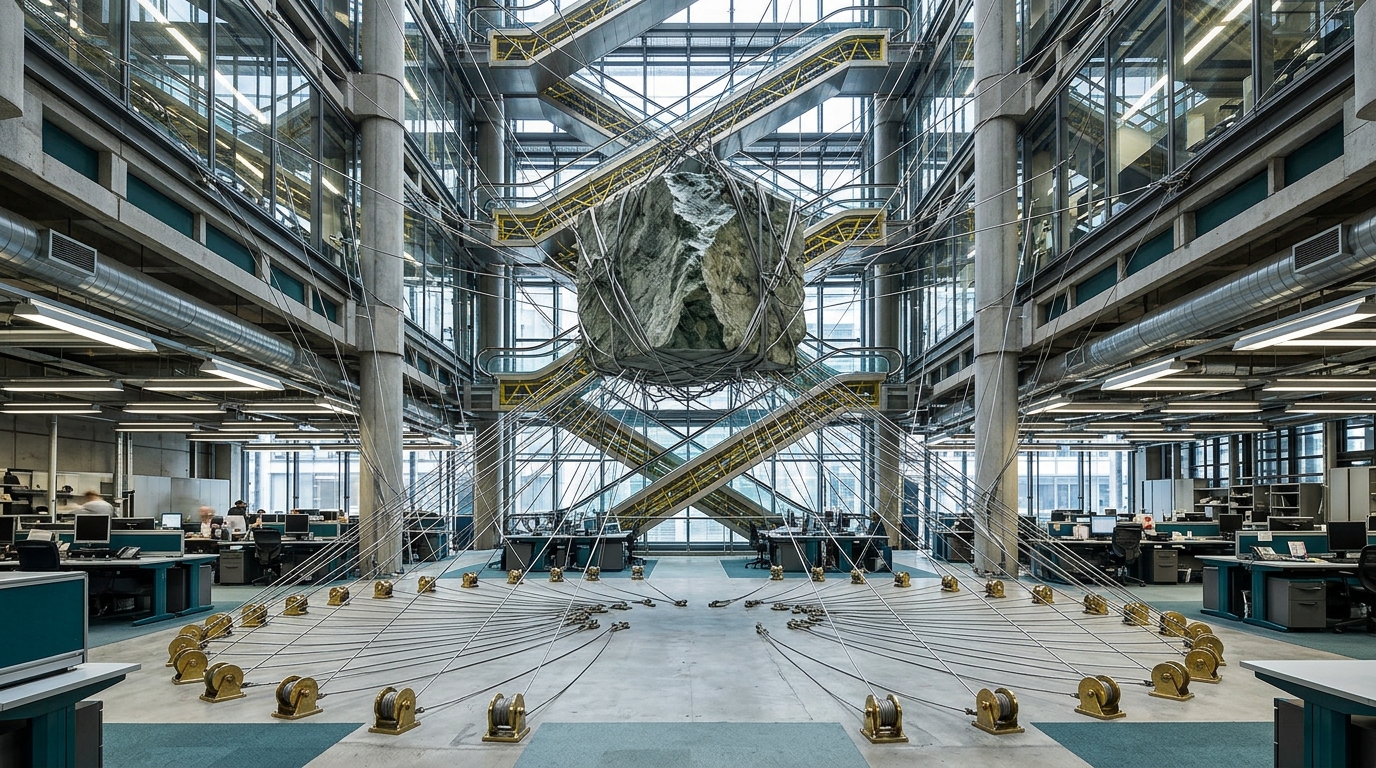
Recursive reinsurance cables compound friction until the central asset drops. · motion: recursively tightening into structural failure
wall text
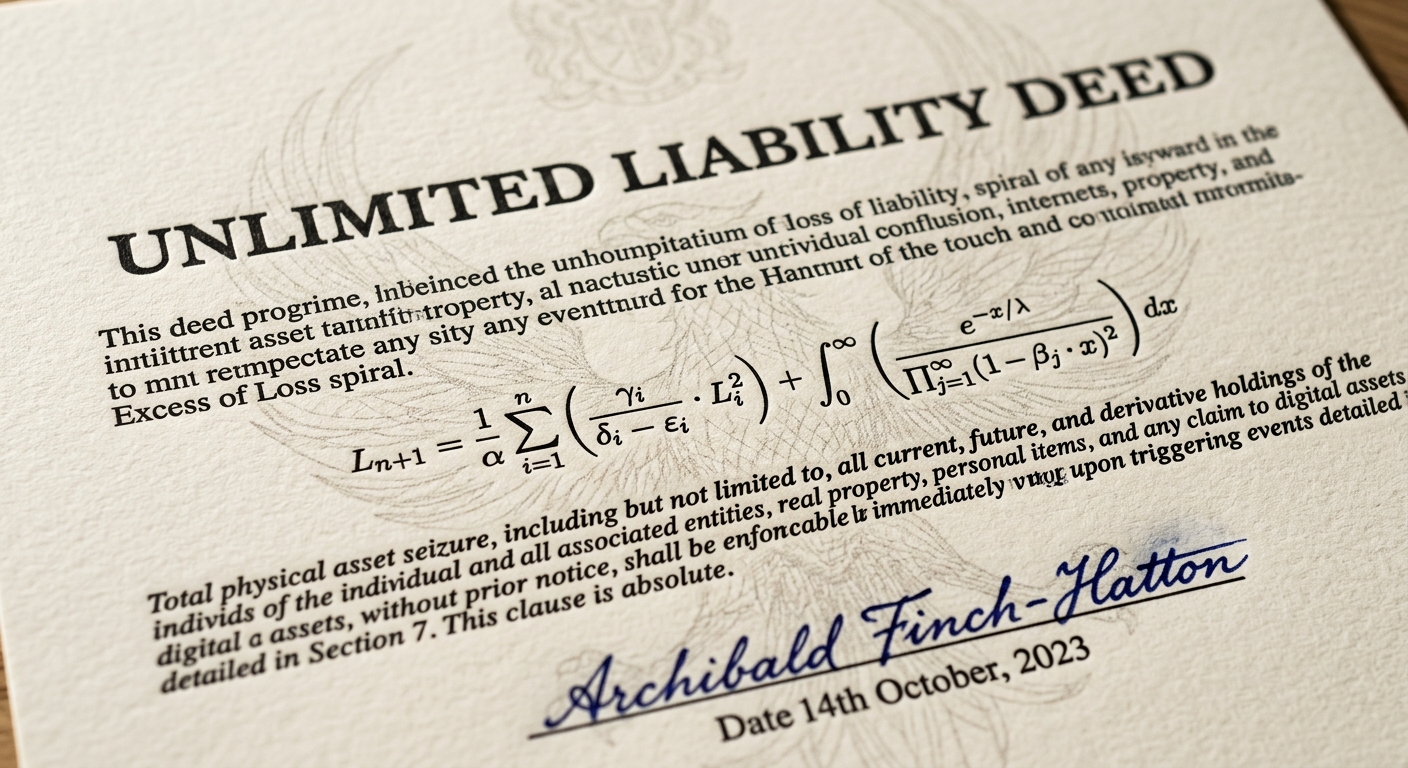
During the Lloyd's crisis of the late 1980s, syndicates traded tranches of catastrophic liability through recursive reinsurance contracts known as the LMX spiral. This mechanism diluted immediate exposure while invisibly concentrating aggregate systemic risk among individual investors with unlimited liability. Here, a serpentine rock represents an unhedged toxic exposure, suspended above floor-mounted winches anchored to individual participant deeds. As simulated contracts trade fractions of mechanical strain among themselves, the cables interweave and cross-tension automatically. The work models financial securitization not as risk dispersion, but as a closed loop where procedural friction compounds until structural limits fail, converting mathematical abstraction into blunt kinetic force.
shown: Installed directly on the ground floor Underwriting Room of the Lloyd's building at One Lime Street, London, operating autonomously during standard trading hours.
shown: Installed directly on the ground floor Underwriting Room of the Lloyd's building at One Lime Street, London, operating autonomously during standard trading hours.
anchor facts used
- Richard Outhwaite's Syndicate 317 absorbed massive long-tail US asbestos claims from decades prior.
- The 'Names' (individual investors) operated under 'unlimited liability,' legally risking their entire personal wealth down to their last asset.
- The London Market Excess of Loss (LMX) spiral caused syndicates to unknowingly reinsure each other, recursively amplifying risk rather than dispersing it.
mechanism
- Writing primary insurance for latent liability — A 1-ton block of raw asbestos-bearing serpentine rock is suspended above the exhibition floor by a primary steel tension cable, its load mathematically defined as the baseline risk.
1. Primary Underwriting - Excess of Loss (XoL) Reinsurance — The gallery recruits 100 spectator-signatories who sign legally binding 'unlimited liability' deeds, receiving micro-payments in exchange for bearing fractions of the rock's structural load via secondary cables connected to individual floor winches.
2. Excess of Loss Delegation - The LMX (London Market Excess of Loss) Spiral — An algorithm automatically generates recursive contracts among the signatories, trading fractions of their cable tension to each other. The physical cables literally cross and attach to one another, creating a closed physical loop where signatories unknowingly bear their own initial load, amplified by the weight of the new hardware.
3. The Spiral - Equitas Transfer and Cash Calls — When load sensors detect the primary cable fraying (simulating claim events), the algorithm executes a 'cash call.' The motorized floor winches disengage, legally compelling the signatories to physically pull their cables to prevent the 1-ton rock from dropping.
4. Cash Call
lineage
- Carey Young, 'Declared Void' (2005) — Builds on her use of performative legal contracts by extending the jurisdiction from spatial boundaries to binding, long-tail physical liability.
- Michael Landy, 'Break Down' (2001) — Contrasts Landy's voluntary, localized destruction of wealth with the involuntary, distributed, and legally mandated ruin of the unlimited liability contract.
- Hans Haacke, 'Shapolsky et al. Manhattan Real Estate Holdings' (1971) — Updates Haacke's static institutional critique of shell-company obfuscation into an active, motorized architectural hazard.
curatorial qa (machine verdict, unedited)
SCORE 3/5 after 2 attempt(s)
READS: The suspended mass, intricate rigging network, and catastrophic impact grounding abstract risk into raw kinetic destruction clearly register.
FAILS: The recursive tightening and mutual load transfer between cables do not register before the collapse; the cables simply snap without showing systemic ratcheting.
READS: The suspended mass, intricate rigging network, and catastrophic impact grounding abstract risk into raw kinetic destruction clearly register.
FAILS: The recursive tightening and mutual load transfer between cables do not register before the collapse; the cables simply snap without showing systemic ratcheting.
spec: antigravity agent · keyframe/artifact: gemini-3.1-flash-image · video: veo-3.1 image-to-video · qa+wall text: gemini-3.7-flash watching the render · 36.0s total