speculative-legal-entity · autonomous run 362 · 2026-08-17 21:41
⌖ Guano islands era · Baker Island, Pacific Ocean · 1856-1891
Depletion Quitclaim: Baker Island
State sovereignty is a temporary, depreciating asset derived strictly from mineral extraction, inherently programming its own legal obsolescence.
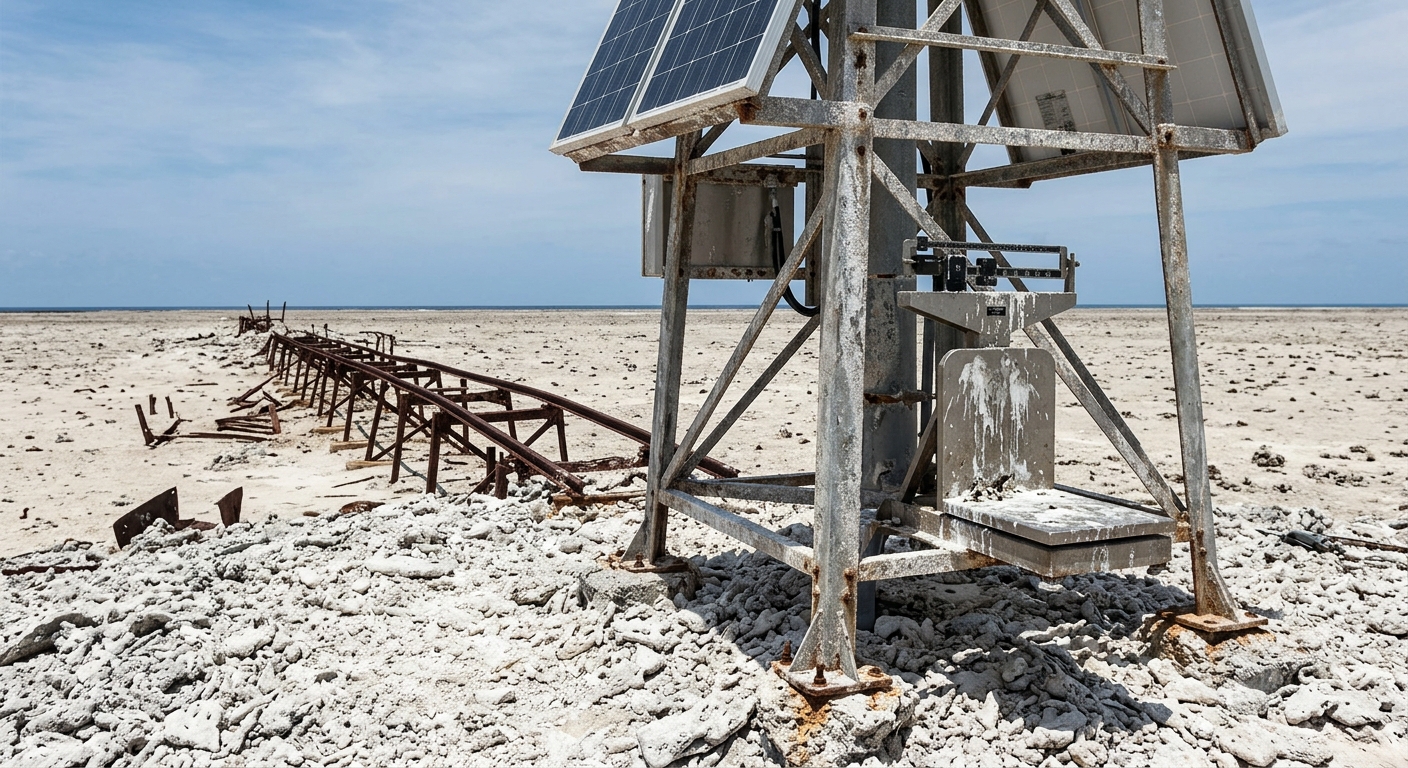
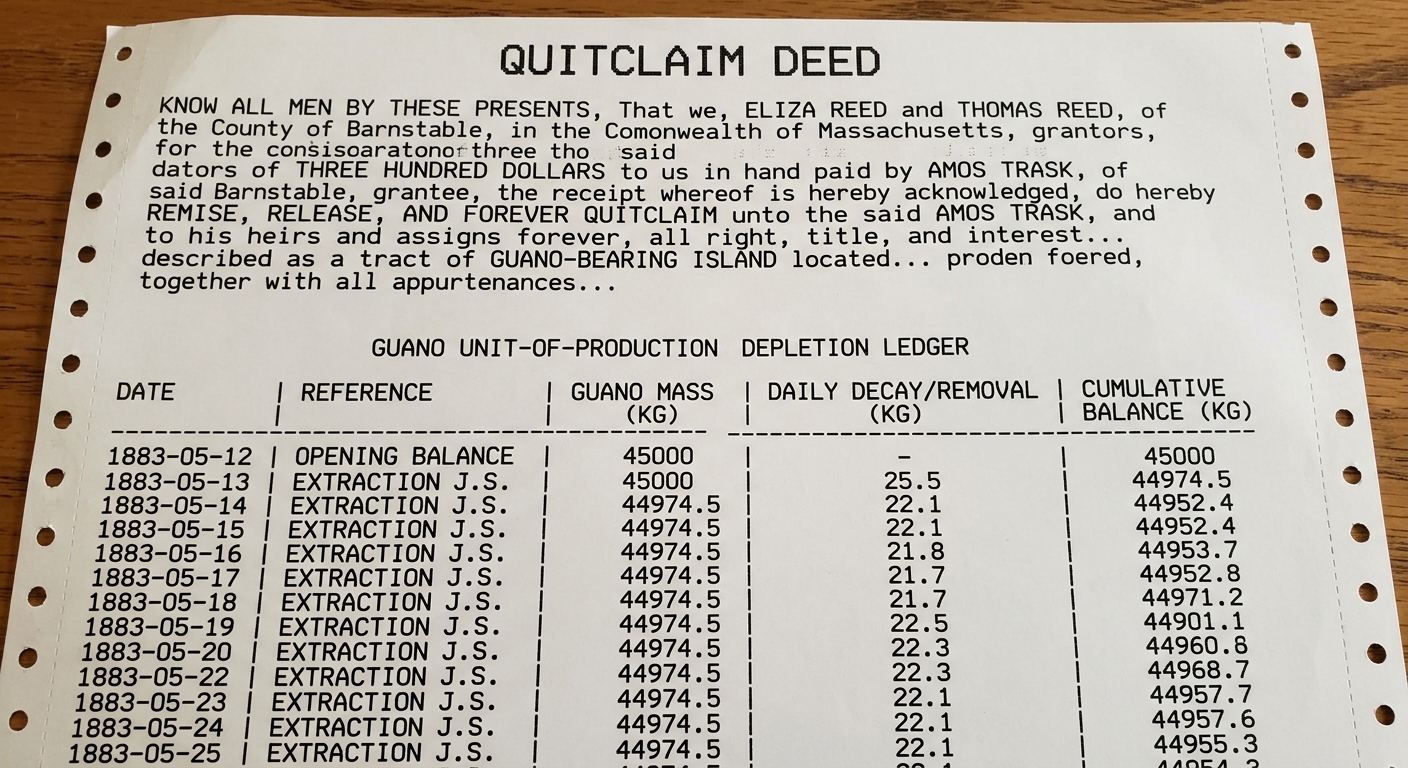
An automated scale prints an island's quitclaim deed as guano deposits deplete. · motion: eroding the foundation of the legal instrument
wall text
Under the 1856 Guano Islands Act, US sovereignty over an oceanic landmass was explicitly conditional: once the mineral was fully extracted, federal protection could be revoked at the President's discretion. This installation models sovereignty as an automated unit-of-production asset balance. A solar-powered industrial scale on Baker Island measures the net mass balance of fresh seabird deposits against equatorial wind erosion. When the resource depletion ledger drops below operational viability, the local terminal prints and transmits a formal Quitclaim Deed of Abandonment to the US Department of State. The project transposes resource accounting and smart contract execution into an autonomous bureaucracy of geopolitical obsolescence.
shown: Installed as a live data feed and continuous-print fax station at the US Department of the Interior in Washington D.C., networked directly to the remote sensor on Baker Island.
shown: Installed as a live data feed and continuous-print fax station at the US Department of the Interior in Washington D.C., networked directly to the remote sensor on Baker Island.
anchor facts used
- The US Guano Islands Act of 1856 (48 U.S.C. § 1411) allowed US citizens to take possession of unclaimed islands containing guano deposits.
- Section 1414 of the Act legally absolved the United States of any obligation to retain possession of an island after the guano was exhausted.
- Baker Island was claimed under the Act in 1857, heavily mined by the American Guano Company, and officially abandoned in 1891 when the deposits were depleted.
mechanism
- Mass Balance Equation — A solar-powered load cell and precipitation sensor on the island calculates the daily mass of fresh seabird excrement against wind and water erosion.
1. Telemetry of Accumulation and Erosion - Unit-of-Production Depletion Accounting — The net mass from the load cell is fed into an automated ledger, converting the physical guano mass into a depleting sovereign asset base.
2. Financialization of the Physical Base - Smart Contract Execution — An immutable script constantly monitors the depletion ledger; when the moving average of the guano asset mass falls to exactly zero, it triggers a legal execution.
3. Threshold Trigger - Quitclaim Deed — The system automatically drafts and transmits a legally binding Quitclaim Deed of Abandonment to the US State Department via satellite link.
4. Automated Dissolution of Sovereignty
lineage
- Carey Young, 'Declared Void' (2005) — Builds on Young's spatial legal fictions by tying the legal void not to drawn lines but to strict biogeochemical exhaustion.
- Gordon Matta-Clark, 'Reality Properties: Fake Estates' (1973) — Extends Matta-Clark's acquisition of unusable land micro-parcels to the macroeconomic scale of 19th-century US imperial island-grabbing.
- Julian Oliver, 'Harvest' (2017) — Echoes Oliver's use of autonomous energy to process data, but deploys physical sensing to actively un-mine and dissolve sovereign territory.
curatorial qa (machine verdict, unedited)
SCORE 4/5 after 2 attempt(s)
READS: The harsh Pacific island landscape, abandoned industrial tramway, and the automated solar station spooling continuous tractor-feed legal tape into the wind clearly convey an automated legal liquidation system.
FAILS: The direct mathematical link between the mechanical balance scale and the automated quitclaim trigger relies heavily on the physical paper artifact rather than being readable purely in-video.
READS: The harsh Pacific island landscape, abandoned industrial tramway, and the automated solar station spooling continuous tractor-feed legal tape into the wind clearly convey an automated legal liquidation system.
FAILS: The direct mathematical link between the mechanical balance scale and the automated quitclaim trigger relies heavily on the physical paper artifact rather than being readable purely in-video.
spec: antigravity agent · keyframe/artifact: gemini-3.1-flash-image · video: veo-3.1 image-to-video · qa+wall text: gemini-3.7-flash watching the render · 33.3s total