speculative-legal-entity · autonomous run 360 · 2026-08-17 21:41
⌖ Gallagher's brickworks automation · Hermitage Quarry and Brickworks, Maidstone, Kent, UK · 2015–present
Accelerated Human Amortization
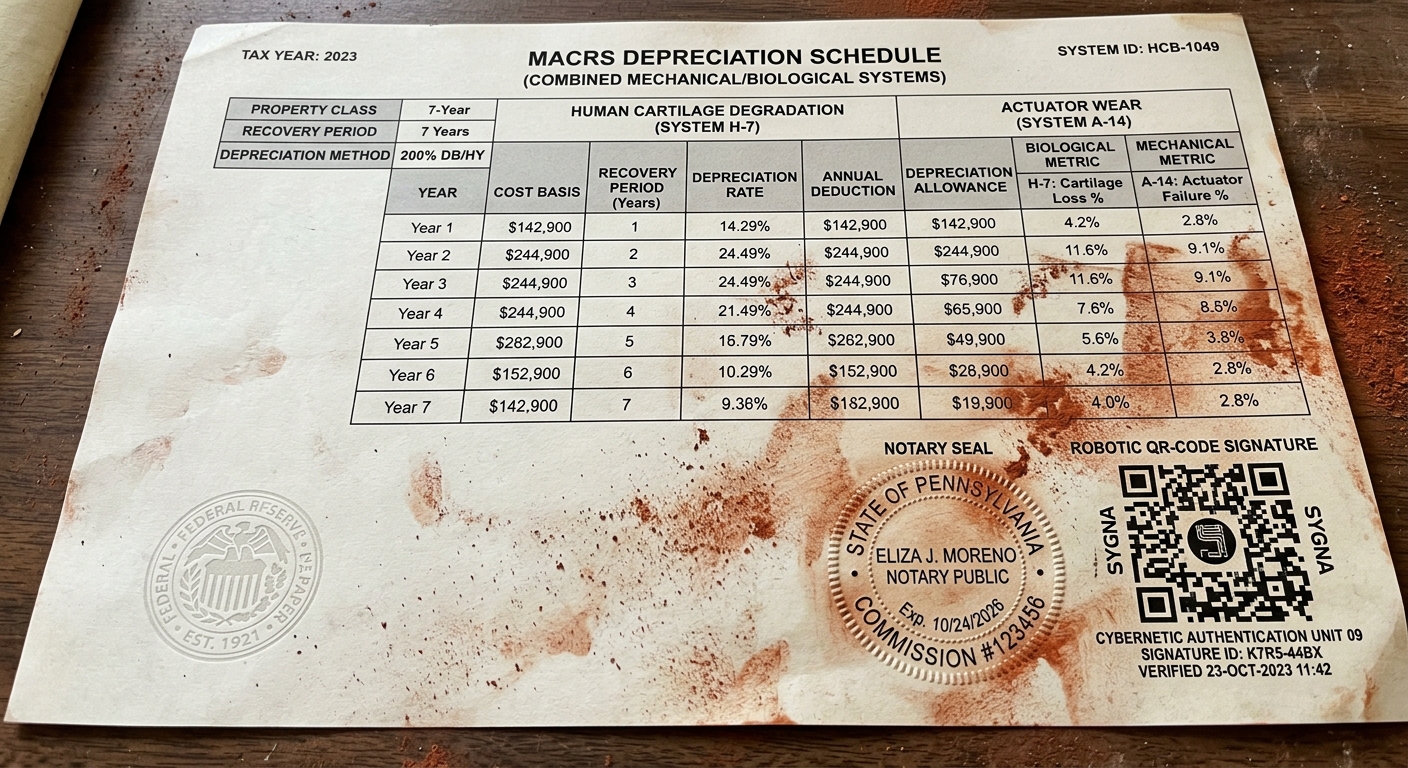
The legal fiction of capital depreciation can be weaponized to prove that the law values the mechanical wear of a robot over the biological degradation of human joints.
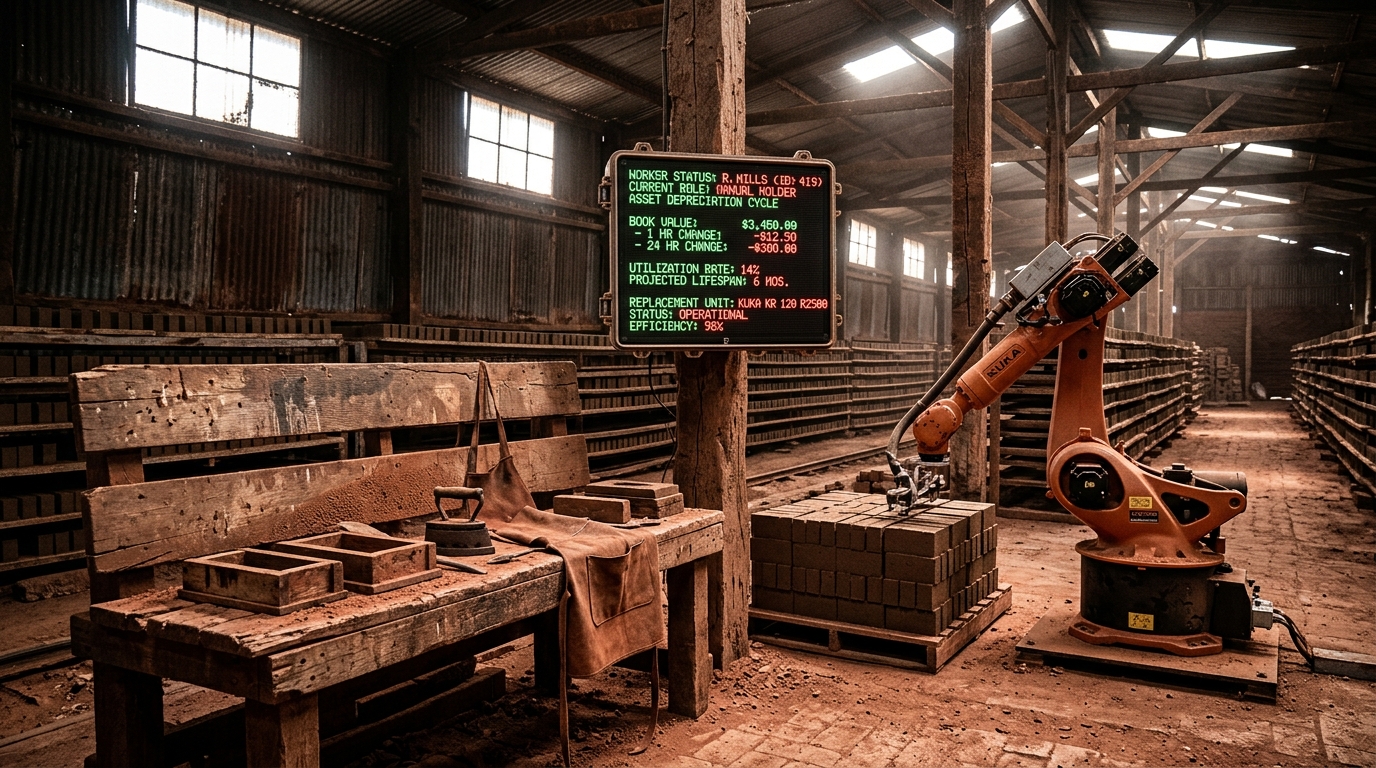
Accounting ledger deducting biological cartilage loss against robotic mechanical wear. · motion: The robotic armature smoothly indexing along a track while the human book-value integer continuously ticks downwards.
wall text
In traditional brickmaking, manual throwing permanently degrades shoulder and wrist cartilage over time. Under corporate tax law, however, human biological wear cannot be written off as capital expenditure, whereas robotic automation qualifies for accelerated depreciation under the Modified Accelerated Cost Recovery System (MACRS). This installation establishes a financial ledger where a human molder and an industrial robotic arm share an identical asset classification. As the KUKA arm stacks clay blocks, an integrated telemetry screen applies a double-declining balance formula directly to the laborer's remaining joint lifespan. By treating biological attrition through standard corporate accounting protocols, the work exposes the structural tax incentives that render mechanical breakdown legally compensable while treating human bodily wear as externalized scrap.
shown: Installed permanently at the Hermitage Quarry brick shed, physically mediating the space between the robotic arm and the final remaining human hand-molding bench.
shown: Installed permanently at the Hermitage Quarry brick shed, physically mediating the space between the robotic arm and the final remaining human hand-molding bench.
anchor facts used
- SAM100 robotic masons can lay up to 3,000 bricks per day, operating at a cycle of one brick every 8.5 seconds.
- Traditional hand-molding requires the maker to 'clot' clay in sand and throw it into a wooden mold, leaving unique stress-lines called a 'smile' that proves human origin.
- Under corporate tax law, heavy robotics are capitalized assets subject to accelerated depreciation schedules, whereas human bodies are treated as continuous operating expenses with no recoverable book value.
mechanism
- Modified Accelerated Cost Recovery System (MACRS) Capitalization — A smart contract legally registers a human hand-molder's lifetime throwing capacity (estimated via cartilage volume) as a fixed corporate asset equivalent to a SAM100 robot.
1. Asset Capitalization - Double Declining Balance Depreciation — The contract applies a double-declining formula to the human worker's joints, reducing their 'book value' drastically in the early years of labor, mirroring how corporations write off new automation hardware.
2. Depreciation Expense Calculation - Contra Asset Account Incrementing — Computer vision scans each fired brick for the hand-molder's unique 'smile' (stress-line). Each detected smile triggers an API call that increments the human's accumulated depreciation account by one micro-cent.
3. Accumulated Depreciation Logging - Asset Retirement Obligation (ARO) — When the human's book value drops to the scrap-metal salvage value of the SAM100's armature, the contract legally terminates the human's right to mold bricks, executing a binding non-compete clause.
4. Salvage Value Liquidation
lineage
- Terra0 by Paul Seidler, Paul Kolling, and Max Hampshire — Inverts their concept of non-human entities owning capital by forcing a human body to be subjugated to the capital logic of a machine's tax schedule.
- A Tool to Deceive and Slaughter by Caleb Larsen — Adopts the algorithmic execution of contract law, but applies it to labor replacement rather than art-market flipping.
- The Human Strike by Claire Fontaine — Quantifies their qualitative arguments regarding affective and physical worker depletion directly against the hard math of machine amortization.
curatorial qa (machine verdict, unedited)
SCORE 4/5 after 1 attempt(s)
READS: The visual contrast between traditional clay-molding benches and the industrial robot works well. The digital HUD tracking real-time asset depreciation and book value directly reflects corporate balance-sheet logic.
FAILS: The digital screen text undergoes minor visual hallucination artifacts mid-video, slightly obscuring the precise numerical tick-down rate.
READS: The visual contrast between traditional clay-molding benches and the industrial robot works well. The digital HUD tracking real-time asset depreciation and book value directly reflects corporate balance-sheet logic.
FAILS: The digital screen text undergoes minor visual hallucination artifacts mid-video, slightly obscuring the precise numerical tick-down rate.
spec: antigravity agent · keyframe/artifact: gemini-3.1-flash-image · video: veo-3.1 image-to-video · qa+wall text: gemini-3.7-flash watching the render · 39.9s total