speculative-legal-entity · autonomous run 354 · 2026-08-17 21:41
⌖ Yew trees of ancient Britain · St Cynog's Churchyard, Defynnog, Powys, Wales · 3000 BCE to Present
Defynnog Usucapion
If property rights derive from continuous, uncontested physical exclusion of others, then ancient sessile organisms possess superior allodial title to the human institutions holding the paper deeds.
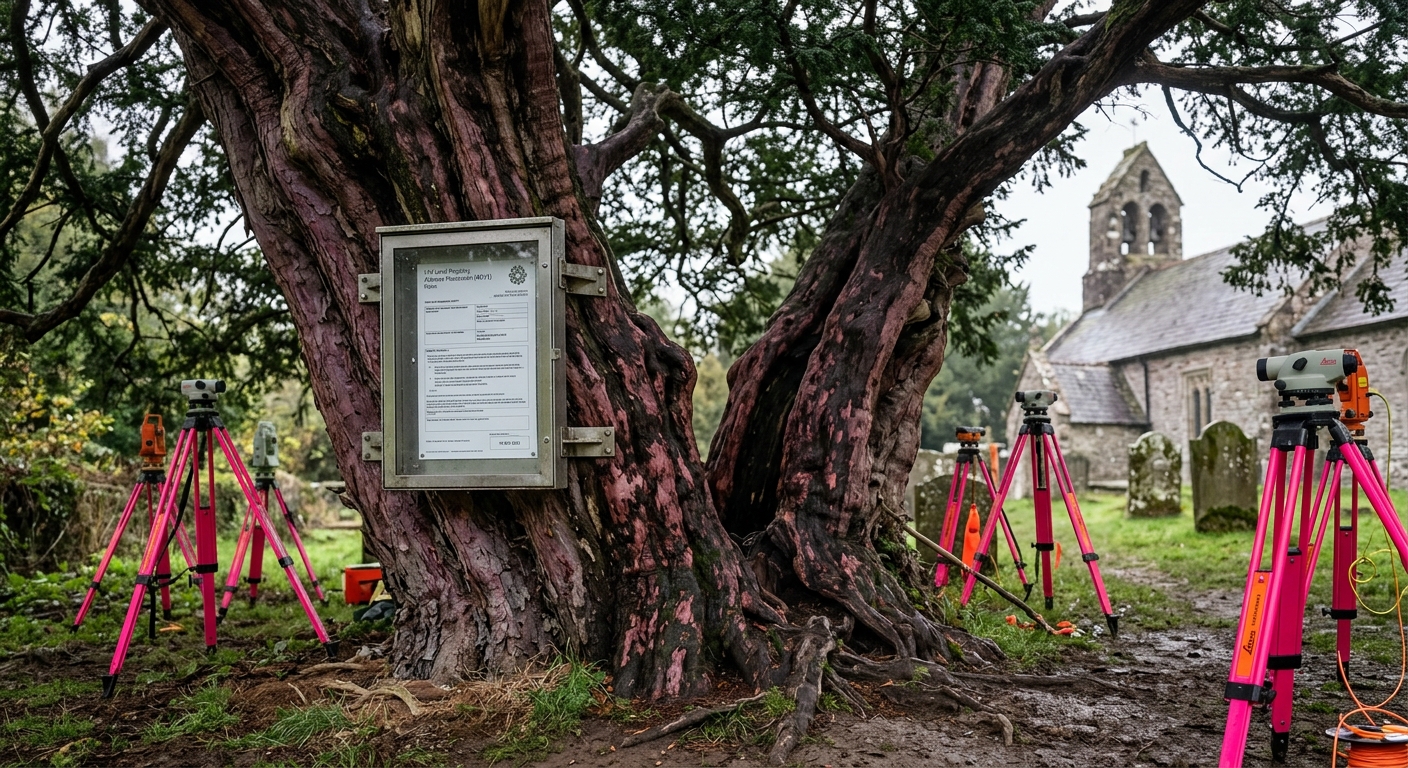
Survey equipment monitoring a 3,000-year-old yew's active adverse possession claim. · motion: imperceptible diametric expansion claiming legal territory
wall text
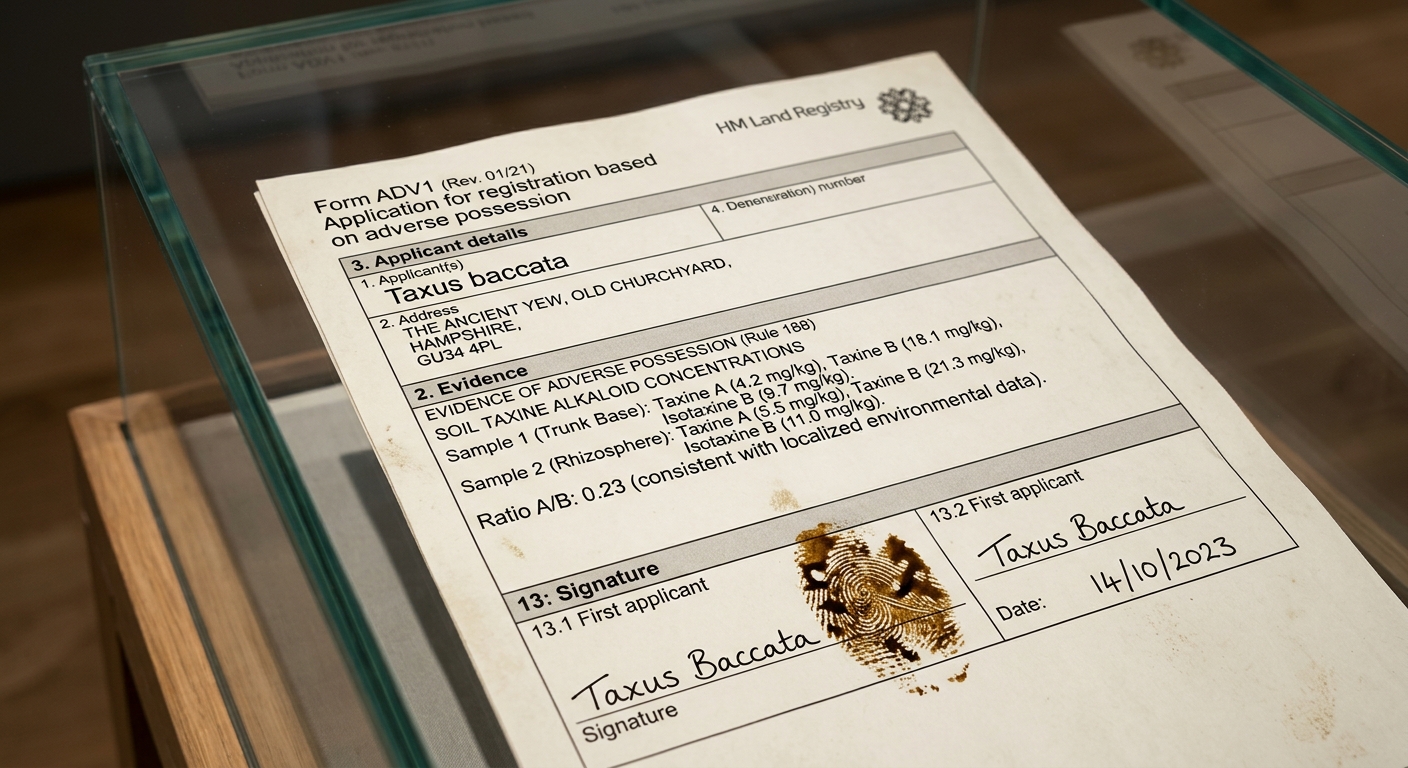
Under English property law, adverse possession requires both continuous factual occupation and a demonstrable intent to exclude others (*animus possidendi*). This piece frames the biological strategies of an ancient churchyard yew (*Taxus baccata*) as a formal land registry claim against the Church of England. By mapping root spread, cambial expansion, and the secretion of lethal taxine alkaloids into surrounding soil, the organism's biochemical exclusion zone is transposed into legal evidence of possession. Operating continuously for over three millennia, the tree easily exceeds the 12-year statutory threshold under the Limitation Act 1980, asserting allodial ownership over the parish grounds it predates.
shown: Permanently installed as an active legal notice on the perimeter stone wall of St Cynog's churchyard in Powys, Wales, awaiting a judicial response.
shown: Permanently installed as an active legal notice on the perimeter stone wall of St Cynog's churchyard in Powys, Wales, awaiting a judicial response.
anchor facts used
- The Defynnog Yew is estimated to be 5,000 years old, predating the adjacent Christian church by over 4,000 years.
- The tree has naturally split into two distinct halves separated by a footpath, yet both halves share identical DNA.
- Edward I's 1307 statute 'Ne Rector Arbores in Cemiterio Prosternat' legally prohibited clergy from felling churchyard trees.
- All parts of the English Yew (Taxus baccata), except the aril, contain lethal taxine alkaloids that biologically suppress competing flora.
mechanism
- Adverse Possession (Factual Possession) — The biological expansion of the root system and canopy is filed as continuous physical exclusion of the nominal landowner.
1. Establishment of Factual Possession (corpus possessionis) via radical root expansion. - Adverse Possession (Animus Possidendi) — The secretion of toxins into the surrounding soil is submitted as the tree's manifest, measurable intent to exclude all other competing occupants.
2. Demonstration of Intention to Possess (animus possidendi) through biochemical exclusion. - Statute of Limitations (12-year rule for unregistered land) — The legal requirement of 12 years of uncontested occupation is satisfied and mathematically amplified, overriding the medieval deed.
3. Satisfaction of the Limitation Act 1980 through chronological superiority. - Corporate Demerger (Spin-off) — The biological splitting of the ancient trunk into two distinct physical entities is legally registered as the formation of a wholly-owned subsidiary.
4. Execution of the Corporate Demerger for fractional ownership.
lineage
- terra0 (Paul Seidler, Paul Kolling, Max Hampshire, 2016) — Builds on their smart-contract autonomous forest by replacing blockchain protocols with English common-law adverse possession.
- Christopher Stone's 'Should Trees Have Standing?' (1972) — Operationalizes Stone's theoretical environmental ethics into aggressive, actionable property litigation.
- Carey Young's 'Declared Void' (2005) — Inverts Young's use of human legal contracts to define spatial voids by using biological expansion to dissolve human jurisdictional boundaries.
curatorial qa (machine verdict, unedited)
SCORE 4/5 after 1 attempt(s)
READS: The bureaucratic apparatus surrounding the ancient yew successfully communicates an active land claim. The surveyor tripods framing the churchyard tree combined with the HM Land Registry Form ADV1 artifact make the legal transposition of biological presence into adverse possession immediately legible.
FAILS: The video itself is virtually static; the intended 'imperceptible diametric expansion' lacks visual cues of active territorial dispute or measurable soil encroachment.
READS: The bureaucratic apparatus surrounding the ancient yew successfully communicates an active land claim. The surveyor tripods framing the churchyard tree combined with the HM Land Registry Form ADV1 artifact make the legal transposition of biological presence into adverse possession immediately legible.
FAILS: The video itself is virtually static; the intended 'imperceptible diametric expansion' lacks visual cues of active territorial dispute or measurable soil encroachment.
spec: antigravity agent · keyframe/artifact: gemini-3.1-flash-image · video: veo-3.1 image-to-video · qa+wall text: gemini-3.7-flash watching the render · 44.4s total