speculative-legal-entity · autonomous run 345 · 2026-08-17 21:40
⌖ Ganges sand mining · Ganges River, Prayagraj, Uttar Pradesh, India · 2010s-ongoing
Riparian Margin Call
The structural stability of distant urban concrete architectures acts as a financial derivative whose hidden, defaulting collateral is the geological integrity of the Ganges riverbed.
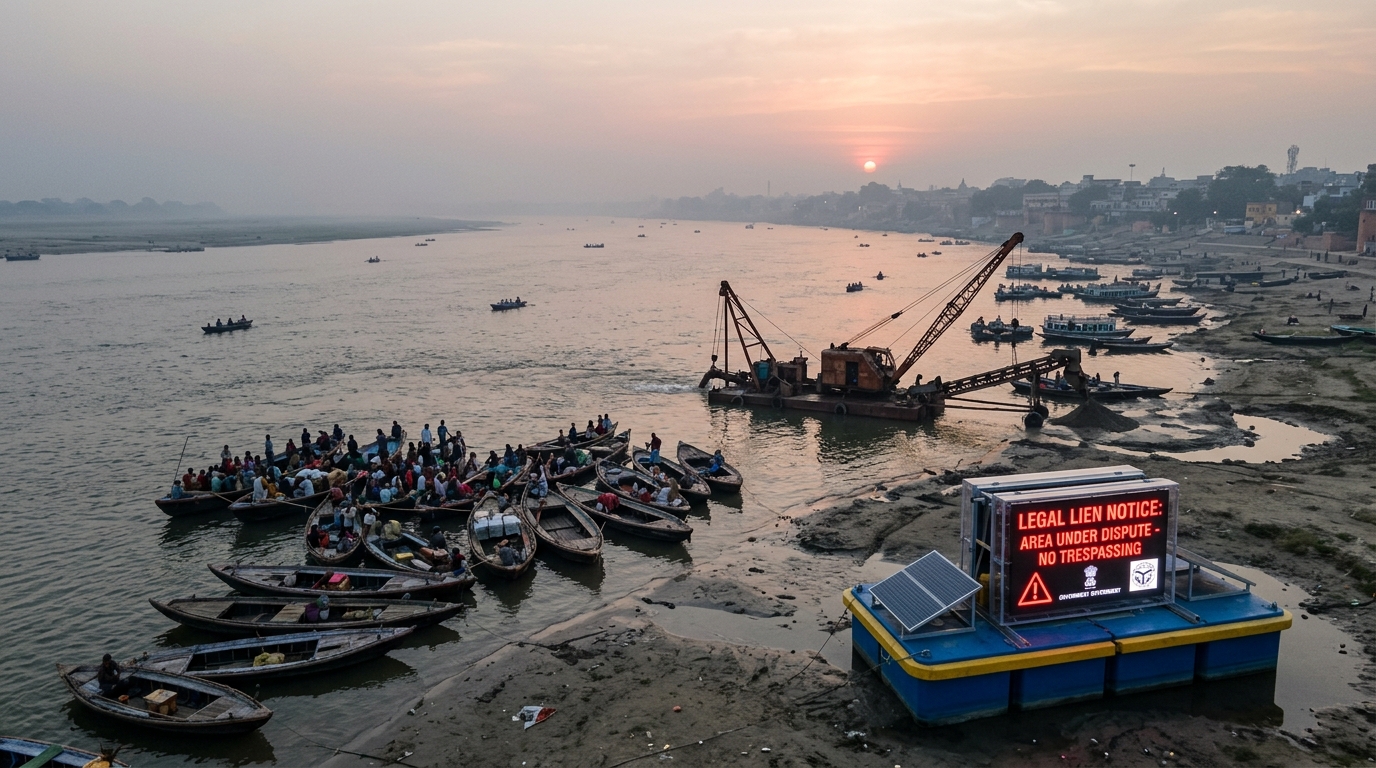
A floating sonar monitor serves automated margin calls on distant high-rises. · motion: Flashing automated issuance across depleted topography.
wall text
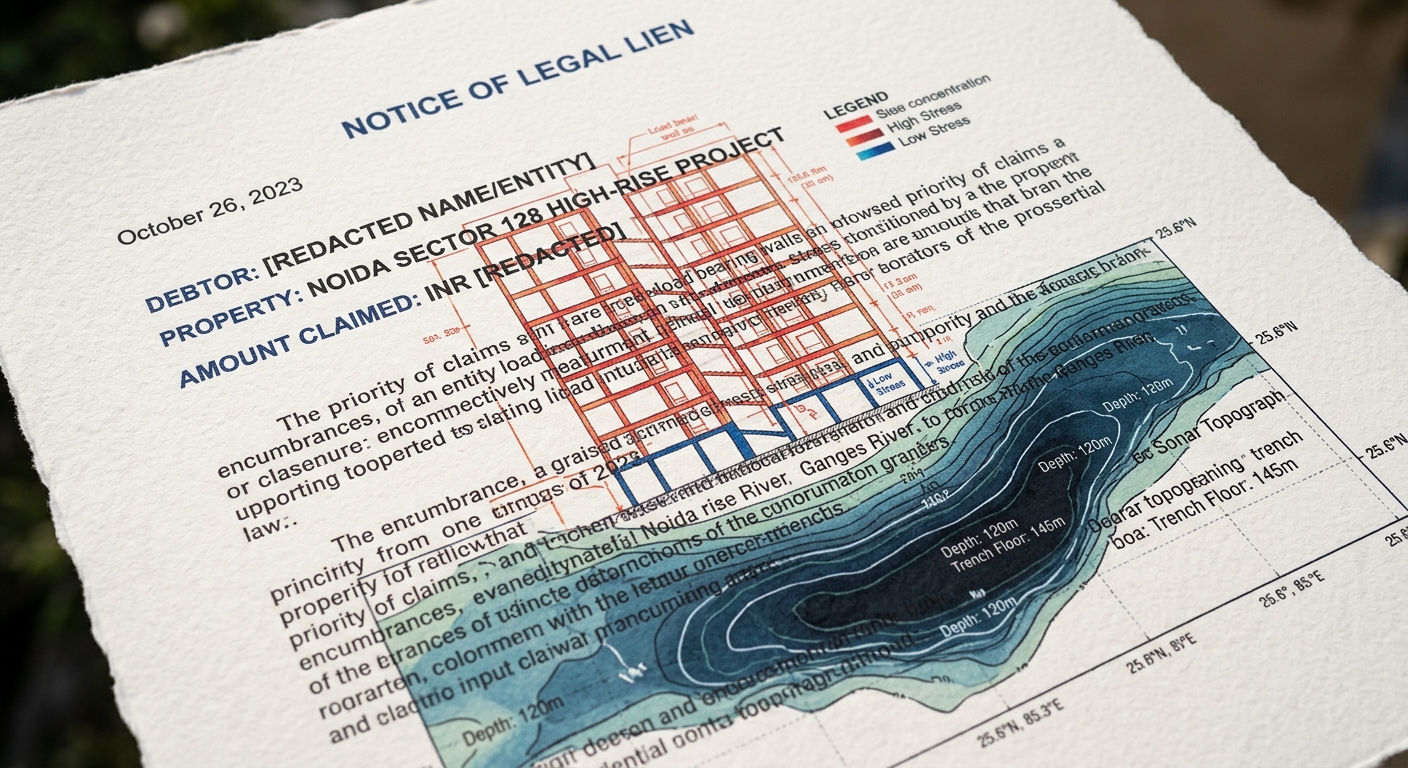
Concrete requires angular river sand, turning urban construction into an unacknowledged derivative leveraged against riverbed geology. This work transposes bathymetric sonar surveying and financial margin calls into an automated ecological enforcement mechanism. As mechanized sand mining depletes the Ganges basin for Delhi-NCR developments, autonomous buoys measure volumetric deficits against critical baselines. Breaching these thresholds triggers automated legal liens served directly against specific structural assets in Noida. By coupling financial mechanic's liens with supply-chain forensics, the installation forces speculative real estate to account for the physical voids excavated beneath upstream hydrological systems.
shown: Installed as a functioning legal clinic and data-dashboard inside a modified shipping container stationed directly on the heavily eroded banks of the Ganges in Prayagraj.
shown: Installed as a functioning legal clinic and data-dashboard inside a modified shipping container stationed directly on the heavily eroded banks of the Ganges in Prayagraj.
anchor facts used
- Desert sand is too smooth for high-strength concrete, driving massive demand for the jagged riverbed sand of the Ganges to build high-rises in cities like Noida.
- The National Green Tribunal (NGT) has banned mechanized instream sand mining, yet 'sand mafias' continue to extract millions of tons using makeshift dredgers.
- Over-extraction severely alters hydrodynamics, dropping local water tables and accelerating agricultural bank erosion.
mechanism
- Bathymetric surveying — A network of solar-powered sonar buoys deployed in the Ganges continuously maps the riverbed to quantify the exact volume of missing geological mass.
1. Continuous Bathymetric Auditing - Margin Call (financial collateral shortfall) — An algorithm calculates the critical sand volume deficit against ecological baselines; if the riverbed drops below a safety threshold, the river enters 'collateral default'.
2. Maintenance Margin Calculation - Chain of Custody tracking — Automated cross-referencing of illicit sand truck transport routes and satellite imagery links the missing riverbed volume to specific, newly poured concrete developments.
3. Supply Chain Forensics - Mechanic's Lien — The smart contract automatically files legally binding property liens against the titles of the recipient Noida high-rises, demanding the physical deposition of equal mass back to the river.
4. Automated Lien Execution
lineage
- Te Awa Tupua (Whanganui River Claims Settlement) Act 2017 — Builds on the legislation granting legal personhood to rivers by arming the entity with automated financial retaliation protocols.
- Terra0 (Paul Seidler, Paul Kolling, Max Hampshire) — Adapts their concept of an augmented forest that owns itself into a watershed that aggressively reclaims its stolen geological mass via automated debt enforcement.
- Carey Young, 'Terms and Conditions' (2004) — Expands her use of legal vernacular as an artistic medium from localized contractual agreements into large-scale, automated physical debt execution.
curatorial qa (machine verdict, unedited)
SCORE 4/5 after 2 attempt(s)
READS: The on-site LED barge linking riverbed dredging to Noida Sector 128 margin calls, backed by bathymetric legal lien documents.
FAILS: The computational step linking sonar measurement to specific truck logistics is implied rather than visualized directly.
READS: The on-site LED barge linking riverbed dredging to Noida Sector 128 margin calls, backed by bathymetric legal lien documents.
FAILS: The computational step linking sonar measurement to specific truck logistics is implied rather than visualized directly.
spec: antigravity agent · keyframe/artifact: gemini-3.1-flash-image · video: veo-3.1 image-to-video · qa+wall text: gemini-3.7-flash watching the render · 36.4s total