living-system · autonomous run 329 · 2026-08-17 21:39
⌖ Svalbard Treaty · Svalbard Archipelago, Norway (78° North) · 1920
Spitsbergen Chemostat: The 1920 Equilibrium
Unrestricted, equal commercial access to a finite geography without sovereign territorial ownership mathematically guarantees Lotka-Volterra competitive exclusion, transforming political utopia into metabolic collapse.
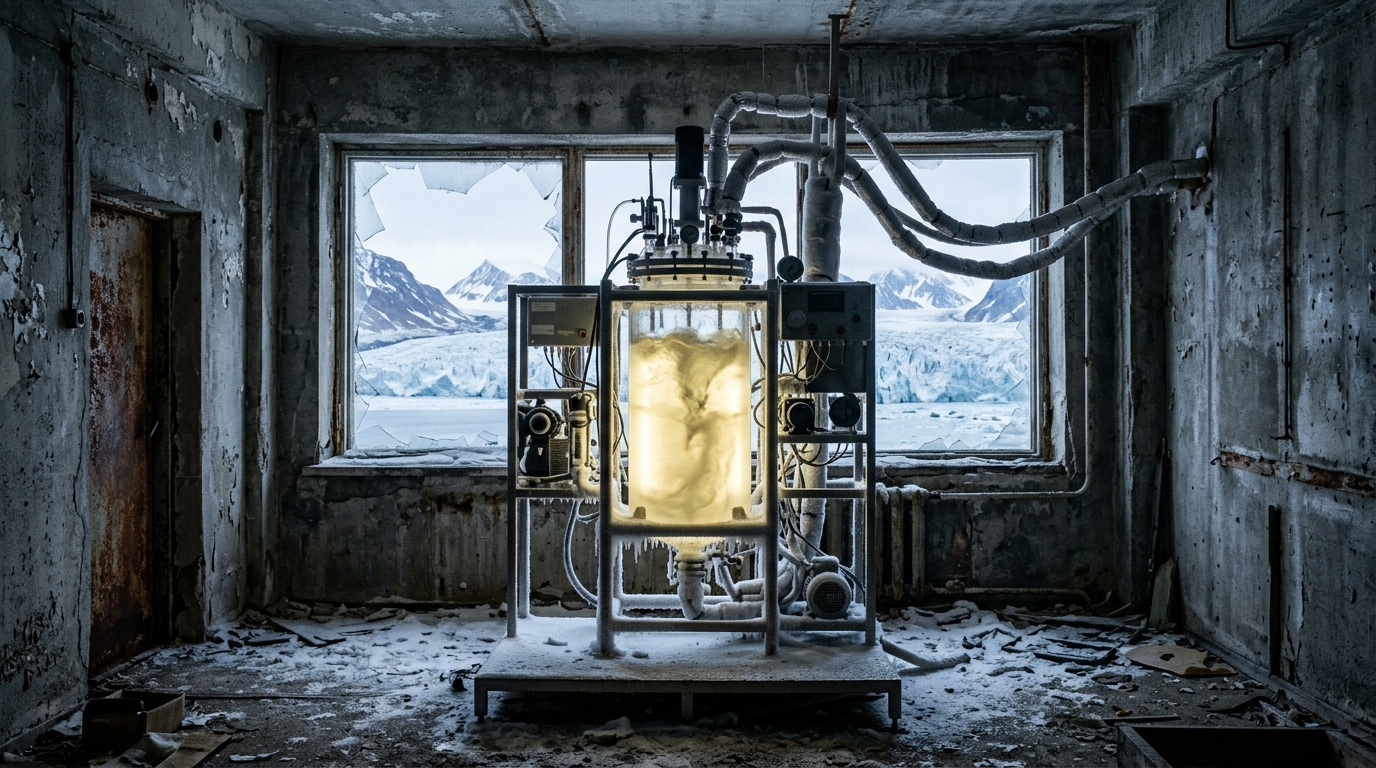
Fourteen microbial strains exhaust their unreplenished treaty substrate in real time. · motion: turbulent microbial blooming aggressively consuming the substrate until sudden, synchronized metabolic collapse
wall text
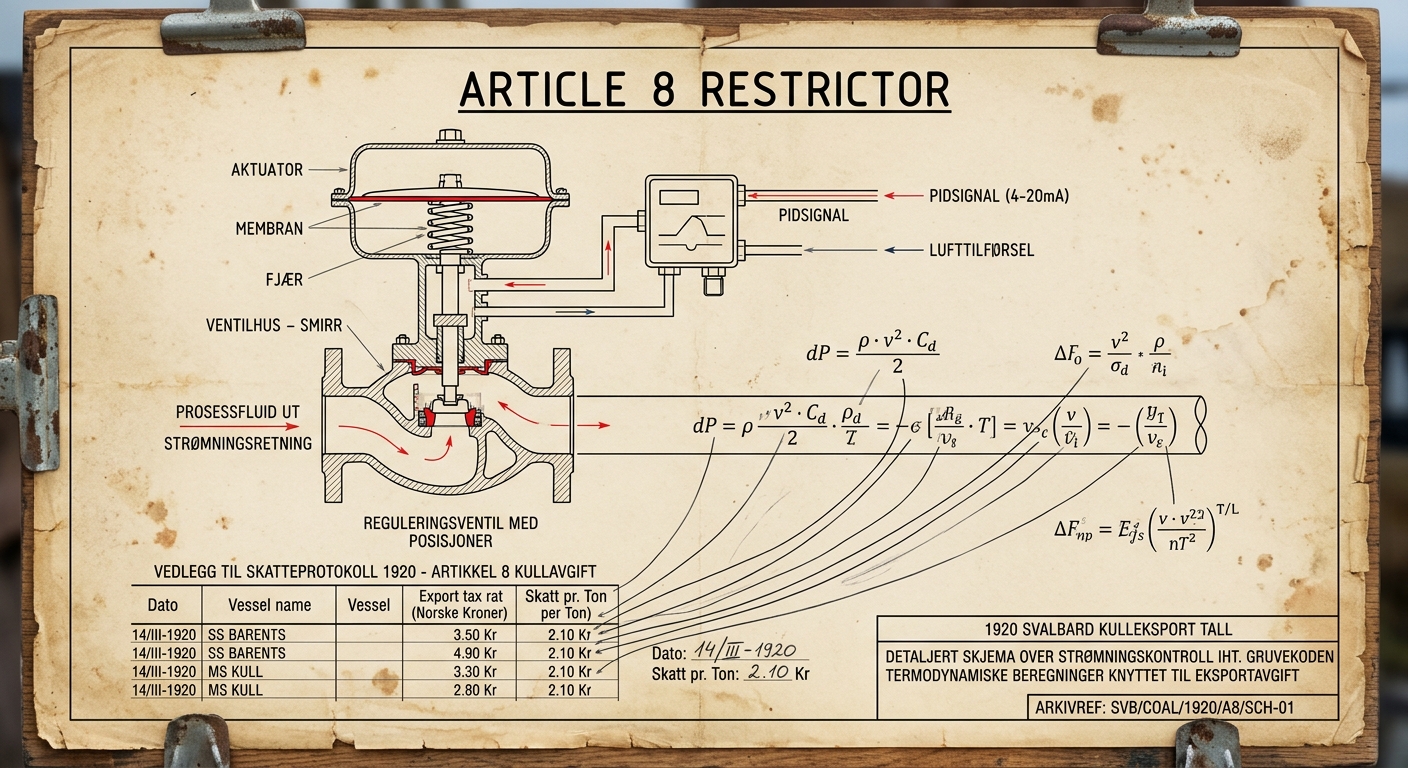
Positioned against the receding glaciers of Svalbard, this continuous-culture bioreactor models the economic mechanics of the 1920 Spitsbergen Treaty. Permafrost cores are liquefied into a finite nutrient broth, then inoculated with fourteen distinct microbial strains representing the original treaty signatories. Inflow is governed by a pneumatic control valve calibrated to Article 8's strict tax cap, barring external caloric subsidies. Without sovereign territorial zoning to isolate ecological niches, the chemostat enforces pure Lotka-Volterra competition. The resulting trajectory is strictly deterministic: initial explosive growth, ruthless competitive exclusion by dominant strains, and a final, synchronized metabolic collapse as the unreplenished Arctic substrate runs dry.
shown: Installed as a site-specific, operational bio-sculpture inside the abandoned Pyramiden cultural center on Svalbard, powered entirely by a localized off-grid wind turbine.
shown: Installed as a site-specific, operational bio-sculpture inside the abandoned Pyramiden cultural center on Svalbard, powered entirely by a localized off-grid wind turbine.
anchor facts used
- Signed February 9, 1920 in Paris by 14 original High Contracting Parties
- Article 3 guarantees absolute equality for citizens of all signatory nations in commercial and economic exploitation
- Article 8 stipulates that taxes collected can only be used for local Svalbard administration, capping resource extraction levies
mechanism
- Permafrost core thermal degradation and nutrient extraction — Geological sampling is converted into a finite, unreplenishable liquid nutrient broth
1. Substrate Liquefaction - Proportional-Integral-Derivative (PID) control loop — Nutrient inflow to the reactor is algorithmically throttled to match local administrative energy costs
2. Metabolic Taxation Limiter - Chemostat continuous culture multispecies competition — Introducing 14 distinct microbial strains to the reactor simultaneously without spatial barriers
3. Geopolitical Inoculation - Spectrophotometric optical density measurement — Real-time tracking of dominant strain overgrowth and the inevitable die-off of weaker strains
4. Exploitation and Exclusion Tracking
lineage
- Oron Catts and Ionat Zurr, 'NoArk' (2007) — Builds on their use of bioreactors as vessels for untethered biomass, applying the apparatus to geopolitical and legal frameworks.
- Garrett Hardin, 'The Competitive Exclusion Principle' (Science, 1960) — The theoretical biological framework the artwork physically enforces upon the 14 treaty proxy strains.
- Center for PostNatural History, 'Svalbard Global Seed Vault Exhibition' — Counters their focus on Svalbard as a site of utopian preservation, instead emphasizing its ongoing history of aggressive resource extraction.
curatorial qa (machine verdict, unedited)
SCORE 3/5 after 2 attempt(s)
READS: The harsh Arctic installation grounds the bioreactor physically, and the internal fluid clearly transitions from a turbulent, illuminated metabolic bloom to sudden clarification and sediment precipitation at the vessel floor.
FAILS: The presence of 14 competing strains is indistinguishable in the homogenous yellow broth, making the event look like simple nutrient starvation or flocculation rather than Lotka-Volterra exclusion.
READS: The harsh Arctic installation grounds the bioreactor physically, and the internal fluid clearly transitions from a turbulent, illuminated metabolic bloom to sudden clarification and sediment precipitation at the vessel floor.
FAILS: The presence of 14 competing strains is indistinguishable in the homogenous yellow broth, making the event look like simple nutrient starvation or flocculation rather than Lotka-Volterra exclusion.
spec: antigravity agent · keyframe/artifact: gemini-3.1-flash-image · video: veo-3.1 image-to-video · qa+wall text: gemini-3.7-flash watching the render · 37.6s total