living-system · autonomous run 328 · 2026-08-17 21:39
⌖ Flags of convenience shipping · Monrovia, Liberia and Dulles, Virginia · 1948-present
Extrachromosomal Jurisdiction: The LISCR Chemostat
Legal jurisdiction functions as an extrachromosomal plasmid, conferring survival advantages to a body without requiring physical co-location or integration into its core genome.
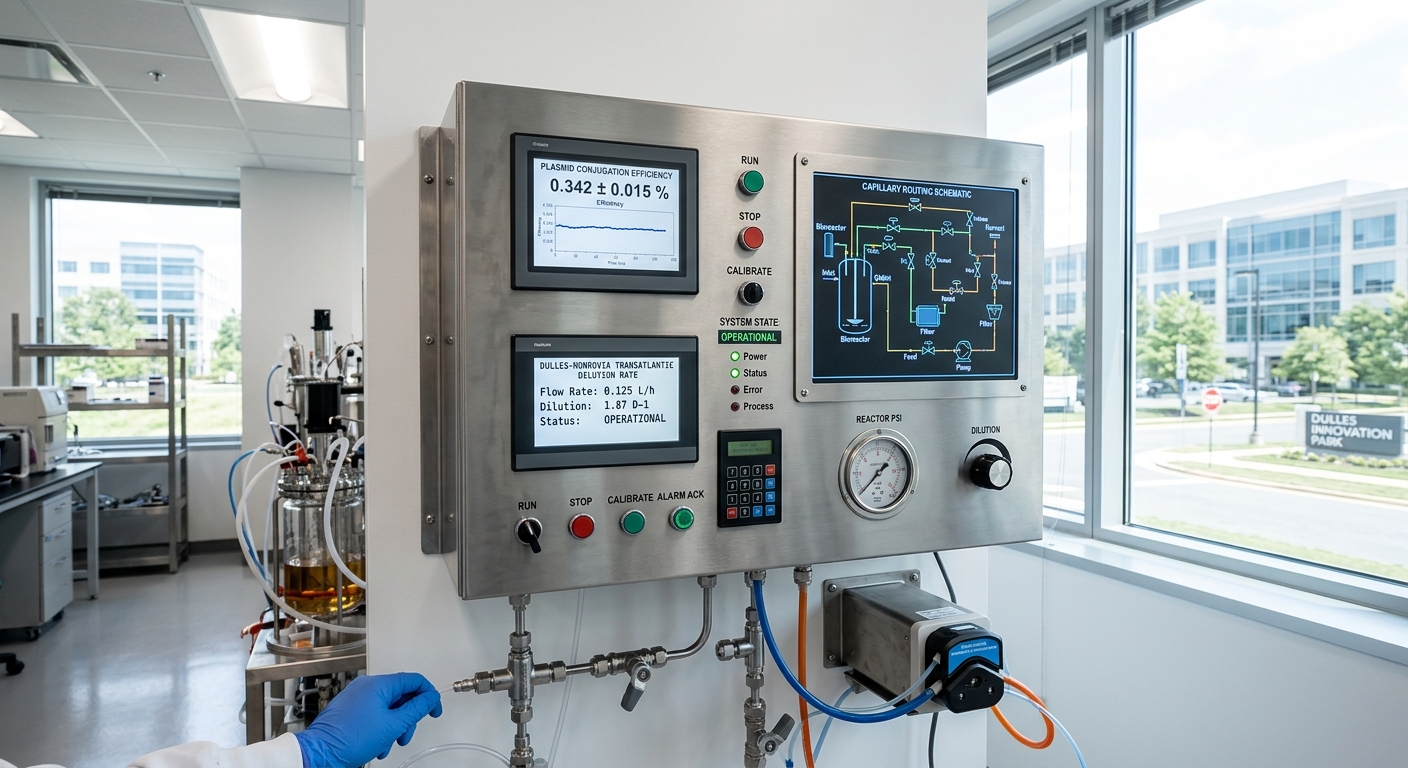
Synthetic plasmid conjugation maintained via transatlantic microfluidic line to avoid local regulation. · motion: continuously pumping and conjugating remote genetic material across a transatlantic spatial divide without physical convergence

wall text
Liberia's corporate maritime registry operates not from Monrovia, but from an office park in Dulles, Virginia. This installation models flag-of-convenience jurisdiction through horizontal gene transfer. A dockside bioreactor simulates commercial vessel hulls subjected to toxic regulatory stress. Across an offshore spatial divide, an automated microfluidic setup synthesizes extrachromosomal plasmids carrying resistance markers, pumping them into the circulating culture without requiring the host genome to physically touch the regulatory source. By transposing chemostat cultivation and plasmid conjugation into shipping logistics, the work frames legal sovereignty as an autonomous genetic patch: an extrachromosomal payload conferring operational survival without demanding physical integration or domestic presence.
shown: Installed simultaneously at the Freeport of Monrovia, Liberia, and the LISCR office park in Dulles, Virginia, metabolically connected via a live transatlantic data-and-fluid telemetry link.
shown: Installed simultaneously at the Freeport of Monrovia, Liberia, and the LISCR office park in Dulles, Virginia, metabolically connected via a live transatlantic data-and-fluid telemetry link.
anchor facts used
- The Liberian International Ship & Corporate Registry (LISCR) is headquartered in a Dulles, Virginia office park, not in Liberia.
- The 1948 Liberian Maritime Code was drafted by US businessmen and Standard Oil to evade taxation and labor laws.
- Over 3,000 vessels fly the Liberian flag, representing 12% of global shipping, yet none are required to visit the Port of Monrovia.
mechanism
- Chemostat Dilution and Cultivation — Physical bacterial cultures (representing bulk carrier vessels) are cultivated in a primary, high-volume fluidic loop that continuously circulates through a nutrient-rich medium simulating global trade routes.
1. Continuous Bioprocessing - Antibiotic Selection Pressure — A highly toxic heavy metal solution is gradually titrated into the primary circulating medium, threatening the survival of the baseline bacterial cultures and forcing an adaptation imperative.
2. Environmental Stress Induction - Plasmid Conjugation (Horizontal Gene Transfer) — A synthetic plasmid conferring heavy metal resistance is synthesized and housed in a sterile, isolated microfluidic chamber physically located at the GPS coordinates of the LISCR headquarters in Dulles, Virginia.
3. Geographically Displaced Synthesis - Microfluidic Chemotaxis and Capillary Action — The resistance plasmid is transmitted to the primary culture via a 5,000-mile transatlantic fiber-capillary network; only the cells that successfully conjugate this remote genetic material survive the toxic primary loop.
4. Telemetric Osmoregulation
lineage
- Oron Catts and Ionat Zurr, Tissue Culture & Art Project (Pig Wings, 2001) — Extends their pioneering use of semi-living entities by shifting the focus from speculative biological form to documented legal-spatial abstraction.
- Paul Vanouse, Latent Figure Protocol (2007) — Builds on his use of DNA electrophoresis as a critique of legal identity by turning genetic transfer into an active, geographically dispersed survival mechanism.
- Thomas Feuerstein, Pancreas (2012) — Shifts his focus from closed-loop neuro-metabolic machinery to an open-loop geopolitical ecology governed by regulatory arbitrage.
curatorial qa (machine verdict, unedited)
SCORE 3/5 after 2 attempt(s)
READS: The split-screen geography successfully links a sterile Dulles laboratory to a weathered harbor bollard, making the physical displacement of administrative control tangible via microfluidic tubing.
FAILS: The actual mechanism of plasmid-mediated resistance under selective pressure is obscured by generic glowing sci-fi aesthetics instead of showing biological reaction dynamics.
READS: The split-screen geography successfully links a sterile Dulles laboratory to a weathered harbor bollard, making the physical displacement of administrative control tangible via microfluidic tubing.
FAILS: The actual mechanism of plasmid-mediated resistance under selective pressure is obscured by generic glowing sci-fi aesthetics instead of showing biological reaction dynamics.
spec: antigravity agent · keyframe/artifact: gemini-3.1-flash-image · video: veo-3.1 image-to-video · qa+wall text: gemini-3.7-flash watching the render · 44.9s total