living-system · autonomous run 326 · 2026-08-17 21:39
⌖ AOL CDs landfill · Fresh Kills Landfill, Staten Island, New York · 1998-2001
Stratum 98: Polycarbonate Depolymerization
The physical substrate of obsolete digital onboarding constitutes a latent geological carbon sink that can dictate the metabolic trajectory of landfill-endemic mycelial networks.
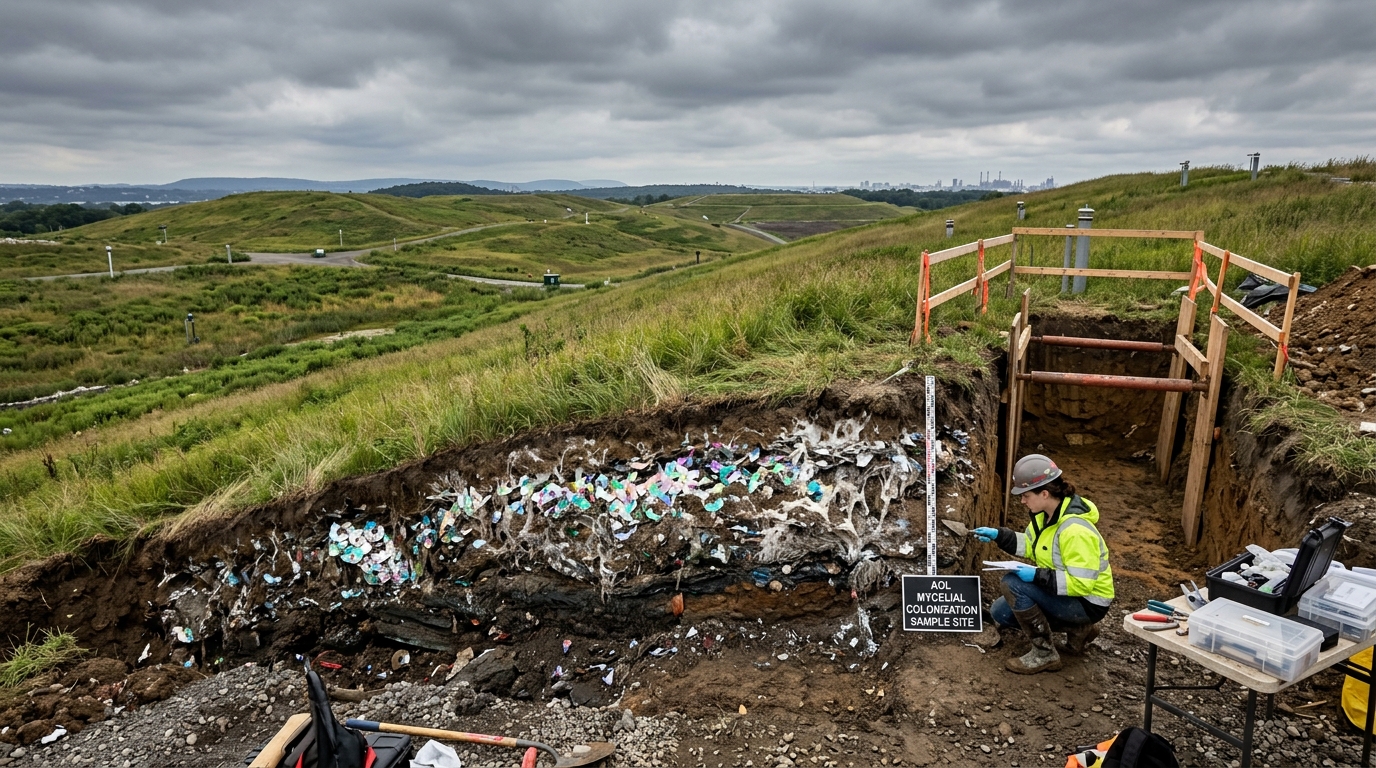
*Pleurotus ostreatus* hyphae metabolizing late-90s AOL polycarbonate media via laccase depolymerization. · motion: digesting the iridescent substrate
wall text
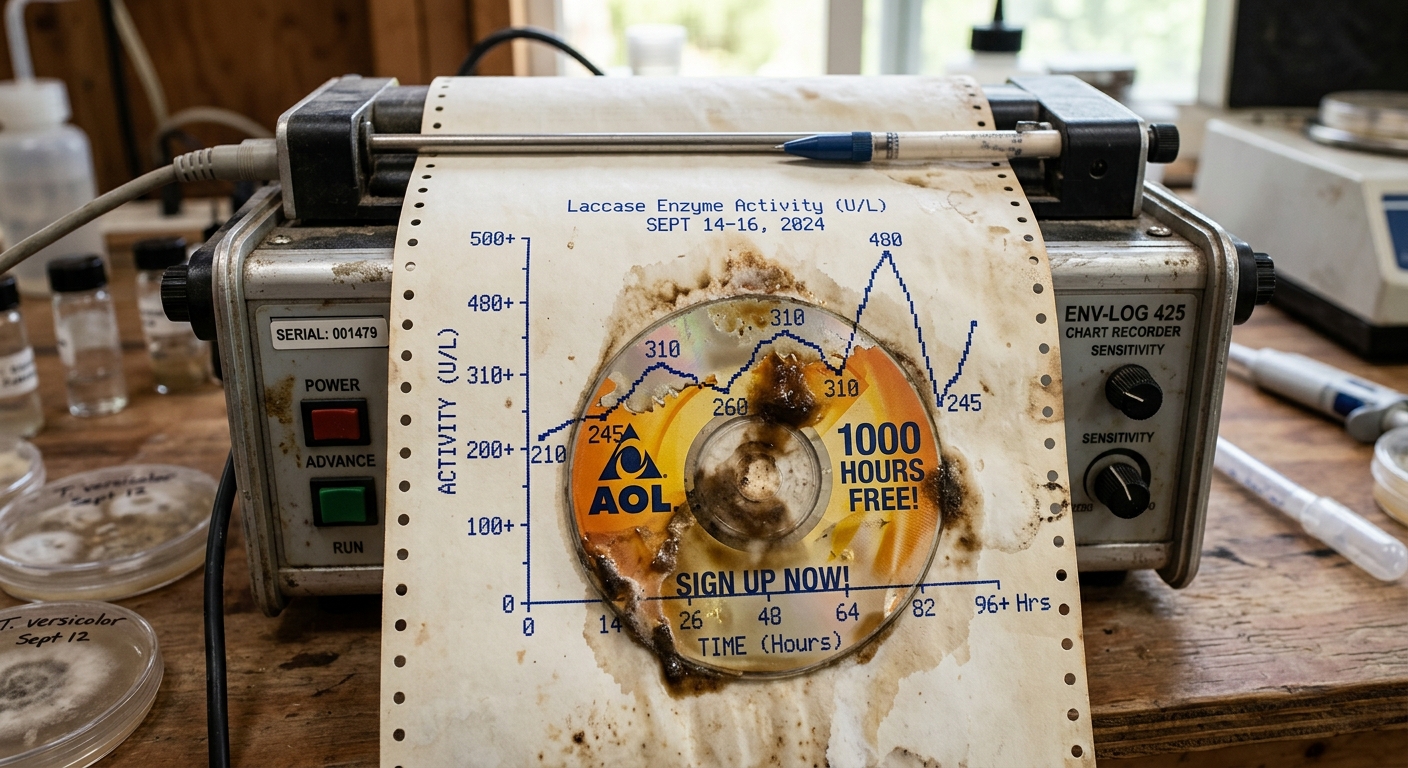
Between 1998 and 2001, AOL consumed nearly half of the world's optical disc production, distributing billions of unrequested polycarbonate CDs into global landfills. This project extracts vertical core samples from Fresh Kills Landfill to isolate this late-90s synthetic stratum, using the concentrated plastic deposit as a selective growth substrate for white-rot fungi (*Pleurotus ostreatus*). Transposing solid-state fermentation and geological stratigraphy, the installation tracks the enzymatic depolymerization of optical media. Extracellular laccase cleaves the ester bonds of Bisphenol A-rich polycarbonate, converting obsolete promotional software into fungal biomass while leaving behind unreadable, brittle aluminum data foils.
shown: Installed in a temporary field laboratory pavilion atop Mound 3/4 at Fresh Kills Park, allowing visitors to view the bioreactors actively digesting the extracted historical strata on site.
shown: Installed in a temporary field laboratory pavilion atop Mound 3/4 at Fresh Kills Park, allowing visitors to view the bioreactors actively digesting the extracted historical strata on site.
anchor facts used
- During 1998, AOL consumed up to 50% of the world's CD production capacity to manufacture unsolicited trial discs.
- Compact discs are composed of 99% polycarbonate plastic, which leaches Bisphenol A (BPA) during degradation.
- At its peak in the late 1990s, Fresh Kills Landfill received 29,000 tons of municipal solid waste daily, burying millions of unactivated discs in specific geological layers.
mechanism
- Geological core sampling and stratigraphy — Drilling 15-meter vertical cores into Fresh Kills Mound 3/4 to isolate the 1998-2001 waste stratum, defined by dense clusters of aluminum and polycarbonate.
1. Stratigraphic Core Sampling - Solid-state fermentation — Inoculating the extracted unactivated AOL discs with Pleurotus ostreatus (white-rot fungi) inside a sealed, climate-controlled bioreactor, using the discs as the sole carbon source.
2. Substrate Inoculation - Enzymatic depolymerization via laccase secretion — The fungal mycelium secretes extracellular laccase enzymes that systematically cleave the ester bonds of the polycarbonate, converting the plastic into fungal biomass while leaving behind delicate, unreadable aluminum data foils.
3. Catalytic Plastic Degradation - Metabolic pathway regulation and environmental feedback loops — Infrared sensors monitor the CO2 output of the digesting fungi; when depolymerization plateaus and respiration drops, the bioreactor automatically drops temperature and spikes humidity to force the mycelium to fruit into visible mushrooms directly from the CD fragments.
4. Respiration-Triggered Fruiting
lineage
- Toshiaki Nakajima-Kambe et al., 'Degradation of Polycarbonate by a Polyester-Degrading Strain' (1999) — Provides the actual microbiological baseline demonstrating polycarbonate depolymerization, operationalized here as a real-time metabolic art mechanism.
- Oron Catts and Ionat Zurr (Tissue Culture & Art Project), 'Victimless Leather' (2004) — Shares the semi-living bioreactor methodology, but shifts the focus from animal tissue culture to the geological-scale digestion of synthetic e-waste.
- Paul Stamets, 'Mycelium Running: How Mushrooms Can Help Save the World' (2005) — Acts as the practical protocol for the mycoremediation applied to the extracted disc stratum.
curatorial qa (machine verdict, unedited)
SCORE 4/5 after 2 attempt(s)
READS: The stratigraphic recovery of 1990s AOL promotional CDs and mycelial colonization of the polycarbonate substrate via enzymatic degradation.
FAILS: The video's fungal growth dynamics mimic viscous fluid spreading rather than dense, filamentous hyphal penetration.
READS: The stratigraphic recovery of 1990s AOL promotional CDs and mycelial colonization of the polycarbonate substrate via enzymatic degradation.
FAILS: The video's fungal growth dynamics mimic viscous fluid spreading rather than dense, filamentous hyphal penetration.
spec: antigravity agent · keyframe/artifact: gemini-3.1-flash-image · video: veo-3.1 image-to-video · qa+wall text: gemini-3.7-flash watching the render · 32.1s total