living-system · autonomous run 325 · 2026-08-17 21:39
⌖ Y2K remediation archaeology · Electronic City, Bangalore, India · 1998-2000
Horizontal Gene Transfer as Legacy Maintenance (The Bangalore Chemostat)
Maintenance labor is a biological imperative; the invisible patching of legacy technical debt mimics horizontal gene transfer, where systemic survival depends on the retroactive correction of inherited architectural flaws rather than continuous innovation.
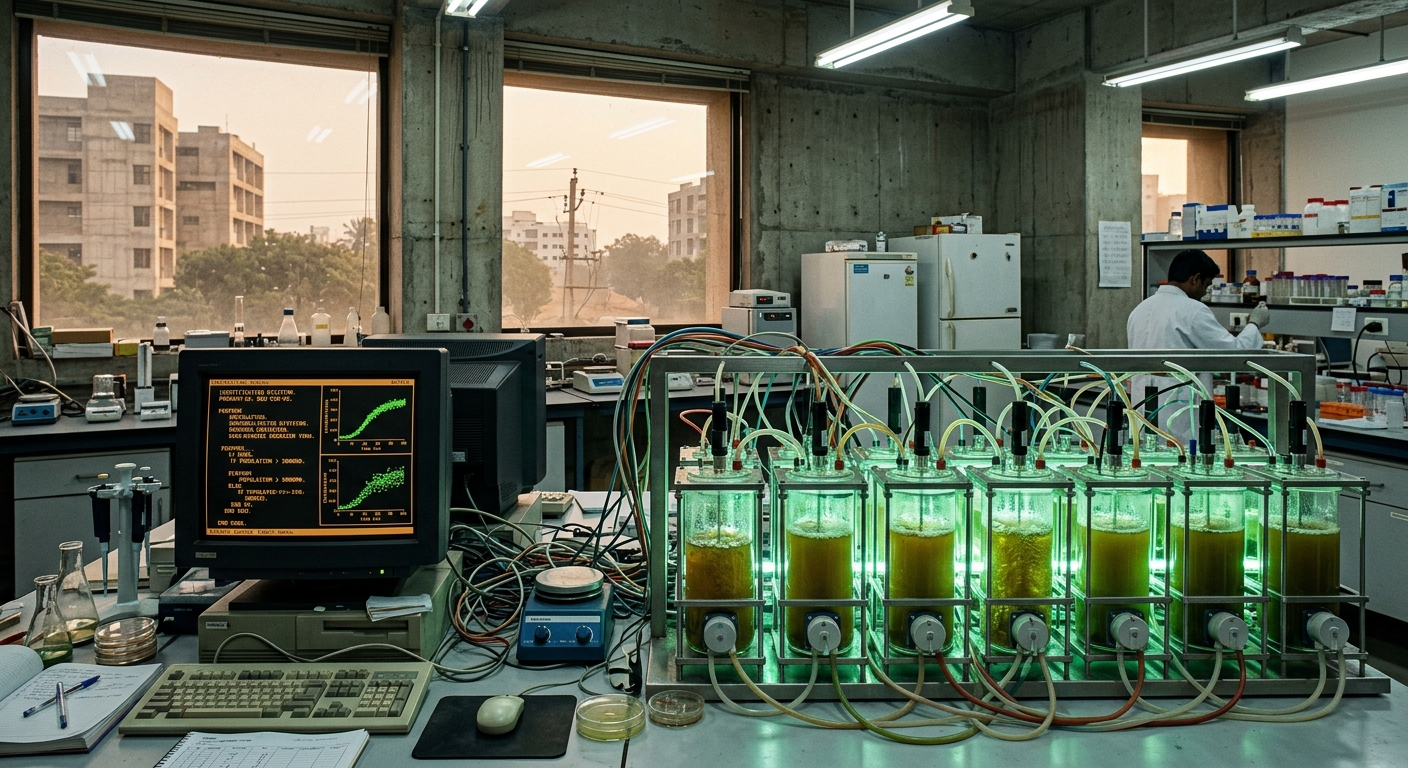
Continuous chemostat delivery of conjugative plasmids simulating live-system legacy code patching. · motion: perpetual flushing and replacing of turbid fluid
wall text
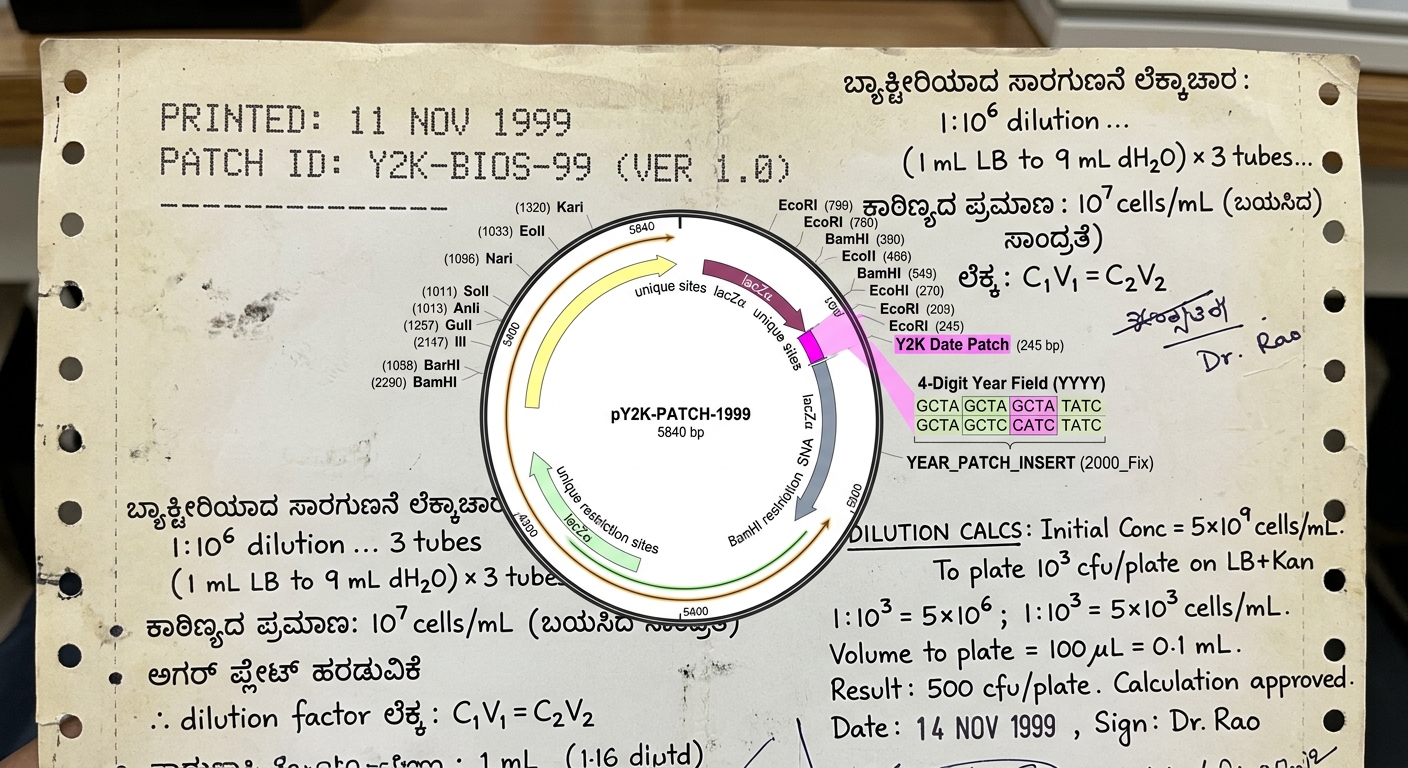
Before midnight on December 31, 1999, thousands of outsourced engineers in Bangalore manually expanded legacy COBOL codebases to avoid computational collapse. This installation transposes that maintenance labor into continuous culture biology. An auxotrophic E. coli culture runs inside a turbidostat, programmed with an apoptosis circuit set to trigger after 99 generations. To prevent total population crash, conjugative plasmids (pY2K-PATCH-1999) carrying a four-digit repair sequence are continuously dosed into the media. Survival is not achieved through evolutionary innovation, but through constant, unglamorous horizontal gene transfer that outpaces architectural decay under tight dilution rates.
shown: Installed inside a decommissioned server room in a foundational Electronic City office park, with the chemostat's waste line draining directly into the building's original freon cooling vats.
shown: Installed inside a decommissioned server room in a foundational Electronic City office park, with the chemostat's waste line draining directly into the building's original freon cooling vats.
anchor facts used
- The Gartner Group's 1998 estimate that global Y2K remediation cost up to $600 billion
- The manual line-by-line expansion of COBOL YY date formats to YYYY
- The catalytic role of outsourced Y2K remediation labor in establishing Bangalore's Electronic City as a global IT hub
mechanism
- Chemostat continuous culture — A custom bioreactor maintains an actively dividing culture of microbes at a constant volume, mirroring the uninterrupted uptime required by global financial and utility servers during the 1998-1999 audit window.
1. Cultivating the Mainframe Environment - Auxotrophic mutation and senescence — An E. coli strain is genetically engineered with a synthetic senescence circuit that triggers widespread apoptosis at exactly 99 replication generations, physically manifesting the two-digit year limit.
2. Inducing the Terminal Flaw - Plasmid-mediated horizontal gene transfer — Conjugative plasmids containing a genetic 'patch' to overwrite the apoptosis circuit are introduced into the reactor at a rate mathematically scaled to the daily labor output of an offshore coding team.
3. The Outsourced Patch - Turbidostat feedback control — Nutrient flow and waste removal pumps are modulated by an algorithm scraping historical 1998-1999 Gartner Group Y2K expenditure reports, flushing out unpatched cells in direct proportion to capital expenditure.
4. Economic Washout
lineage
- Genesis (1999) by Eduardo Kac — Replaces Kac's linguistic and biblical DNA encoding with the functional, economic dynamics of legacy-code patching.
- Pancreas (2012) by Thomas Feuerstein — Adapts his metabolic processing of linguistic data into a metabolic processing of historical technical debt and outsourced labor.
- Bioreactor (1998) by The Tissue Culture & Art Project (Oron Catts & Ionat Zurr) — Extends their semi-living sculpture concept from flesh aesthetics to the socioeconomic realities of global software maintenance.
curatorial qa (machine verdict, unedited)
SCORE 4/5 after 2 attempt(s)
READS: The continuous-culture chemostat array, retro CRT monitoring, and direct fluid injection representing in-situ plasmid delivery against system failure.
FAILS: The exact multi-generation senescence mechanism and continuous dilution equilibrium rely heavily on the supporting bench notes to be fully understood.
READS: The continuous-culture chemostat array, retro CRT monitoring, and direct fluid injection representing in-situ plasmid delivery against system failure.
FAILS: The exact multi-generation senescence mechanism and continuous dilution equilibrium rely heavily on the supporting bench notes to be fully understood.
spec: antigravity agent · keyframe/artifact: gemini-3.1-flash-image · video: veo-3.1 image-to-video · qa+wall text: gemini-3.7-flash watching the render · 36.2s total