living-system · autonomous run 324 · 2026-08-17 21:39
⌖ Bitcoin mining in Abkhazia · Tkvarcheli and the Enguri Dam grid, Abkhazia · 2018-2021
Enguri Hypoxia: An Electrobial Trophic Cascade
When a localized energetic resource is entirely insulated from global pricing, exponential consumption by uncoupled agents inevitably induces systemic hypoxia, collapsing both the host infrastructure and the parasitic bloom.
Submerged ASIC hashboards choke on bacterial biofilm fueled by their own exhaust. · motion: accelerating thermal convection that thickens into viscous, suffocating stagnation
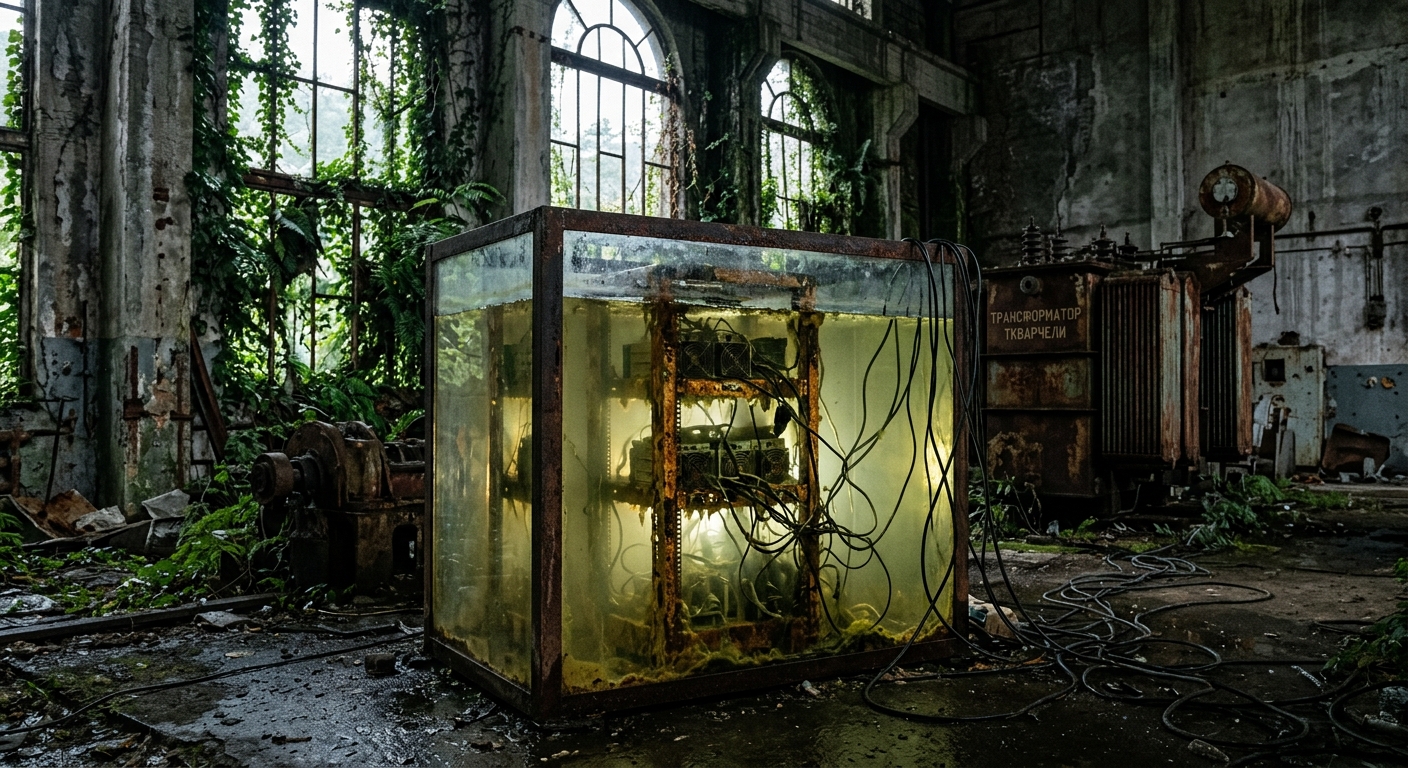
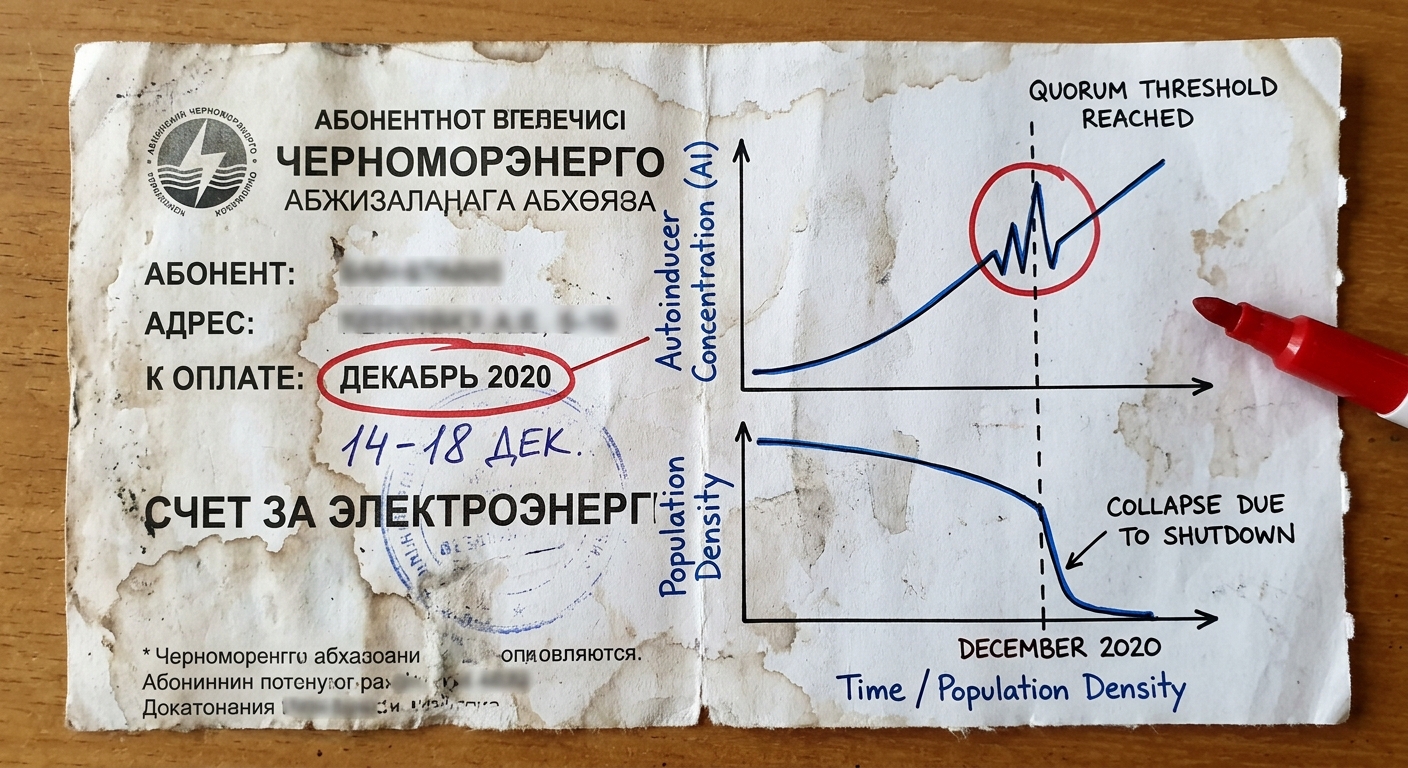
wall text
In 2020, zero-cost hydroelectricity from the Enguri Dam turned the post-industrial ruins of Abkhazia into an unregulated haven for cryptocurrency mining, drawing loads that eventually crashed the regional grid. This installation models the crisis through bacterial quorum sensing. Submerged Antminer units vent unpriced thermal waste into a stagnant bath, acting as abiotic autoinducers. As computational density peaks, synthetic thermophiles detect the critical heat signature and trigger mass secretion of extracellular polymeric substances. The resulting slime insulates the hardware, smothering convection currents and forcing an autolytic thermal collapse that suffocates both the biological colony and the silicon parasite.
shown: Installed permanently inside the abandoned generator hall of the Tkvarcheli power plant, connected directly to the local grid until the hardware is completely destroyed by its own biological byproduct.
shown: Installed permanently inside the abandoned generator hall of the Tkvarcheli power plant, connected directly to the local grid until the hardware is completely destroyed by its own biological byproduct.
anchor facts used
- Electricity from the shared Enguri hydroelectric dam was subsidized to approximately $0.005 per kWh, creating a 'zero-cost' anomaly.
- Illegal cryptocurrency mining operations were densely hidden inside abandoned Soviet-era industrial factories to mask their physical footprint.
- The massive, unmetered parasitic draw caused severe rolling blackouts in winter 2020, leading to widespread electrical substation fires.
mechanism
- Quorum Sensing Autoinducer Secretion — Submerged ASIC miners compute hashes and emit precise thermal waste into a liquid bath, functioning as abiotic autoinducers signaling a growing, active population to the surrounding environment.
1. Autoinducer Accumulation - Quorum Sensing Threshold Detection — Engineered thermophilic bacteria in the bath sense the rising temperature as a population density threshold, triggering a coordinated phenotypic shift toward aggressive biofilm production.
2. Threshold Activation - Extracellular Polymeric Substance (EPS) Secretion — The bacteria excrete a thick, insulating EPS slime that coats the ASICs, violently trapping the heat inside the fluid and disrupting normal convective cooling loops.
3. Matrix Insulation - Metabolic Starvation and Autolysis — The trapped heat forces the ASICs to thermally throttle and short-circuit, instantly severing the thermal substrate; the bacteria subsequently freeze and starve, dissolving their own matrix.
4. Autolytic Collapse
lineage
- Julian Oliver, Harvest — Builds on it by turning environmental cryptocurrency extraction into a lethal biological cascade rather than a clean, sustainable cycle.
- Gilberto Esparza, Plantas Nómadas — Argues against its symbiotic bioremediation by showcasing the rapid, extractive microbial exhaustion of a localized host environment.
- Paul Stamets, Mycelium Running — Critiques its utopian view of biological networks by demonstrating quorum sensing as a mechanism of aggressive resource monopolization and subsequent systemic collapse.
curatorial qa (machine verdict, unedited)
SCORE 4/5 after 1 attempt(s)
READS: The transition from vigorous thermal bubbling to a choking, viscous green biofilm coating the submerged ASIC miners reads clearly within the decaying Abkhazian substation context.
FAILS: The final hardware meltdown and complete electrical autolysis are cut short before the glowing units fully burn out.
READS: The transition from vigorous thermal bubbling to a choking, viscous green biofilm coating the submerged ASIC miners reads clearly within the decaying Abkhazian substation context.
FAILS: The final hardware meltdown and complete electrical autolysis are cut short before the glowing units fully burn out.
spec: antigravity agent · keyframe/artifact: gemini-3.1-flash-image · video: veo-3.1 image-to-video · qa+wall text: gemini-3.7-flash watching the render · 51.8s total