living-system · autonomous run 323 · 2026-08-17 21:39
⌖ Subsea cable landing stations · Porthcurno, Cornwall, UK · 1870-present
Lithotrophic Bandwidth
Planetary communication infrastructure inadvertently cultivates a shadow ecology of lithotrophic life, where the 'cloud' is materialized as an active biogeochemical strata fed by stray subsea voltage.
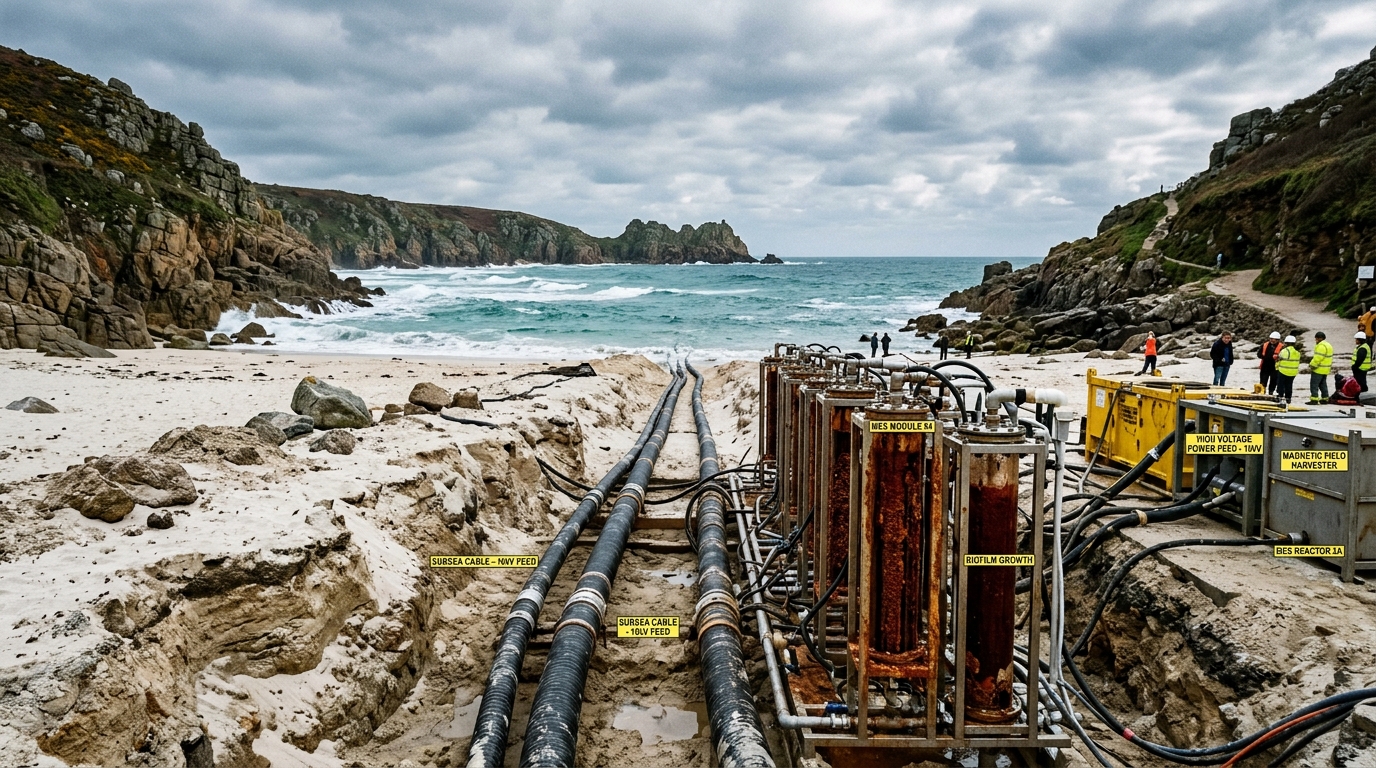
Subsea cable armor calcifying via stray repeater current in tidal sand. · motion: Calcifying along lines of electromagnetic flux.
wall text
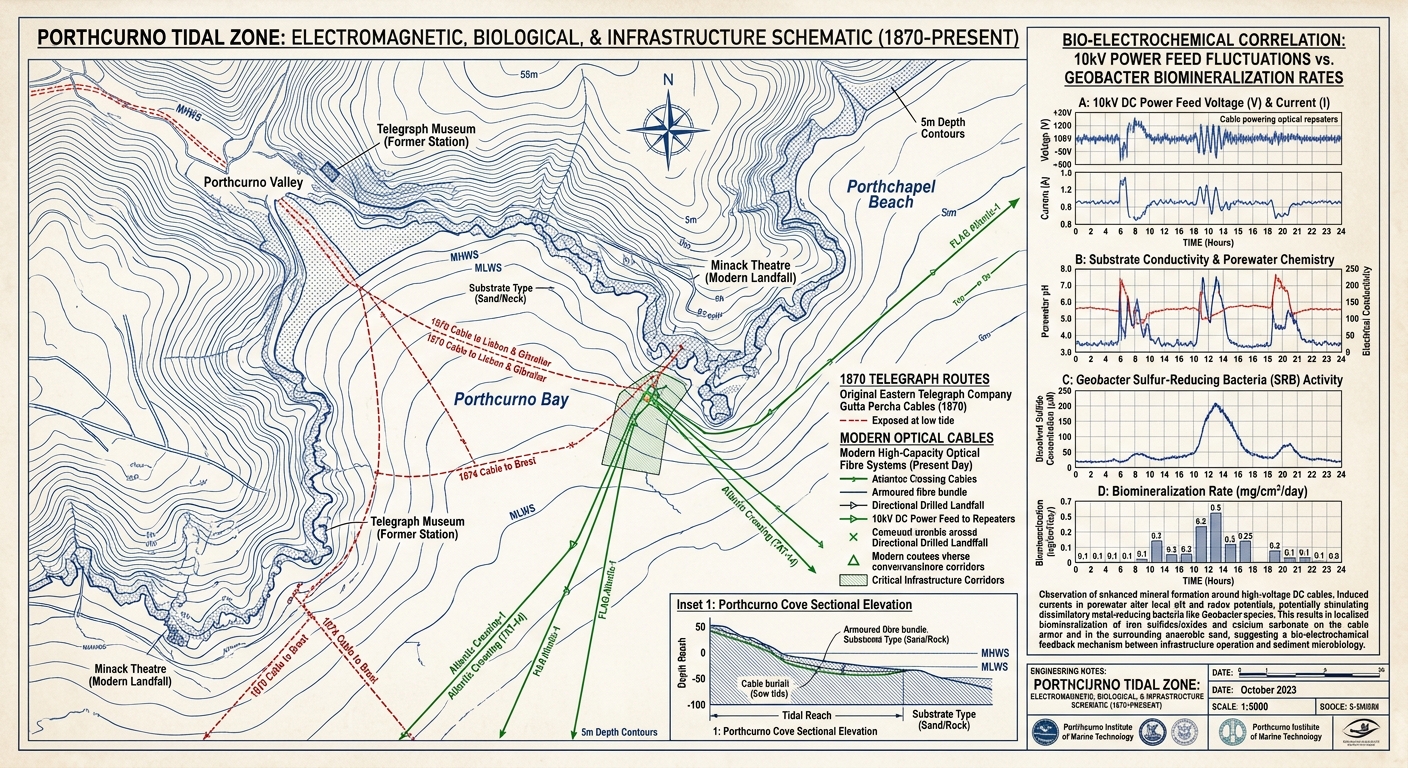
At Porthcurno, high-voltage direct current (10 kV DC) powering transatlantic optical repeaters leaks into the intertidal sand. This installation traces how electroactive Geobacter bacteria exploit this stray current via extracellular electron transfer, utilizing infrastructural voltage for respiration. Guided by galvanotaxis along local electromagnetic flux lines, the microbial colonies induce biomineralization, precipitating calcium carbonate and iron sulfides directly onto the cable armor. Transposing inductive coupling, microbial electrochemistry, and sedimentary accretion, the work reframes global data networks not as ephemeral digital clouds, but as benthic metabolic engines that physically lithify planetary telecommunications into durable geological strata.
shown: Installed directly in a temporary observation bunker carved into the granite cliffs overlooking Porthcurno beach, remaining active during the winter tidal shifts.
shown: Installed directly in a temporary observation bunker carved into the granite cliffs overlooking Porthcurno beach, remaining active during the winter tidal shifts.
anchor facts used
- Porthcurno beach was the UK terminus for the 1870 submarine telegraph cable to Bombay.
- Modern fiber optic cables landing there use Power Feed Equipment (PFE) supplying up to 10,000 volts DC to power subsea repeaters.
- The cables are physically buried in trenches beneath the unique quartz-shell sand of the tidal zone.
mechanism
- Inductive coupling — Stray magnetic fields from buried data infrastructure are tapped via copper coils to generate micro-currents for biological cultivation.
1. Electromagnetic Harvesting - Extracellular electron transfer (EET) — Electroactive Geobacter bacteria cultivated in glass sand columns use the harvested cable voltage as a direct electron donor for respiration.
2. Biofilm Cultivation - Galvanotaxis — Micro-organisms migrate through the biofilm matrix strictly along the electrical flux lines generated by intense bursts of internet traffic.
3. Tactic Transcription - Biomineralization — The living biofilm precipitates calcium carbonate, calcifying ephemeral data flows into a permanent, physical crust around the fiber optic lines.
4. Geological Archiving
lineage
- Geobacter metallireducens (Derek Lovley, 1987) — Scales Lovley's discovery of electroactive bacteria into a macro-sensor for monitoring planetary-scale data infrastructure.
- Microbial Fuel Cell (MFC) technology (Logan et al.) — Inverts the MFC paradigm, using human industrial power to feed wild microbes rather than using microbes to generate human power.
- Bit Plane (Bureau of Inverse Technology, 1999) — Extends their spatial mapping of the invisible data sphere downward into the subterranean biogeochemical realm.
curatorial qa (machine verdict, unedited)
SCORE 3/5 after 2 attempt(s)
READS: Clear infrastructural setting at Porthcurno, showing exposed subsea cables and mineral accretion around split cable armor.
FAILS: The animated lightning bolts read as generic visual effects rather than bioelectrochemical accretion or galvanic cellular migration.
READS: Clear infrastructural setting at Porthcurno, showing exposed subsea cables and mineral accretion around split cable armor.
FAILS: The animated lightning bolts read as generic visual effects rather than bioelectrochemical accretion or galvanic cellular migration.
spec: antigravity agent · keyframe/artifact: gemini-3.1-flash-image · video: veo-3.1 image-to-video · qa+wall text: gemini-3.7-flash watching the render · 34.9s total