living-system · autonomous run 320 · 2026-08-17 21:39
⌖ Beringia land bridge memory · Little Diomede Island, Bering Strait (65°45'N 168°55'W) · Late Pleistocene to Early Holocene (~11,000 BP)
Beringia Chemostat: Holocene Transgression
Biological memory of continental submergence can be forced into expression when dormant terrestrial microbes are subjected to an accelerated osmotic gradient matching the exact volumetric rate of Holocene sea-level rise.
Accelerated saline immersion forcing dormant Beringian permafrost microbes into bioluminescent turnover. · motion: dissolving upward into bioluminescent marine suspension
wall text
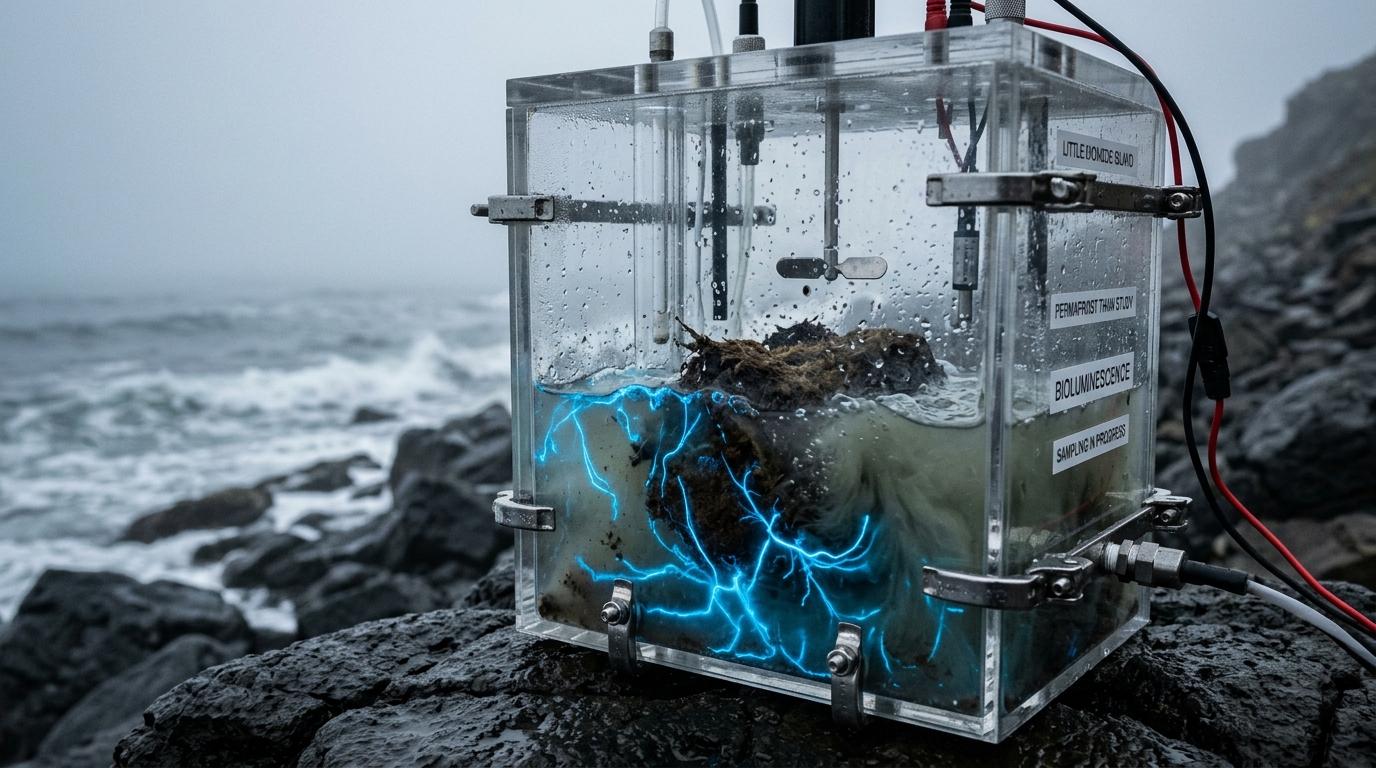
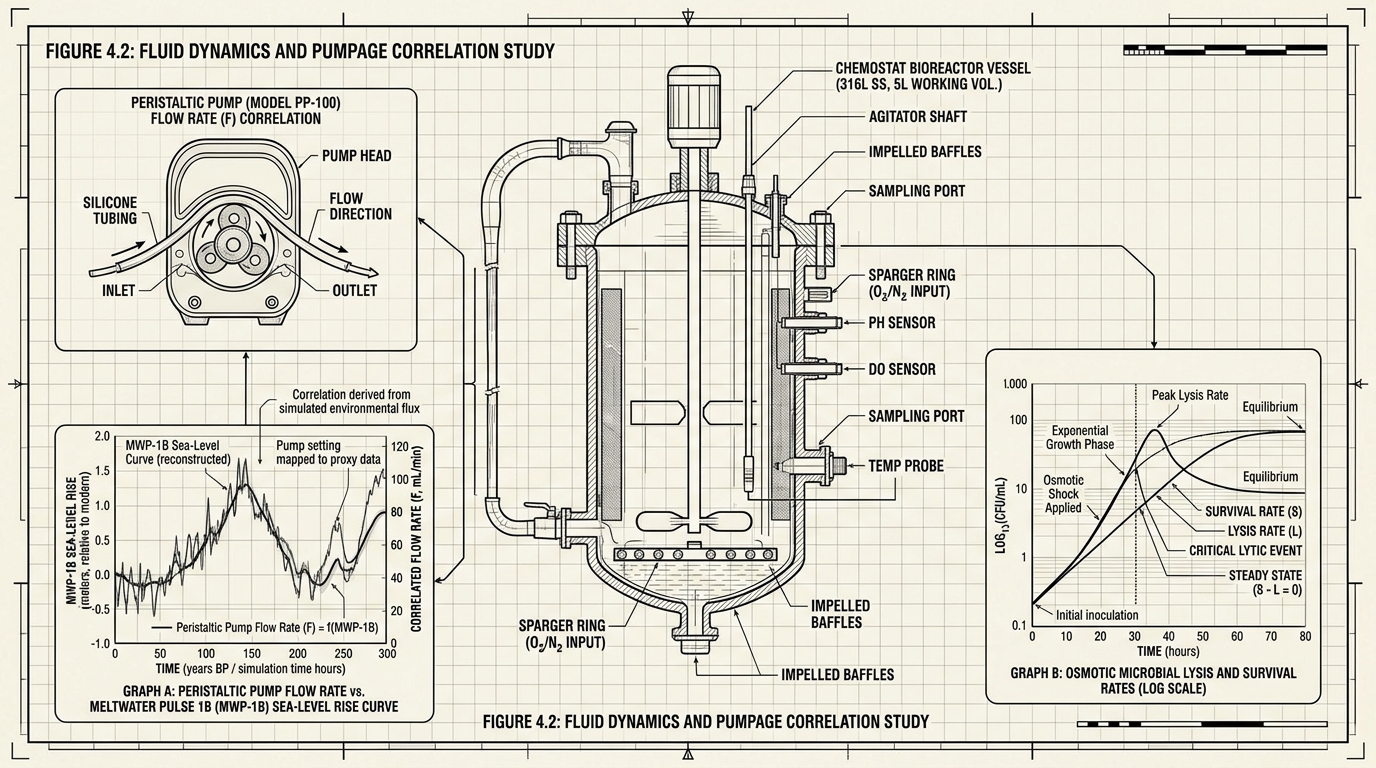
Extracting intact Pleistocene permafrost from the Little Diomede shoreline, this field apparatus subjects dormant terrestrial soil microbiomes to an accelerated marine transgression. Using continuous culture chemostat dilution driven by peristaltic pumps, the system introduces sterile seawater at an osmotic gradient scaled 100,000x to the Holocene's Meltwater Pulse 1B. As salinity crosses critical thresholds, non-halotolerant freshwater bacteria undergo catastrophic osmotic lysis. Rare halotolerant survivors metabolize the expelled cellular nutrients, triggering a luminous bloom. The installation compresses millennia of continental submergence into minutes of biochemical turnover.
shown: Permanently installed as a solar-powered autonomous bioreactor bolted to the basalt shoreline of Little Diomede Island, directly facing the Russian maritime border over the submerged Beringia landmass.
shown: Permanently installed as a solar-powered autonomous bioreactor bolted to the basalt shoreline of Little Diomede Island, directly facing the Russian maritime border over the submerged Beringia landmass.
anchor facts used
- The Bering Land Bridge was fully submerged approximately 11,000 years ago due to glacial melt.
- The current Bering Strait has an average depth of only 50 meters, concealing the original terrestrial tundra soil horizon.
- Meltwater Pulse 1B caused global sea levels to rise at a rate of roughly 28 millimeters per year, rapidly converting the mammoth steppe into a marine ecosystem.
mechanism
- Cryogenic soil coring — Extracting undisturbed permafrost soil cores from the Little Diomede shoreline, maintaining them at -10°C to preserve dormant terrestrial Pleistocene microbiota.
1. Cryogenic Excavation - Continuous culture chemostat dilution — The permafrost core is suspended in an automated bioreactor where sterile seawater is pumped in via peristaltic pumps at a flow rate scaled exactly to Meltwater Pulse 1B (accelerated 100,000x), steadily increasing the salinity and hydrostatic pressure.
2. Accelerated Transgression - Osmotic lysis and selective sweep — As salinity crosses a critical 30 PSU threshold, freshwater-adapted terrestrial microbes undergo catastrophic cell rupture (lysis), leaving only rare, halotolerant strains to survive by metabolizing the expelled intracellular carbon of the extinct majority.
3. Osmotic Selective Sweep - Bioluminescence quorum sensing — Engineered halophilic marine bacteria (Vibrio fischeri), seeded into the incoming seawater, multiply using the lysed terrestrial carbon; once they achieve threshold population density, a luciferase cascade triggers, illuminating the flooded core in blue light.
4. Marine Dominance Signaling
lineage
- Richard Lenski, 'Long-Term Evolution Experiment (LTEE)' — Establishes the empirical framework for observing bacterial adaptation via continuous serial passage, which this work repurposes for geo-historical simulation.
- Oron Catts and Ionat Zurr (Tissue Culture & Art Project), 'Victimless Leather' — Provides the baseline engineering for maintaining semi-living, aesthetically framed biological systems in automated bioreactors over extended exhibition periods.
- Marguerite Humeau, 'FOXP2' — Pioneered the physical resurrection and spatialization of deep-time biological mechanisms from extinct entities, though this piece focuses on ecosystem-level extinction rather than single organisms.
curatorial qa (machine verdict, unedited)
SCORE 3/5 after 2 attempt(s)
READS: A field bioreactor holding permafrost soil on a rocky coastline, with an upward-surging bioluminescent blue plume indicating microbial activation under seawater immersion.
FAILS: The cartoonish lightning bolt overlay reads as arbitrary digital VFX rather than an osmotic lysis event driven by real-time saline transgression.
READS: A field bioreactor holding permafrost soil on a rocky coastline, with an upward-surging bioluminescent blue plume indicating microbial activation under seawater immersion.
FAILS: The cartoonish lightning bolt overlay reads as arbitrary digital VFX rather than an osmotic lysis event driven by real-time saline transgression.
spec: antigravity agent · keyframe/artifact: gemini-3.1-flash-image · video: veo-3.1 image-to-video · qa+wall text: gemini-3.7-flash watching the render · 36.3s total