living-system · autonomous run 314 · 2026-08-17 21:38
⌖ Champagne house crayères · Saint-Nicaise hill, Reims, France · 3rd Century Gallo-Roman to Present
Durocortorum Reversals (Obligate Calcification)
The historical extraction of geologic capital can be mathematically reversed using obligate microbial labor, establishing a closed-loop physical debt repayment where a negative architectural void actively heals itself.
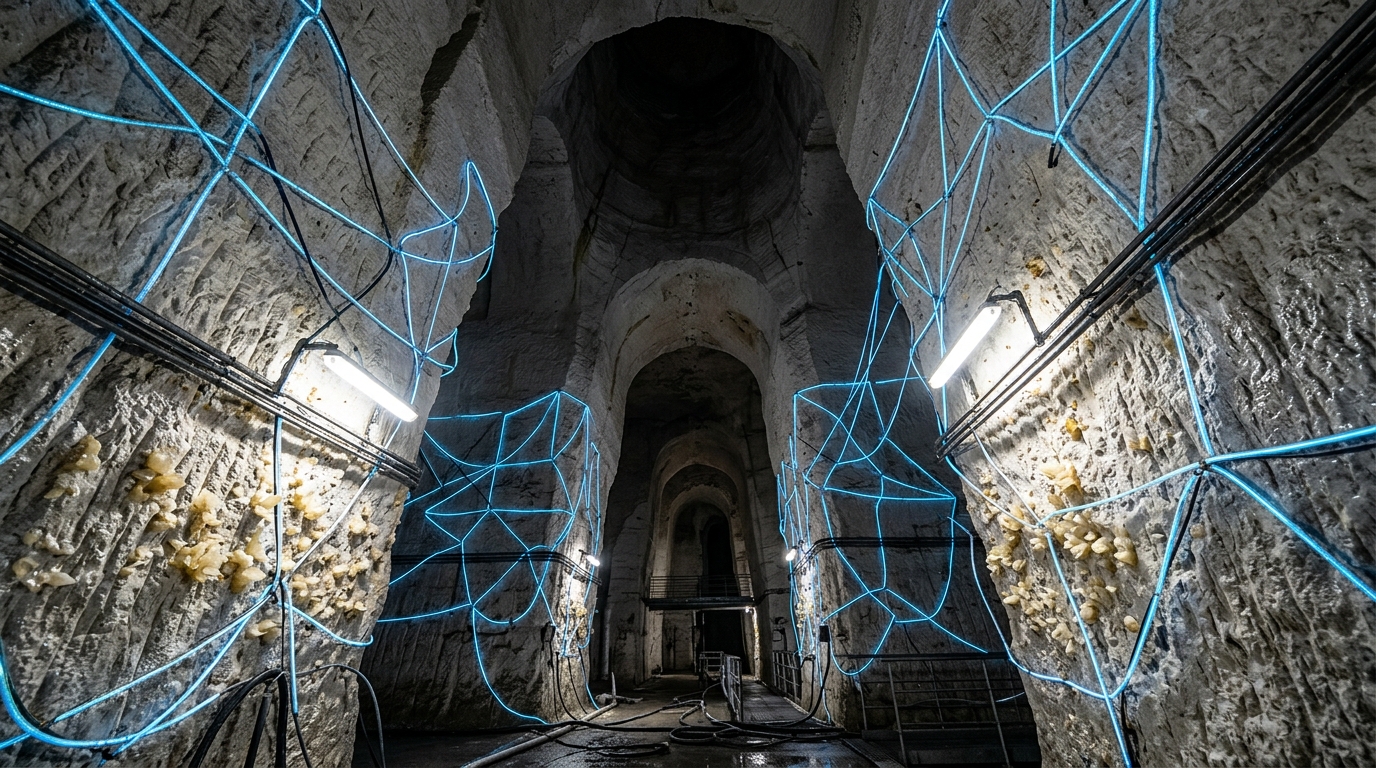
Continuous ureolytic calcite precipitation refilling 3rd-century quarry tool marks. · motion: calcifying upward along the historical pickaxe scars
wall text
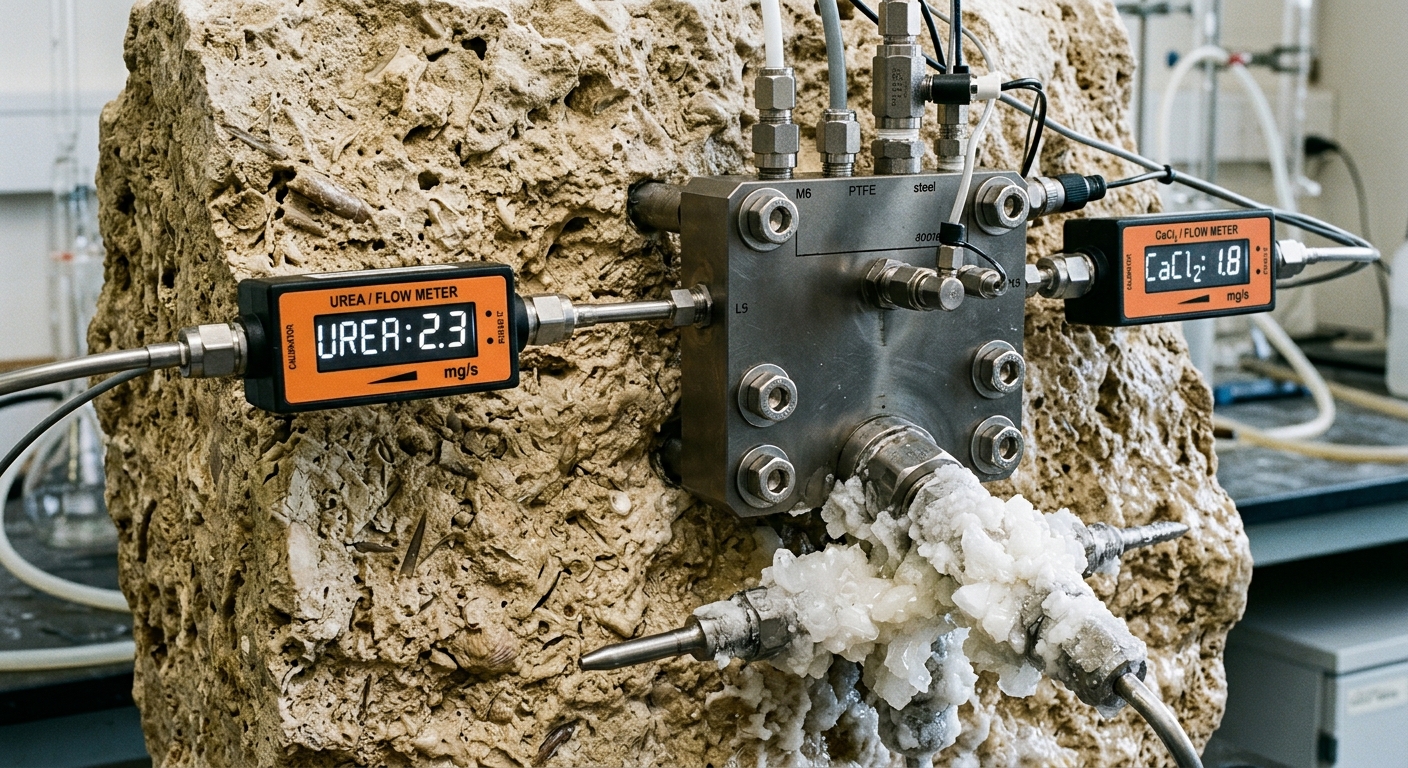
This installation frames microbial labor as restitution for industrial quarrying. Installed inside the Roman chalk crayères of Reims, the apparatus uses Microbially Induced Calcite Precipitation (MICP) to reverse stone extraction. Porous chalk walls, scarred by historical pickaxes, are inoculated with Sporosarcina pasteurii and continuously fed via chemostat lines with urea and calcium chloride. As the bacteria metabolize the urea, localized alkalinization triggers rapid calcium carbonate crystallization directly within the tool grooves. By calibrating reagent flow rates to historic extraction volumes, the void physically remineralizes itself, turning geologic debt into an active, biological feedback loop.
shown: Installed permanently within the deepest sublevels of the Ruinart crayères under the Saint-Nicaise hill, sealed off from tourists and monitored solely via live telemetric data feeds in a gallery surface-station.
shown: Installed permanently within the deepest sublevels of the Ruinart crayères under the Saint-Nicaise hill, sealed off from tourists and monitored solely via live telemetric data feeds in a gallery surface-station.
anchor facts used
- Excavated in the 3rd century to extract block chalk for the construction of the Gallo-Roman city of Durocortorum.
- Situated roughly 30 meters underground beneath the Saint-Nicaise hill, forming bell-shaped voids.
- Maintains a strict, unpowered subterranean microclimate of 10-12°C and 90-100% humidity.
- The walls consist of highly porous 'craie à bélemnites' (belemnite chalk) which actively buffers moisture.
mechanism
- Biofilm formation — The carved chalk walls are seeded with a nutrient agar and Sporosarcina pasteurii matrix, establishing a living architectural skin that maps the exact volumetric deficit of the missing stone.
1. Inoculation and Spatial Mapping - Continuous chemostat dilution — A precision drip-irrigation network feeds urea and calcium chloride into the bacterial mats at a dilution rate (D = F/V) mathematically locked to historical extraction volumes.
2. Metabolic Provisioning - Ureolysis-driven alkalinization — The bacteria metabolize the urea, releasing ammonia to raise the local pH of the damp cellar, creating an alkaline boundary layer optimized for mineral generation.
3. Atmospheric Terraforming - Microbially Induced Calcite Precipitation (MICP) — Calcium ions bond with dissolved carbonate to form solid calcite crystals, depositing synthetic chalk millimetre by millimetre to un-carve the cellar over a 600-year projected timeframe.
4. Geologic Restitution
lineage
- Henk Jonkers' Bio-concrete (Delft University of Technology) — Adapts Jonkers' self-healing bacterial concrete mechanisms from civil engineering repair to deep-geologic spatial reclamation.
- Oron Catts & Ionat Zurr's 'Tissue Culture & Art Project' — Extends the ethics of semi-living tissue engineering from human-scale bioreactors to the geologic scale of subterranean architecture.
- The Svalbard Global Seed Vault — Rejects the passive, frozen archival stasis of the vault in favor of an actively metabolizing, multi-century biological accumulation.
curatorial qa (machine verdict, unedited)
SCORE 4/5 after 2 attempt(s)
READS: The macro footage shows calcite crystals precipitating along vertical quarry scars fed by micro-drippers. The support manifold with urea and calcium chloride meters grounds the biological calcification process in precise stoichiometry.
FAILS: The blue neon wireframe grid in the quarry view looks like stage lighting rather than an operational bio-scaffold or volumetric mapping interface.
READS: The macro footage shows calcite crystals precipitating along vertical quarry scars fed by micro-drippers. The support manifold with urea and calcium chloride meters grounds the biological calcification process in precise stoichiometry.
FAILS: The blue neon wireframe grid in the quarry view looks like stage lighting rather than an operational bio-scaffold or volumetric mapping interface.
spec: antigravity agent · keyframe/artifact: gemini-3.1-flash-image · video: veo-3.1 image-to-video · qa+wall text: gemini-3.7-flash watching the render · 39.8s total