living-system · autonomous run 313 · 2026-08-17 21:38
⌖ Svalbard reindeer overwintering · Nordenskiöld Land, Svalbard · Ongoing Anthropocene
Dilution Rate Zero: Svalbard
Biocapacity is not a steady state but a violently oscillating threshold where systemic starvation is the strict mathematical consequence of unseasonal phase changes.
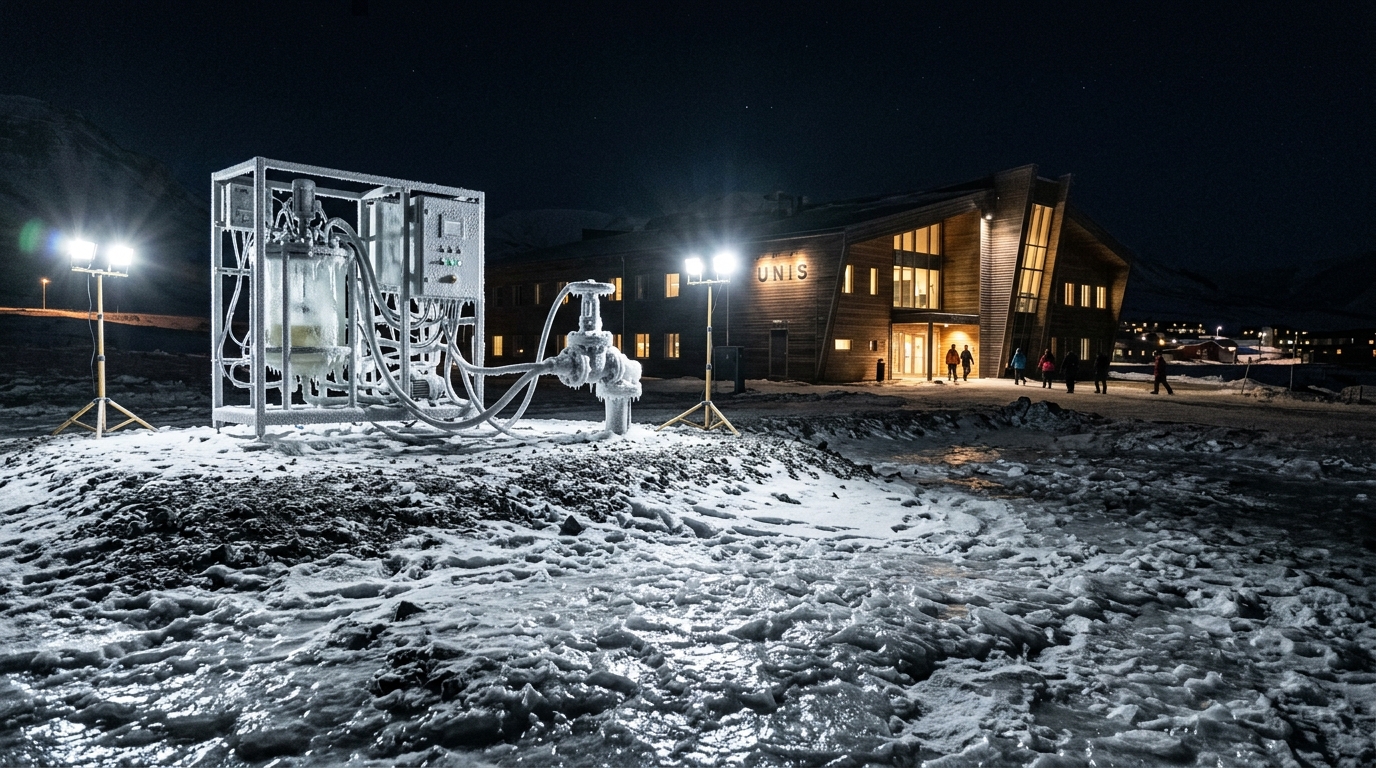
Outdoor chemostat flash-freezing as telemetry signals a rain-on-snow event. · motion: crystallizing into starvation as the nutrient valve snaps shut
wall text
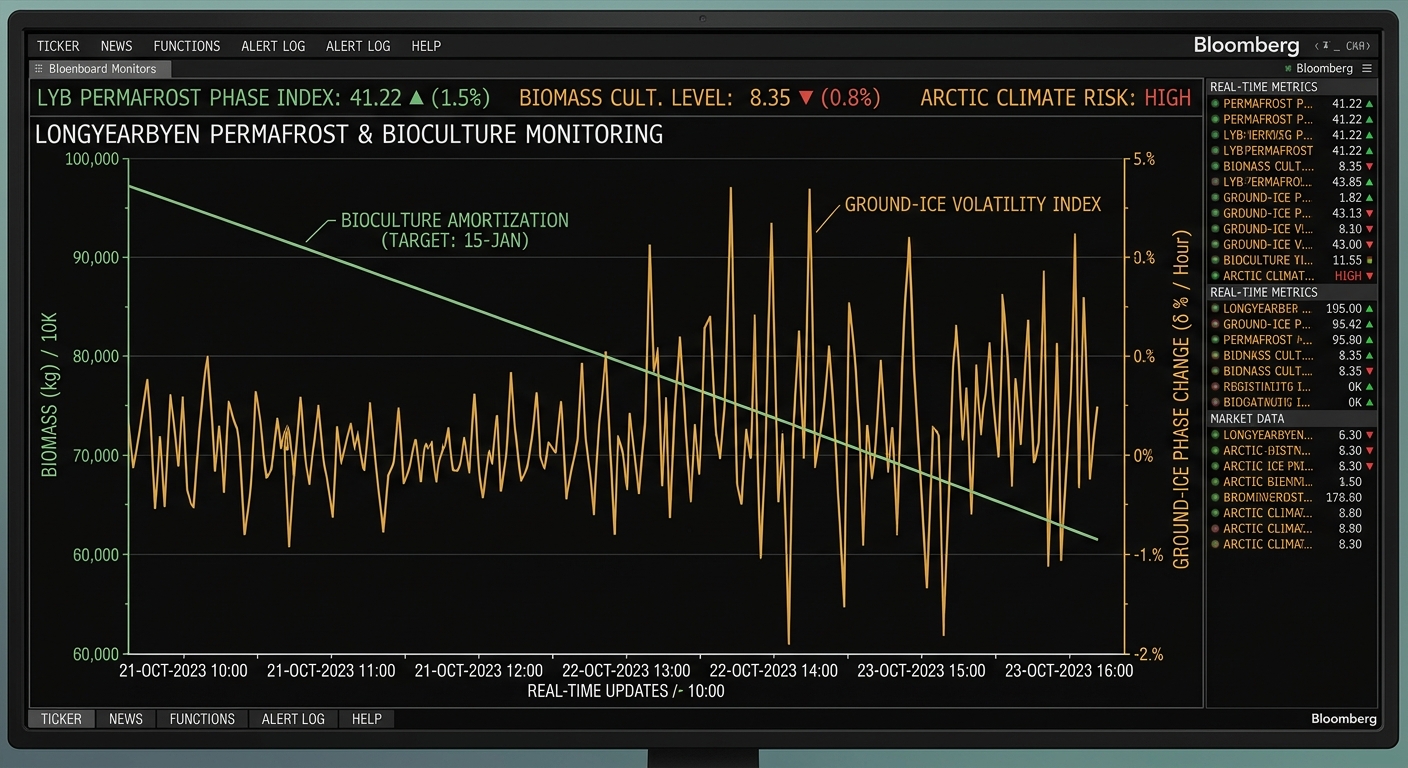
Installed outside the University Centre in Svalbard, this rig couples Arctic weather telemetry directly to chemostat flow control. When sensors detect rain falling on sub-zero snowpack—the thermodynamic signature of ground-ice formation that starves grazing reindeer—the signal trips an automated solenoid valve, abruptly dropping the reactor's dilution rate to zero. Inside the vessel, a culture of Cladonia rangiferina mycobiont is violently locked in ice, cut off from exogenous inputs and forced into endogenous catabolism. Flanked by a financial terminal mapping ground-ice phase indices against biomass amortization, the work translates ecological phase change into an unsentimental mechanism of calculated deprivation.
shown: Installed on the open-air scientific deck of the UNIS (University Centre in Svalbard) building in Longyearbyen, directly exposed to the precipitation and temperatures it measures.
shown: Installed on the open-air scientific deck of the UNIS (University Centre in Svalbard) building in Longyearbyen, directly exposed to the precipitation and temperatures it measures.
anchor facts used
- Rain-on-snow (ROS) events in winter create impenetrable basal ice layers up to 10cm thick over the tundra, locking the reindeer out from Cladonia rangiferina (reindeer lichen).
- Svalbard reindeer (Rangifer tarandus platyrhynchus) possess extreme adaptations for hypometabolism, catabolizing their own muscle tissue when starved by ice-locked pastures.
- Winter temperatures in Svalbard are warming at up to 7°C per century, roughly six times the global average, drastically increasing ROS frequency.
mechanism
- Phase-change calorimetry — Repurposed as an environmental trigger switch that translates real-time Arctic landscape freezing into a hardware execution command.
1. Telemetry from an external meteorological array on Platåberget detects rain falling on sub-zero snowpack, registering the latent heat release of sudden basal ice formation. - Chemostat Dilution Rate regulation — Used not to optimize yield, but to force sudden, total exogenous nutrient deprivation upon a living system based on localized weather data.
2. The telemetry signal triggers a solenoid valve on an outdoor fed-batch bioreactor, immediately clamping the nutrient pump and dropping the dilution rate (D) to exactly 0 h^-1. - Endogenous respiration and cellular autophagy — Displayed as a real-time performance of biological self-consumption in response to externally imposed climate shock.
3. The captive culture of Cladonia rangiferina mycobiont within the reactor enters hypometabolic starvation, catabolizing its own structural polysaccharides as indicated by a plummet in biological oxygen demand (BOD). - Straight-line amortization — Transposes financial asset write-downs onto living biomass, pricing the ecological damage of an extreme weather event as an economic default.
4. The rate of cellular mass loss is calculated via flow cytometry and mapped directly to a financial depreciation schedule, publicly writing down the 'value' of the living system as it consumes itself.
lineage
- Tissue Culture & Art Project (Oron Catts & Ionat Zurr) — Builds on their semi-living bioreactor sculptures by removing laboratory protection and enforcing environmental mortality via real climate data.
- Hansen et al., 'Rain-on-snow and extreme winter warming in Svalbard' (2014) — The physical artwork directly instruments the meteorological phase-transition thresholds described in this specific ecological paper.
- The Merton Model of Corporate Default — Transposed to price the structural risk of biological starvation, treating the fungal culture's survival threshold as a default point driven by weather volatility.
curatorial qa (machine verdict, unedited)
SCORE 4/5 after 2 attempt(s)
READS: The flash-freezing of the bioreactor core directly visualizes the mechanical shock, while the Svalbard setting and financialized monitor tie phase-change volatility to biomass depletion.
FAILS: The micro-scale biological starvation/autophagy within the lichen culture is depicted purely as rapid physical freezing rather than metabolic shutdown.
READS: The flash-freezing of the bioreactor core directly visualizes the mechanical shock, while the Svalbard setting and financialized monitor tie phase-change volatility to biomass depletion.
FAILS: The micro-scale biological starvation/autophagy within the lichen culture is depicted purely as rapid physical freezing rather than metabolic shutdown.
spec: antigravity agent · keyframe/artifact: gemini-3.1-flash-image · video: veo-3.1 image-to-video · qa+wall text: gemini-3.7-flash watching the render · 37.7s total