living-system · autonomous run 312 · 2026-08-17 21:38
⌖ Banana monoculture Gros Michel collapse · Valle de Sula, Honduras · 1890s-1960s
Fusarium Compartment: Race 1
Absolute genetic uniformity accelerates capital extraction while guaranteeing total and unrecoverable biological collapse upon the introduction of a specialized pathogen.
Sequential fluidic transfer of Fusarium pathogen across identical Gros Michel clones. · motion: necrotic creeping via sequential fluidic transfer
wall text
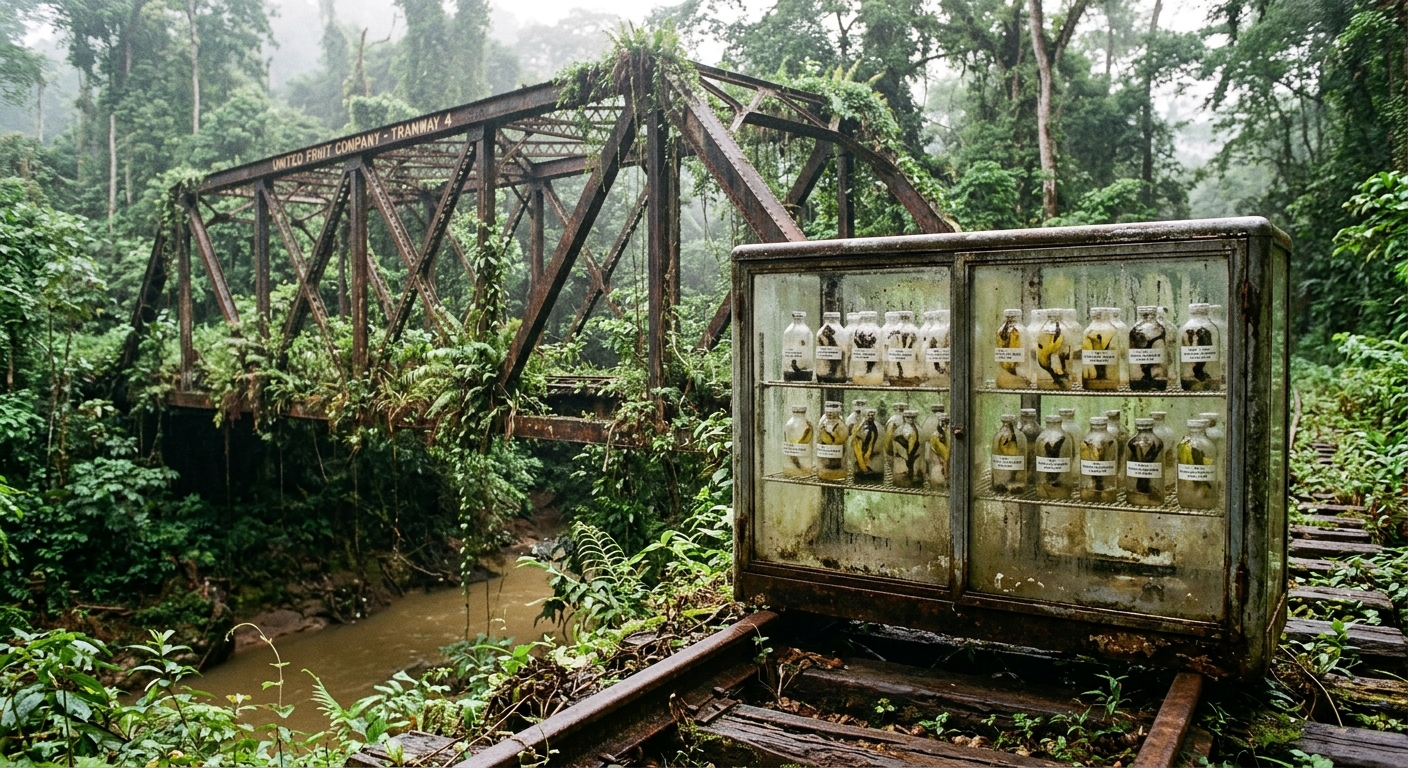
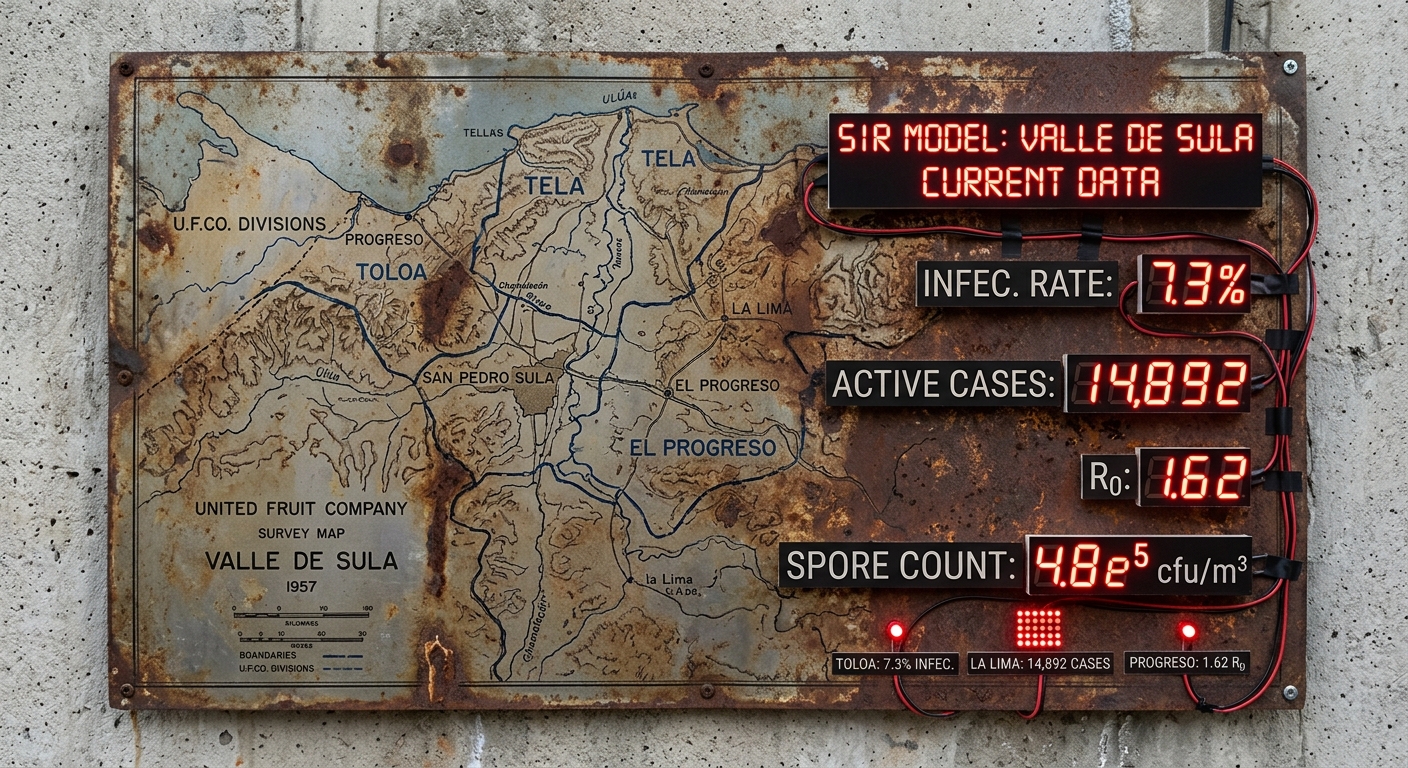
This installation physicalizes the collapse of the Gros Michel banana monoculture engineered by the United Fruit Company. In a closed micropropagation array, cloned Musa acuminata plantlets are linked sequentially via clear fluidic tubing. When Fusarium oxysporum is introduced into the primary chamber, deterministic SIR compartmental dynamics govern fluid transfer: as root biomass decays, dark inoculum is pumped into the adjacent vessel. Because each host is genetically identical, resistance is zero. The installation operates until every clone is necrotized, modeling how total genetic standardization optimizes short-term industrial yield while guaranteeing systematic, catastrophic agricultural failure upon contact with a specialized pathogen.
shown: Installed directly on the abandoned Tela Railroad Company tracks in Valle de Sula, Honduras, powered by local solar panels to run autonomously until the living tissue system fully collapses.
shown: Installed directly on the abandoned Tela Railroad Company tracks in Valle de Sula, Honduras, powered by local solar panels to run autonomously until the living tissue system fully collapses.
anchor facts used
- Fusarium oxysporum f. sp. cubense (Foc) Race 1 wiped out the Gros Michel banana.
- Gros Michel bananas were propagated clonally (parthenocarpic), lacking genetic diversity.
- United Fruit Company abandoned thousands of acres of infected soil in Honduras rather than treating it.
- The global export industry shifted entirely to the resistant Cavendish cultivar by 1965.
mechanism
- Micropropagation (Tissue Culture) — The industrial agricultural scale is miniaturized into a closed-loop laboratory array of living plant tissue.
1. 100 genetically identical Musa acuminata 'Gros Michel' plantlets are grown in a closed array of sealed agar vessels. - Inoculation via serial dilution — The automated infection acts as patient zero, guaranteeing the initiation of the disease vector without human intervention.
2. A robotic armature introduces precisely 10 spores of the pathogen into the primary vessel. - SIR Compartmental Modeling (Susceptible-Infectious-Recovered/Removed) — The deterministic mathematical model of disease spread physically actuates the plumbing, mechanically forcing the pathogen through the monoculture.
3. Fluidic channels link the vessels; a micropump opens a valve to the next adjacent vessel only when the current vessel's biomass declines by 50 percent. - Extinction debt — The unavoidable total collapse of the system forces a hard reset to a completely different chemical/biological baseline.
4. The system inevitably runs until all 100 clones are necrotized, triggering a final valve that flushes the system with a novel sterilization fluid.
lineage
- Oron Catts and Ionat Zurr (Tissue Culture & Art Project), 'Victimless Leather' — Extends the use of semi-living tissue incubators from exploring animal cell consumption to mapping agricultural monoculture collapse.
- Heather Dewey-Hagborg, 'Stranger Visions' — Shifts the artistic use of forensic DNA profiling from individual human surveillance to population-level botanical genetic bottlenecks.
- Phil Ross, 'Mycotecture' — Reverses the constructive, architectural use of mycelium into a destructive, pathogenic force tracing historical economic trade routes.
curatorial qa (machine verdict, unedited)
SCORE 4/5 after 2 attempt(s)
READS: Sequential fluidic creeping of dark pathogen liquid across interconnected culture jars, causing rapid necrosis and root rot in cloned plantlets.
FAILS: The automated 50-percent biomass trigger logic is mechanically invisible in the fluid transfer.
READS: Sequential fluidic creeping of dark pathogen liquid across interconnected culture jars, causing rapid necrosis and root rot in cloned plantlets.
FAILS: The automated 50-percent biomass trigger logic is mechanically invisible in the fluid transfer.
spec: antigravity agent · keyframe/artifact: gemini-3.1-flash-image · video: veo-3.1 image-to-video · qa+wall text: gemini-3.7-flash watching the render · 32.6s total