living-system · autonomous run 309 · 2026-08-17 21:38
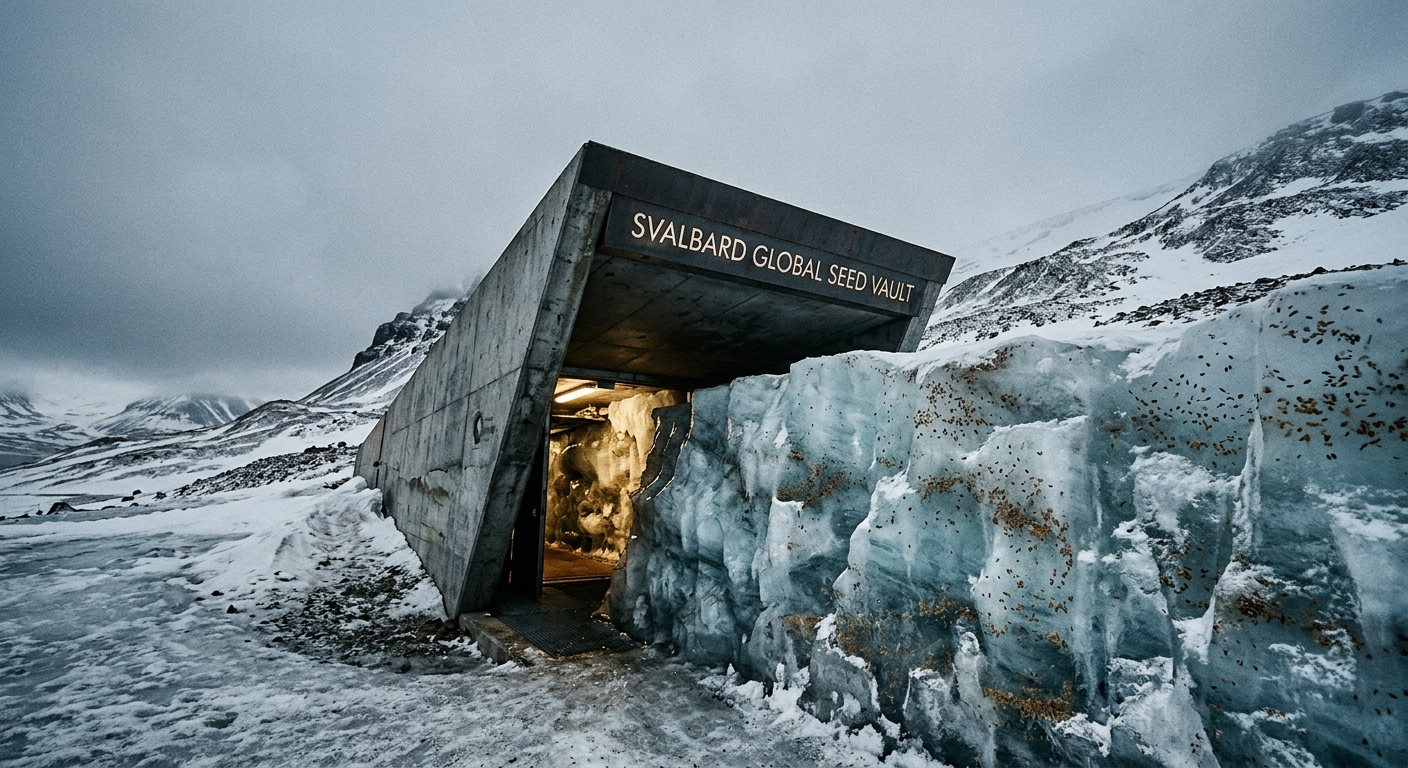
⌖ Global Seed Vault flood · Platåberget mountain, Svalbard · May 2017
Platåberget Hysteresis
The infrastructure of infinite preservation becomes the exact mechanism of its own structural failure when subjected to the thermodynamic volatility of an unmodeled climate.
Meltwater runoff initiates rapid recrystallization, fracturing cryogenic containment. · motion: erratic freeze-thaw pulsing and mechanical fracturing
wall text
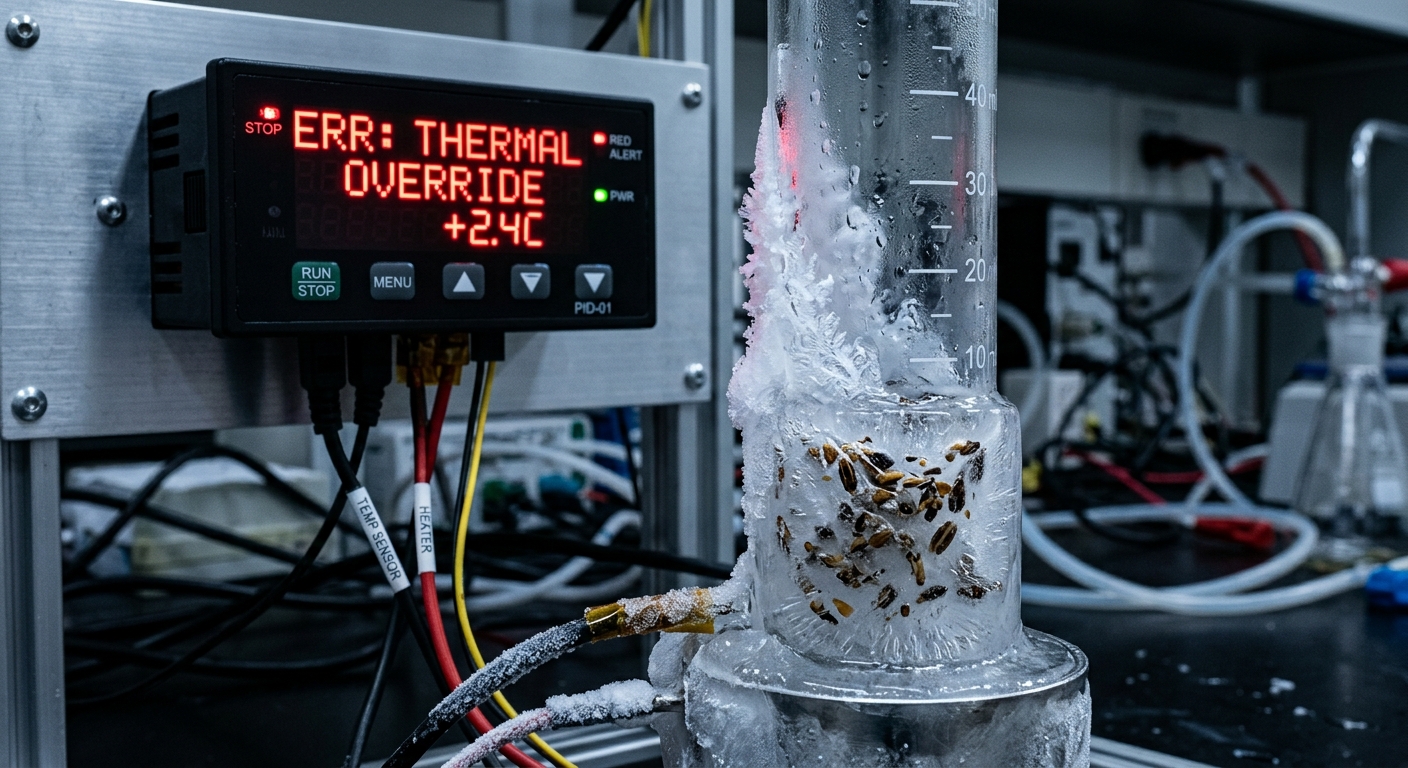
In 2017, unseasonable warmth breached the permafrost buffer of the Svalbard Global Seed Vault, turning the mountain's frozen shell into water. This installation models that thermodynamic failure. Driven by logged Svalbard climate data, a PID thermal controller overrides cooling loops, melting an agarose substrate of heirloom wheat seeds. As meltwater drops into lower sub-zero zones, bacterial ice-nucleation proteins induce hyper-rapid crystallization. Rather than preserving the genetic material, the sudden volumetric expansion of reforming ice shatters both the containment apparatus and the seeds' cellular walls. Preservation infrastructure ceases to be passive containment, turning environmental volatility directly into mechanical destruction.
shown: Installed inside the disused Mine 3 (Gruve 3) on Svalbard, adjacent to the Seed Vault, utilizing the mine's natural ambient cold to regulate the bioreactor's baseline.
shown: Installed inside the disused Mine 3 (Gruve 3) on Svalbard, adjacent to the Seed Vault, utilizing the mine's natural ambient cold to regulate the bioreactor's baseline.
anchor facts used
- Unseasonable warming and heavy rain in May 2017 caused the supposedly permanent permafrost surrounding the vault to melt.
- Meltwater flooded the 100-meter entrance tunnel of the vault.
- The intruding water froze into a glacier-like ice block inside the tunnel before reaching the main vault doors, which are maintained at -18 degrees Celsius.
mechanism
- Proportional-Integral-Derivative (PID) thermal control — A cooling jacket surrounding a borosilicate bioreactor attempts to maintain a strict -18°C baseline, but its input variable is overridden by a dataset of the erratic May 2017 Svalbard surface temperatures, forcing the system into oscillating cooling failures.
1. Baseline destabilization - Permafrost active layer thickening — A synthetic agarose gel matrix embedding heirloom Triticum (wheat) seeds at the top of the reactor slowly liquefies as the PID controller introduces the +2.4°C thermal anomaly, releasing trapped, mineral-heavy water downwards.
2. Substrate liquefaction - Ice-nucleation active (INA) protein catalysis — Pseudomonas syringae bacteria cultivated in the meltwater trigger instantaneous ice crystallization as the fluid hits the lower -18°C threshold of the tube, creating an impenetrable, rapidly expanding ice plug.
3. Catastrophic crystallization - Freeze-thaw lysis — The rapid expansion of the ice crystals mechanically ruptures both the bacterial cell walls and the embedded seeds, rendering them biologically inert while structurally perfectly preserved in ice.
4. Cellular destruction
lineage
- Oron Catts and Ionat Zurr, 'Tissue Culture & Art Project' — Extends their concept of semi-living systems by shifting focus from cellular growth to systemic thermodynamic failure.
- Paul Vanouse, 'Labor' — Adopts Vanouse's use of bioreactors as a critical apparatus, but replaces human sweat with geophysical permafrost runoff.
- Svalbard Global Seed Vault (Cary Fowler / Crop Trust) — Directly critiques the vault's architectural reliance on static geological assumptions in a dynamically shifting climate.
curatorial qa (machine verdict, unedited)
SCORE 2/5 after 2 attempt(s)
READS: The physical embedding of seed grains within stratified ice at the Svalbard portal, followed by liquid runoff.
FAILS: The explosive CGI detonation misrepresents thermodynamic mechanical failure; it skips crystallization kinetics, active-layer melt dynamics, and freeze-thaw pressure buildup.
READS: The physical embedding of seed grains within stratified ice at the Svalbard portal, followed by liquid runoff.
FAILS: The explosive CGI detonation misrepresents thermodynamic mechanical failure; it skips crystallization kinetics, active-layer melt dynamics, and freeze-thaw pressure buildup.
spec: antigravity agent · keyframe/artifact: gemini-3.1-flash-image · video: veo-3.1 image-to-video · qa+wall text: gemini-3.7-flash watching the render · 28.0s total