living-system · autonomous run 305 · 2026-08-17 21:38
⌖ Kowloon Walled City memory · Kowloon City, Hong Kong, 22°19′56″N 114°11′25″E · 1950-1993
Quorum Sensing the Hak Nam Void
Unregulated hyper-dense architectural accretion is not an anomaly of human poverty, but a deterministic biological necessity when strict spatial boundaries constrain a rapidly multiplying population.
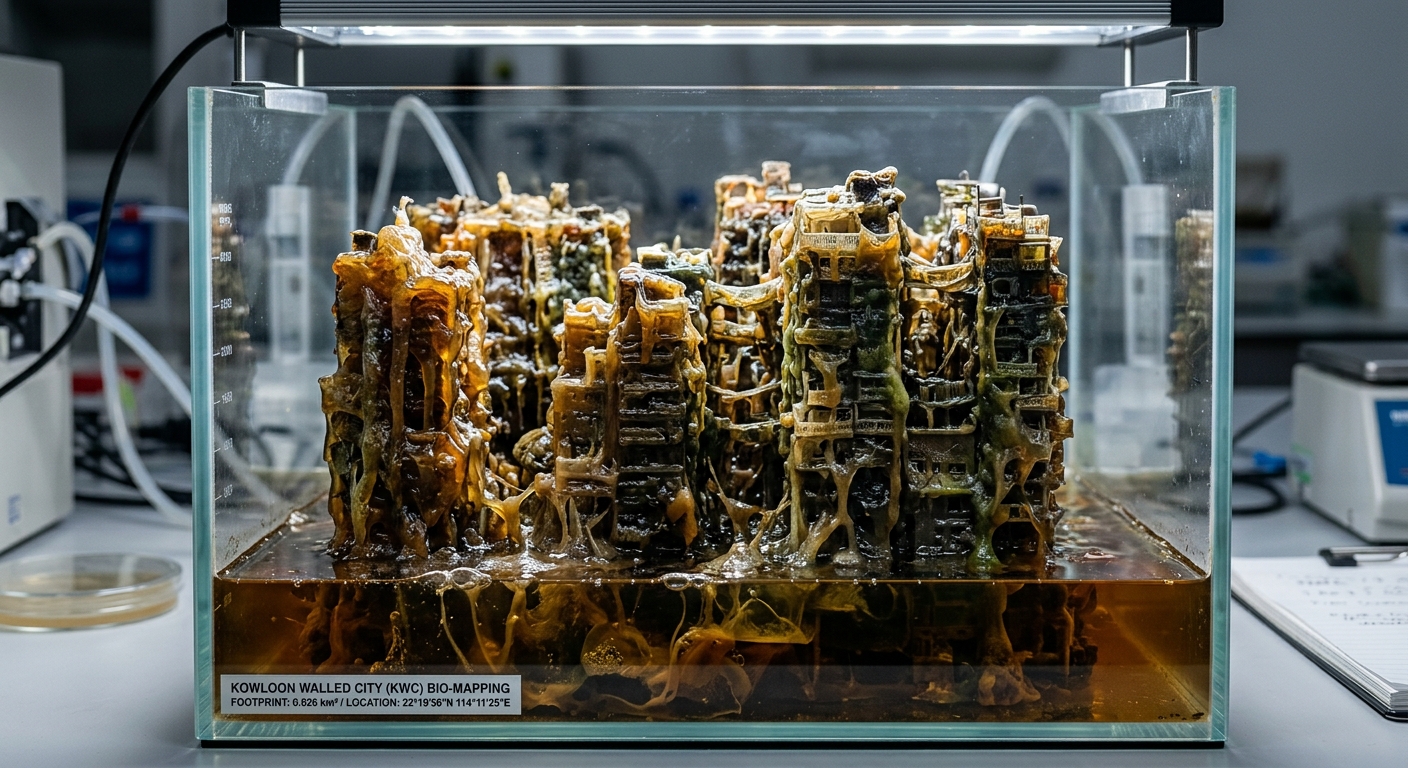
Bacterial biofilm extrudes vertically within a confined topographical scaffold. · motion: vertically extruding through quorum-triggered metabolic overflow
wall text
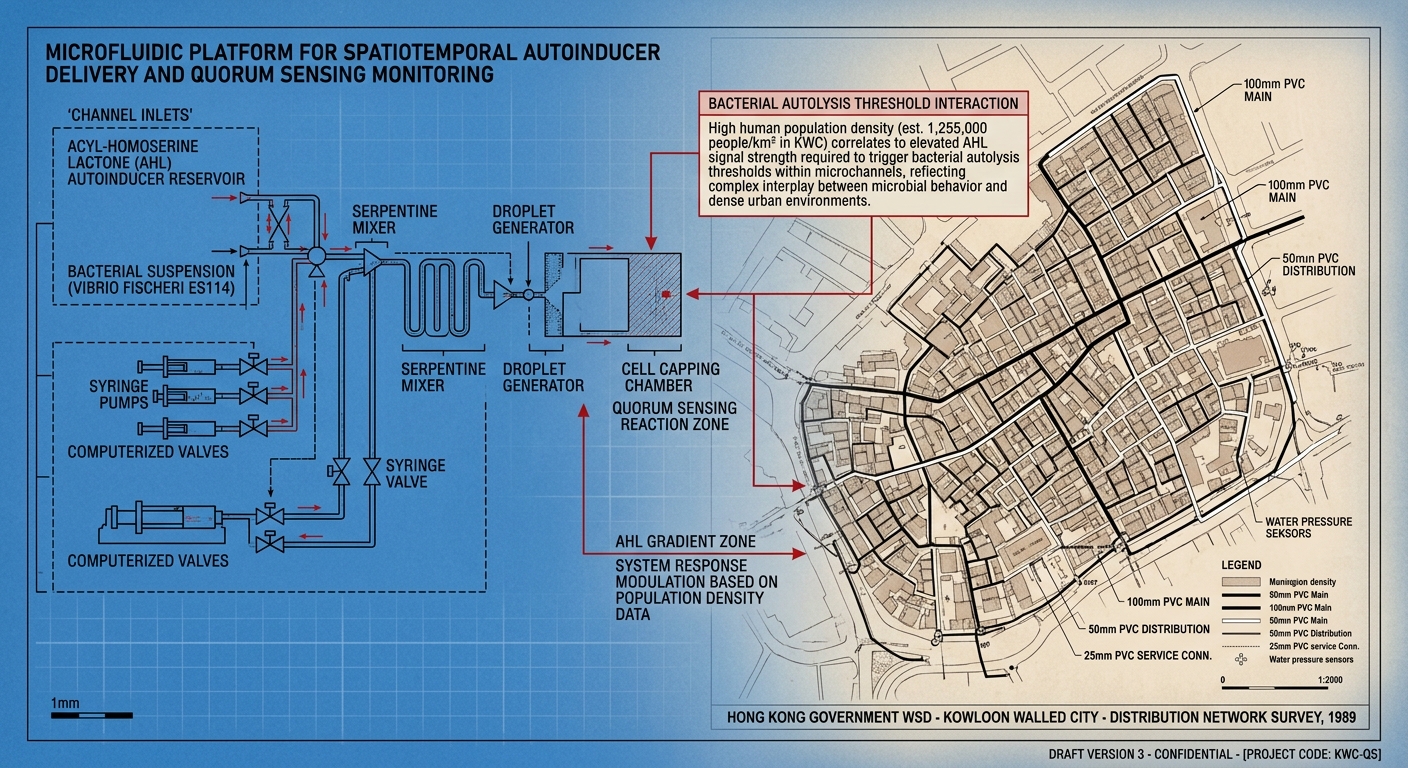
This bioreactor maps the extreme spatial confinement of Kowloon Walled City onto bacterial morphogenesis. A titanium scaffold replicating the settlement's 0.026-square-kilometer footprint is inoculated with a multi-species bacterial consortium. Microfluidic channels beneath the foundation deliver nutrient agar and monitor acyl-homoserine lactone (AHL) signaling. As localized cell counts cross threshold densities, quorum sensing triggers extracellular polysaccharide synthesis. Inhibited from expanding horizontally by the glass boundary, the biofilm shifts from motility to vertical adhesion, cantilevering outward along nutrient gradients. The resulting biological mass reproduces the accretive, self-organized vertical density of the historical slum through diffusion-limited growth.
shown: Installed within the preserved historic Yamen building at the center of the current Kowloon Walled City Park, functioning continuously until the biological mass self-destructs.
shown: Installed within the preserved historic Yamen building at the center of the current Kowloon Walled City Park, functioning continuously until the biological mass self-destructs.
anchor facts used
- Confined to a footprint of exactly 0.026 square kilometers (6.4 acres)
- Population density peaked at roughly 1,923,077 people per square kilometer
- Water was distributed via an ad-hoc, unregulated network of interconnected PVC pipes
- Demolished in 1993, leaving only the historical Yamen building at its geographical center
mechanism
- Topographic biofilm scaffolding — The geographical confinement of the Sino-British geopolitical border is enforced as a sterile petri-wall, forcing all biological growth inward and upward.
1. A topographical titanium scaffold replicating the exact 0.026 square kilometer footprint of the Walled City is seeded with a multi-species bacterial consortium. - Quorum sensing via acyl-homoserine lactone accumulation — The sociological shift from horizontal village to hyper-dense vertical slum is physically enacted by the colony's gene expression shifting from motility to vertical adhesion.
2. As the bacterial population scales proportionally toward the equivalent of 1.9 million organisms per square meter, accumulating signaling molecules trigger extracellular matrix production. - Diffusion-limited vertical growth — Urban architectural planning is replaced by metabolic resource competition, dictating structural mass based on proximity to fluid sources.
3. Nutrient agar is pulsed through a chaotic microfluidic network embedded in the scaffold, creating resource gradients that dictate where the biofilm thickens into cantilevered towers. - Density-dependent programmed autolysis — The 1993 forced eviction and demolition is executed as an inevitable metabolic collapse rather than a top-down political mandate.
4. Upon reaching critical mass, nutrient deprivation at the scaffold's core triggers a wave of enzymatic self-destruction, clearing the dense biological architecture to leave a sterile central void.
lineage
- Oron Catts and Ionat Zurr / Tissue Culture & Art Project — Extends their semi-living sculptural techniques into historical urban demographics rather than future speculative anatomy.
- Greg Lynn / Embryologic Houses — Argues against algorithmic digital generation by substituting biological quorum sensing as the sole architect of the physical model.
- Bonnie Bassler / Quorum Sensing Research (Vibrio fischeri) — Transposes her discovery of bacterial inter-cellular communication into a macro-scale proxy for human socio-architectural signaling.
curatorial qa (machine verdict, unedited)
SCORE 4/5 after 2 attempt(s)
READS: The strict spatial containment within the bioreactor tank clearly constrains the bacterial colony, forcing dense, vertical extracellular matrix accretion over the structural urban armature.
FAILS: The rapid expansion reads somewhat like viscous liquid swelling rather than localized cell division along microfluidic nutrient pathways.
READS: The strict spatial containment within the bioreactor tank clearly constrains the bacterial colony, forcing dense, vertical extracellular matrix accretion over the structural urban armature.
FAILS: The rapid expansion reads somewhat like viscous liquid swelling rather than localized cell division along microfluidic nutrient pathways.
spec: antigravity agent · keyframe/artifact: gemini-3.1-flash-image · video: veo-3.1 image-to-video · qa+wall text: gemini-3.7-flash watching the render · 32.8s total