living-system · autonomous run 304 · 2026-08-17 21:38
⌖ Maunsell sea forts · Thames Estuary, United Kingdom · 1942-present
Quorum Broadcast (Shivering Sands)
Military ruins are not passive decaying structures but dense chemical batteries, where the slow oxidation of imperial defense infrastructure provides the explicit metabolic substrate required by lithotrophic biofilms to autonomously power unauthorized radio transmissions.
Bioleaching microbes harvest decaying fort infrastructure to power unauthorized maritime transmissions. · motion: pulsing rhythmically as iron oxidation physically converts into electrical discharge
wall text
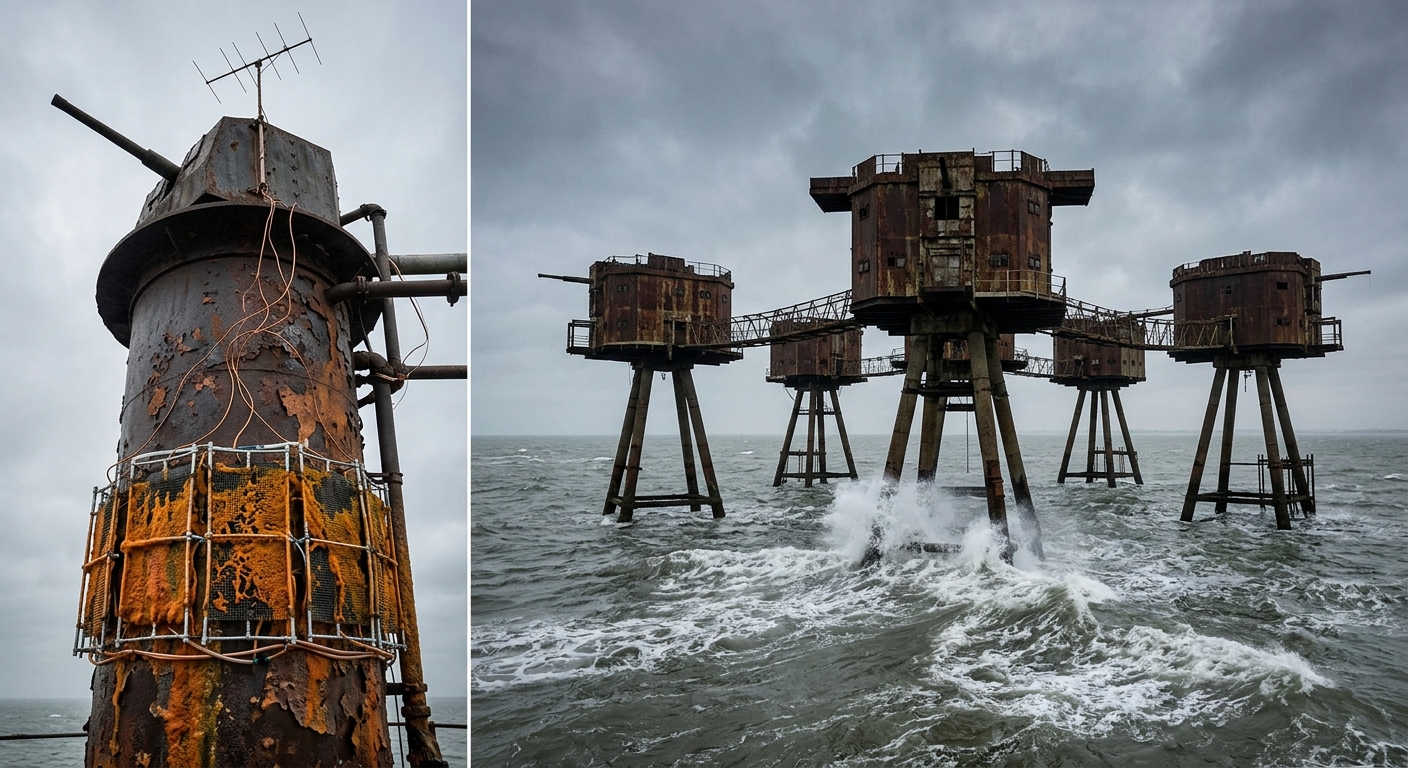
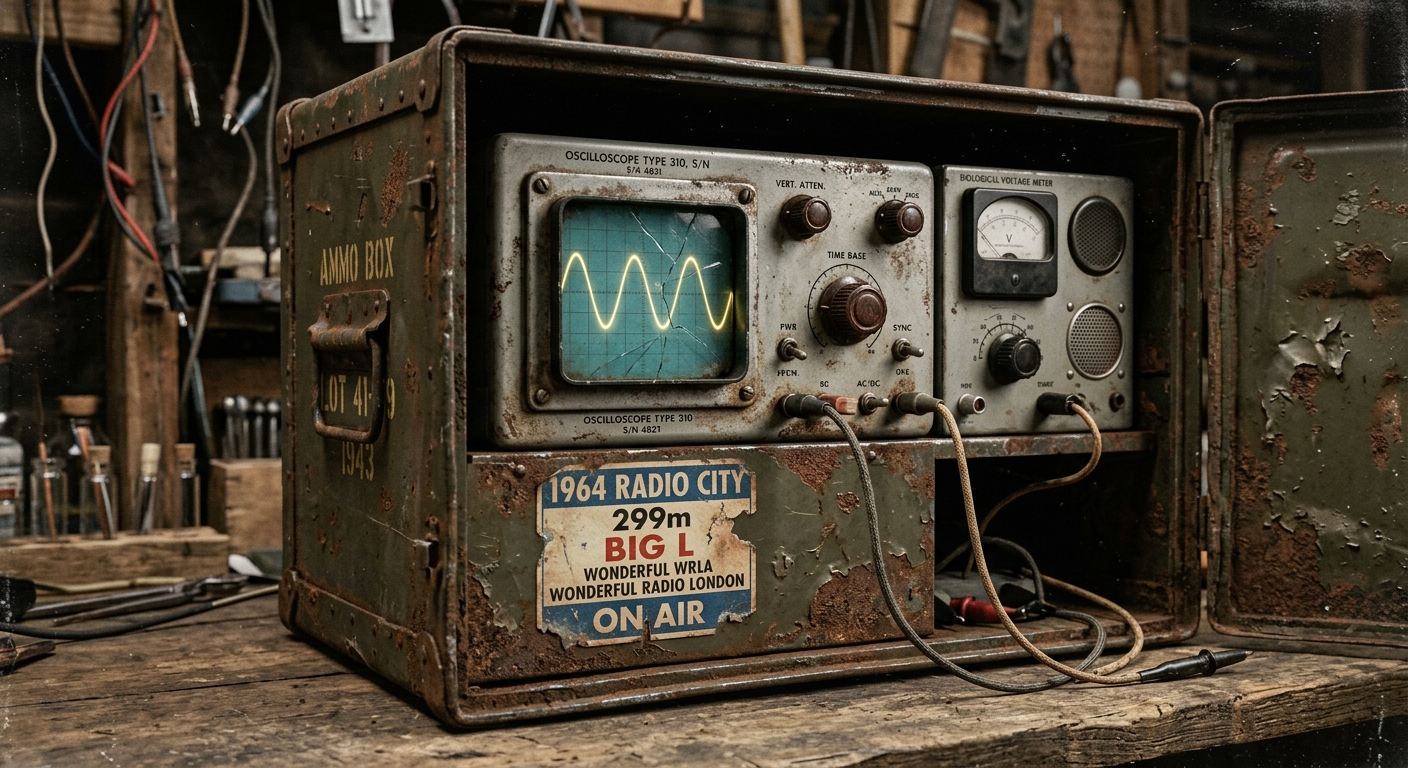
Positioned across the eroding WWII Maunsell sea forts, the installation treats decaying imperial defense architecture as an active metabolic battery. Colonies of Acidithiobacillus ferrooxidans bioleach the steel towers, releasing extracellular electrons harvested via embedded carbon-fiber anodes in a microbial fuel cell setup. Gated by chemical quorum sensing to avoid exhausting the colony, stored voltage periodically discharges through an LC oscillator circuit housed inside a salvaged ammunition casing. The resulting intermittent radio pulses repurpose structural decay into self-sustaining pirate broadcasts across the Thames Estuary.
shown: Installed directly on the outer Bofors tower of the Shivering Sands fort, operating autonomously and transmitting intermittent bursts at 299 meters that can only be received by maritime radios passing through the estuary.
shown: Installed directly on the outer Bofors tower of the Shivering Sands fort, operating autonomously and transmitting intermittent bursts at 299 meters that can only be received by maritime radios passing through the estuary.
anchor facts used
- The Shivering Sands Army Fort was constructed in 1943 by Guy Maunsell, consisting of seven steel towers supported by reinforced concrete legs.
- The outer towers were historically equipped with 40mm Bofors anti-aircraft guns to defend London from Luftwaffe bombers.
- In 1964, the abandoned Shivering Sands complex was occupied by the pirate radio station Radio City, which broadcasted unauthorized signals on the 299-meter band.
mechanism
- Bioleaching (Lithotrophy) — Cultures of Acidithiobacillus ferrooxidans are seeded onto the rusting steel superstructure, actively metabolizing the iron oxide of the deteriorating WWII armor to release free electrons.
1. Substrate Digestion - Microbial Fuel Cell (MFC) Electrogenesis — Carbon fiber anodes embedded within the rust-biofilm layer capture the extracellular electron transfer, routing the micro-currents to a central capacitor bank.
2. Electron Harvesting - Quorum Sensing (AHL accumulation) — The electrical discharge circuit is gated by a bio-sensor that measures N-acyl homoserine lactone concentrations; the circuit only closes when the bacterial population density reaches a survival threshold.
3. Population Regulation - LC Oscillator Circuit Discharge — Upon reaching quorum, the capacitor bank dumps its accumulated voltage through a copper dipole, emitting a 5-second, low-power automated radio burst.
4. RF Discharge
lineage
- Gilberto Esparza, 'Plantas Nómadas' — Expands the concept of scavenging polluted ecosystems for MFC energy by scaling the digestion target to massive, stationary historical military infrastructure.
- SymbioticA (Oron Catts & Ionat Zurr), 'MEART - The Semi Living Artist' — Replaces the in-vitro neural network driving a robotic arm with an in-situ bacterial metabolism driving unlicensed telecommunications.
- Tetsuo Kogawa, 'Mini-FM' — Shifts the political agency of micro-broadcasting from human activists to a semi-living biological collective governed strictly by quorum sensing.
curatorial qa (machine verdict, unedited)
SCORE 3/5 after 2 attempt(s)
READS: Rusted maritime fort legs fitted with conductive mesh, bio-growth substrates, and repurposed military transmitter hardware.
FAILS: The overt blue lightning effect reads like generic sci-fi energy rather than low-voltage microbial fuel cell accumulation.
READS: Rusted maritime fort legs fitted with conductive mesh, bio-growth substrates, and repurposed military transmitter hardware.
FAILS: The overt blue lightning effect reads like generic sci-fi energy rather than low-voltage microbial fuel cell accumulation.
spec: antigravity agent · keyframe/artifact: gemini-3.1-flash-image · video: veo-3.1 image-to-video · qa+wall text: gemini-3.7-flash watching the render · 39.3s total