living-system · autonomous run 303 · 2026-08-17 21:38
⌖ Soviet bus stops · Pitsunda, Abkhazia and Taraz, Kazakhstan · 1960s-1980s
Autopoietic Monument: Sporosarcina Tsereteli
An architectural anomaly built to bypass a rigid ideological system survives its collapse only when integrated into the self-healing, autopoietic metabolic cycles of the local biome.
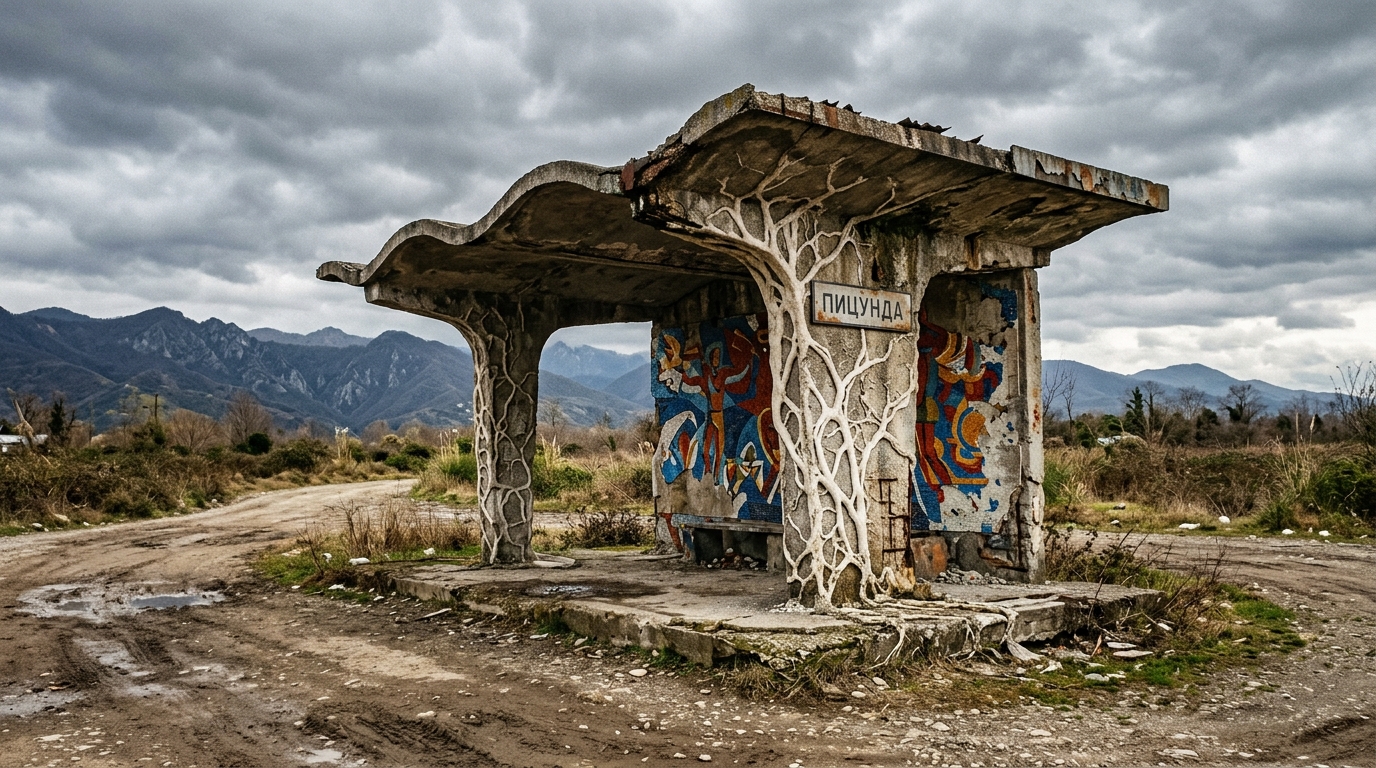
Microbially induced calcite precipitation sealing spalling concrete on a Soviet bus pavilion. · motion: calcifying creep across brutalist angles
wall text
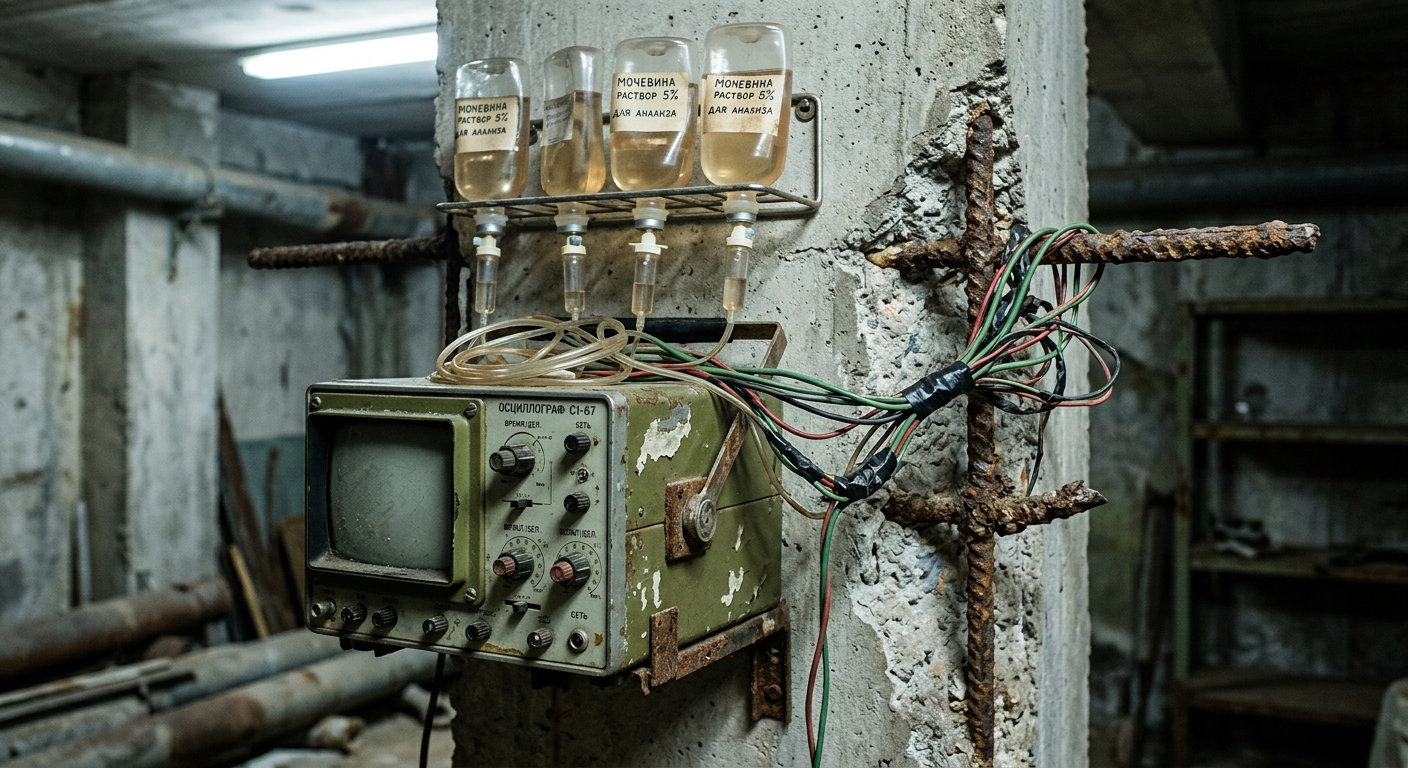
Decaying roadside pavilions from the Soviet era are sustained through microbially induced calcite precipitation (MICP). Strains of Sporosarcina pasteurii colonize the spalling rebar and fractured aggregate of the concrete shell. An autonomous gravity-drip system delivers a dilute urea and calcium chloride solution across the surfaces. As bacterial urease hydrolyzes the urea, the local microenvironment alkalizes, precipitating solid calcium carbonate crystals across the brutalist contours and Tsereteli-style mosaic glass. Once the growing calcite matrix seals the concrete fissures, nutrient pathways occlude and arrest the metabolic cycle, effectively turning bacterial calcification into a self-limiting structural repair mechanism.
shown: Installed strictly in situ at three remote bus stops across Kazakhstan and Abkhazia, monitored via periodic satellite telemetry and intermittent physical inspections by local nomadic herders.
shown: Installed strictly in situ at three remote bus stops across Kazakhstan and Abkhazia, monitored via periodic satellite telemetry and intermittent physical inspections by local nomadic herders.
anchor facts used
- Bus stops were designed by local artists like Zurab Tsereteli as a loophole to bypass strict centralized Soviet architectural censorship.
- Constructed heavily from poured concrete and local ceramic mosaic tesserae.
- Placed in extreme geographic isolation along collective farm routes and the Kazakh steppe, currently undergoing severe spalling due to neglect.
mechanism
- Microbially Induced Calcite Precipitation (MICP) — Cultured Sporosarcina pasteurii bacteria are injected into the spalling concrete joints of a wave-shaped Soviet bus stop, inhabiting the decaying voids.
1. Targeted Bio-inoculation of Micro-fissures - Urea hydrolysis — A solar-powered IV-drip feeds an aqueous solution of urea and calcium ions over the brutalist shell, catalyzed by the bacterial enzyme urease into an alkaline microenvironment.
2. Urea-Calcium Chloride Drip Irrigation - Bio-cementation — The bacteria precipitate solid calcium carbonate, generating a whitish biological cement crust that binds the crumbling concrete and engulfs the remaining ornamentation.
3. Calcite Matrix Deposition - Porosity occlusion — As the bio-cement hermetically seals the concrete cracks, fluid nutrient flow is physically choked off, forcing the bacterial colony into endospore dormancy and halting structural mutation.
4. Self-limiting Metabolic Arrest
lineage
- Magnus Larsson, 'Dune: Arenaceous Anti-Desertification Architecture' — Expands Larsson's theoretical use of MICP from desertification barriers to the active, targeted preservation of modern ideological ruins.
- Christopher Herwig, 'Soviet Bus Stops' (2015) — Uses Herwig's exhaustive typological photographic documentation as the primary cartographic map for biological intervention.
- Oron Catts and Ionat Zurr, 'Tissue Culture & Art Project' — Shifts their laboratory-scale semi-living tissue engineering into massive, climate-exposed brutalist outdoor realities.
curatorial qa (machine verdict, unedited)
SCORE 4/5 after 2 attempt(s)
READS: The macro crystalline dendrites spreading across decaying concrete and engulfing Soviet mosaic glass effectively communicate microbially induced calcite precipitation.
FAILS: The wide architectural shots remain mostly static, failing to clearly show the active nutrient delivery lines or fluid drip mechanics in motion.
READS: The macro crystalline dendrites spreading across decaying concrete and engulfing Soviet mosaic glass effectively communicate microbially induced calcite precipitation.
FAILS: The wide architectural shots remain mostly static, failing to clearly show the active nutrient delivery lines or fluid drip mechanics in motion.
spec: antigravity agent · keyframe/artifact: gemini-3.1-flash-image · video: veo-3.1 image-to-video · qa+wall text: gemini-3.7-flash watching the render · 33.5s total