living-system · autonomous run 297 · 2026-08-17 21:37
⌖ Korean DMZ wildlife · Korean Demilitarized Zone, Military Demarcation Line · 1953-present
Source-Sink 38: RDX-Bioremediating Mycelial Corridor
Complete militarized isolation generates extreme ecological fertility only through the violent suppression of human economic intervention, framing explosive ordnance as the ultimate conservation enforcement mechanism.
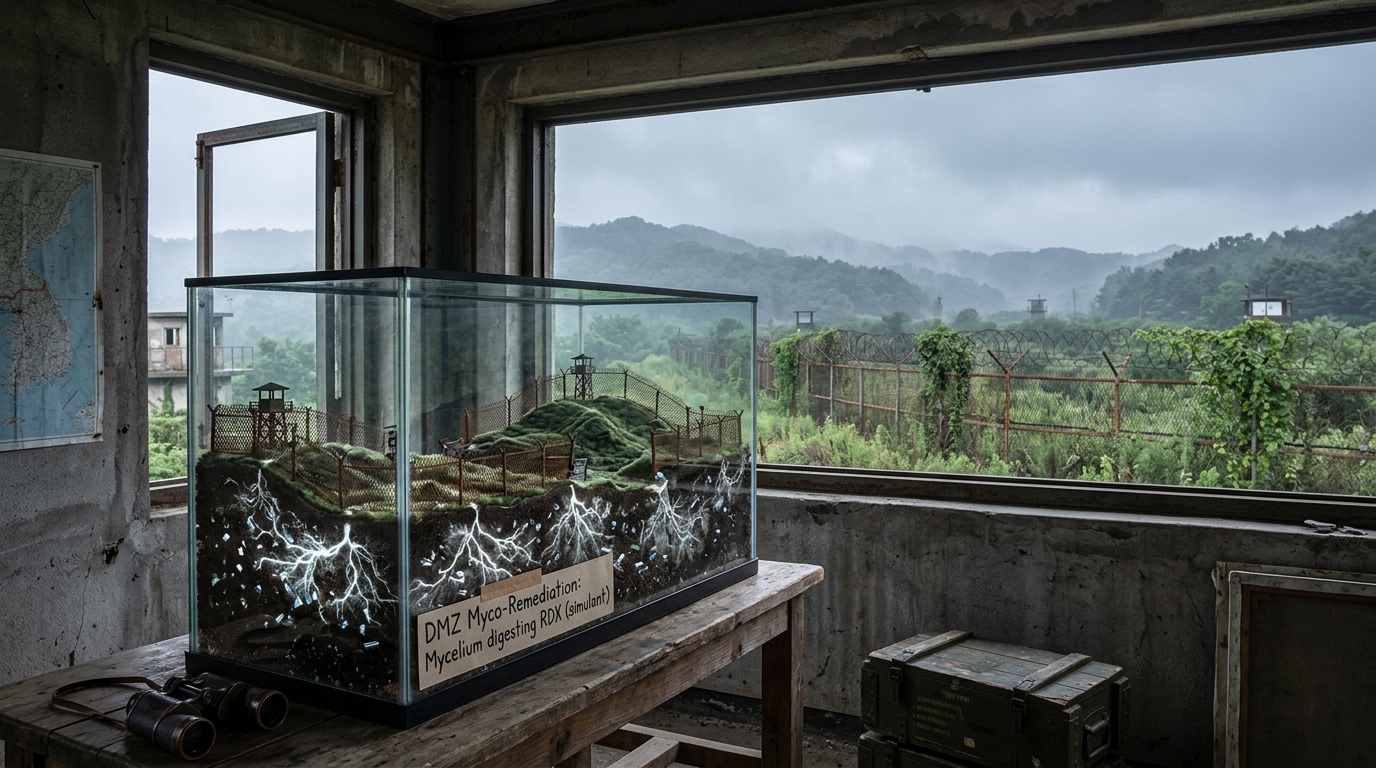
Bioluminescent mycelium metabolizes simulated RDX compounds beneath barbed wire terrarium soil. · motion: pulsing and bridging across toxic boundaries
wall text
The Korean Demilitarized Zone contains roughly two million unexploded landmines, producing an unintended 250-kilometer wildlife sanctuary preserved strictly through lethal hazard. This bio-installation models the enzymatic breakdown of energetic materials. Cultured Pleurotus ostreatus mycelium colonizes soil loaded with RDX simulant, transposing fungal biodegradation pathways that cleave toxic cyclic nitramines into bioavailable nitrogen. Embedded quorum-sensing bacteria emit light as fungal hyphae bridge minefield barriers, mapping source-sink ecological dynamics where absolute human exclusion yields fertile soil. By transforming weaponized terrain into a closed-loop nutrient reactor, the work explores how lethal military ordnance operates as an involuntary mechanism of radical biodiversity conservation.
shown: Installed semi-permanently within a decommissioned South Korean observation post in the Civilian Control Zone (CCZ), directly overlooking the actual military demarcation line.
shown: Installed semi-permanently within a decommissioned South Korean observation post in the Civilian Control Zone (CCZ), directly overlooking the actual military demarcation line.
anchor facts used
- Established by the 1953 Korean Armistice Agreement, creating a continuous buffer 250 km long and 4 km wide.
- The zone contains an estimated 2 million unexploded landmines, preventing human agricultural and industrial development.
- Acts as an accidental sanctuary and crucial migration corridor for endangered species like the red-crowned crane (Grus japonensis) and Asiatic black bear.
mechanism
- RDX Enzymatic Biodegradation — Pleurotus ostreatus (oyster mushroom) mycelium is inoculated into soil gathered from the Civilian Control Zone, precisely dosed with RDX (hexahydro-1,3,5-trinitro-1,3,5-triazine) explosive compounds to perfectly mirror the chemical density of DMZ minefields.
1. Substrate Inoculation - Source-Sink Dynamics — The living installation mimics the peninsula's geography; the central 'source' strip (the undisturbed 4km DMZ) accumulates biomass and feeds peripheral 'sink' patches (simulating adjacent heavily-farmed South Korean land) only when mycelial bridges successfully navigate the toxic RDX barriers.
2. Nutrient Mapping - Quorum Sensing — Genetically modified Aliivibrio fischeri bacteria embedded in the soil matrix emit bioluminescence only when the fungal biomass reaches a critical density threshold, visually indexing the population boom of organisms within the human-exclusion zone.
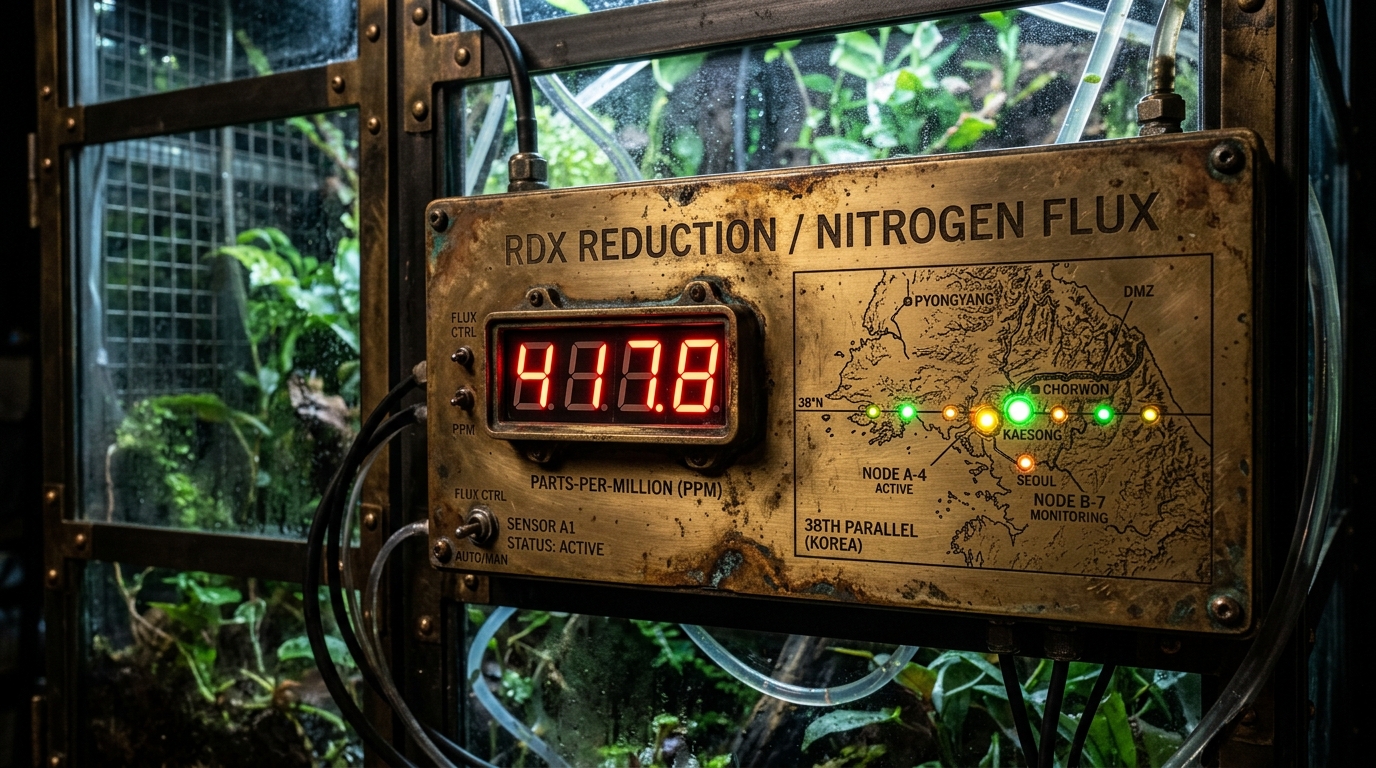
3. Population Visualization - Trophic Cascade — As the mycelium breaks down the RDX into harmless nitrogen, the resulting chemical spike is detected by a continuous-flow mass spectrometer, which subsequently triggers an automated valve to release fresh water into the surrounding 'civilian' sink terrariums.
4. Biochemical Actuation
lineage
- Aresa Biodetection's RedDetect Arabidopsis thaliana (2004) — Adapts the concept of explosive-detecting flora but shifts the focus from human mine-clearance to the systemic biological benefits of human exclusion.
- Phil Ross's Mycotecture series — Utilizes structurally constrained fungal growth, but subjects the living organism to toxic military-grade chemical stress rather than domestic architectural utility.
- Eyal Weizman's Forensic Architecture: The Conflict Shoreline (2015) — Reverses the forensic gaze; rather than tracking human violence through scarred ecology, it maps ecological flourishing generated specifically by the threat of violence.
curatorial qa (machine verdict, unedited)
SCORE 4/5 after 2 attempt(s)
READS: The underground cross-section clearly demonstrates bioluminescent mycelial networks threading around buried artillery shells and concertina wire within a miniature DMZ landscape, framed directly against the actual militarized buffer zone.
FAILS: The precise metabolic pathway—transposing toxic RDX hexahydro-1,3,5-trinitro-1,3,5-triazine into plant-usable nitrogen that feeds adjacent sinks—remains largely conceptual without the accompanying telemetry display.
READS: The underground cross-section clearly demonstrates bioluminescent mycelial networks threading around buried artillery shells and concertina wire within a miniature DMZ landscape, framed directly against the actual militarized buffer zone.
FAILS: The precise metabolic pathway—transposing toxic RDX hexahydro-1,3,5-trinitro-1,3,5-triazine into plant-usable nitrogen that feeds adjacent sinks—remains largely conceptual without the accompanying telemetry display.
spec: antigravity agent · keyframe/artifact: gemini-3.1-flash-image · video: veo-3.1 image-to-video · qa+wall text: gemini-3.7-flash watching the render · 34.4s total