living-system · autonomous run 296 · 2026-08-17 21:37
⌖ Hans Island whisky war · Hans Island (Tartupaluk), Kennedy Channel of Nares Strait · 1973-2022
Tartupaluk Bioreactor: 1.3 km² Equilibrium
Geopolitical borders are thermodynamic fictions; prolonged territorial friction in a closed, nutrient-poor system inevitably resolves into biochemical symbiosis and spatial stratification rather than mutual destruction.
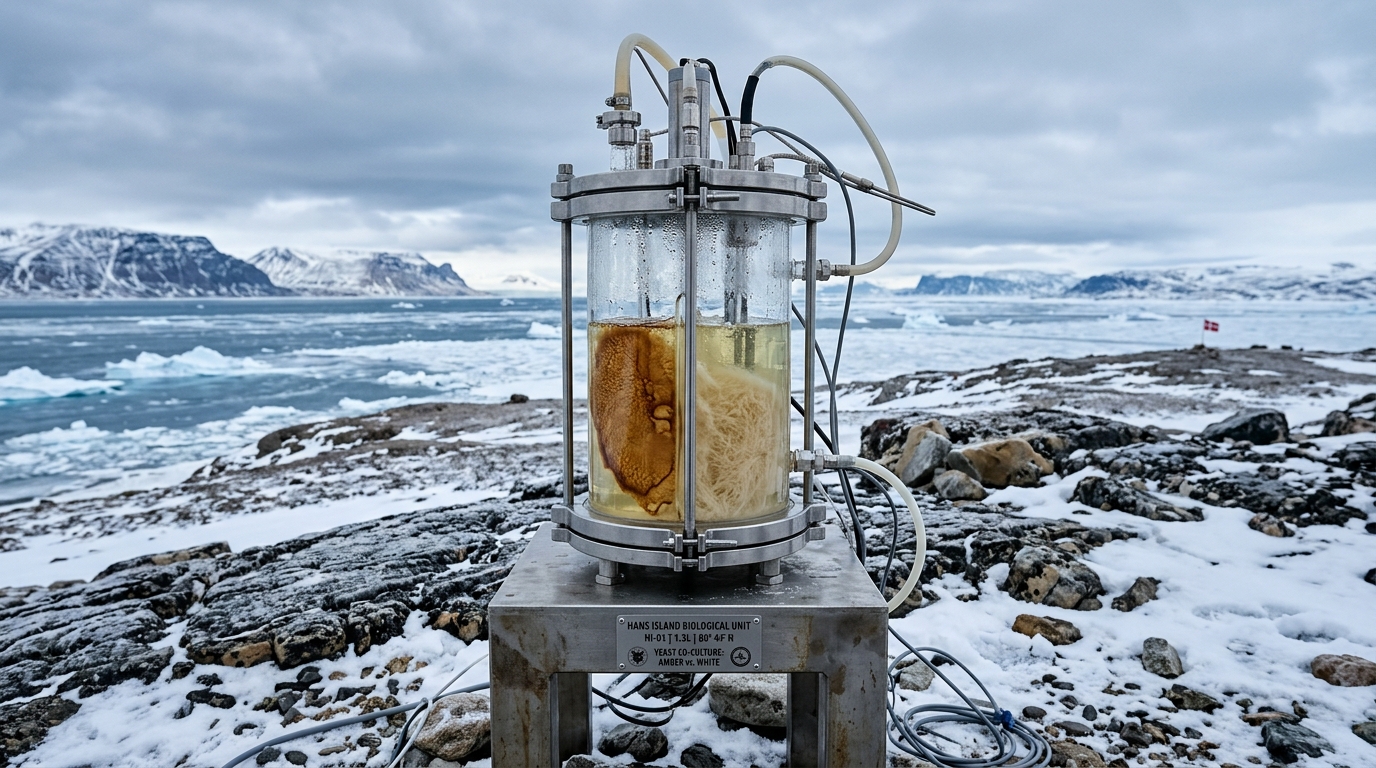
Two yeast strains partition a 1.3-liter chemostat on Hans Island. · motion: slowly stratifying and reaching stasis along a central axis
wall text
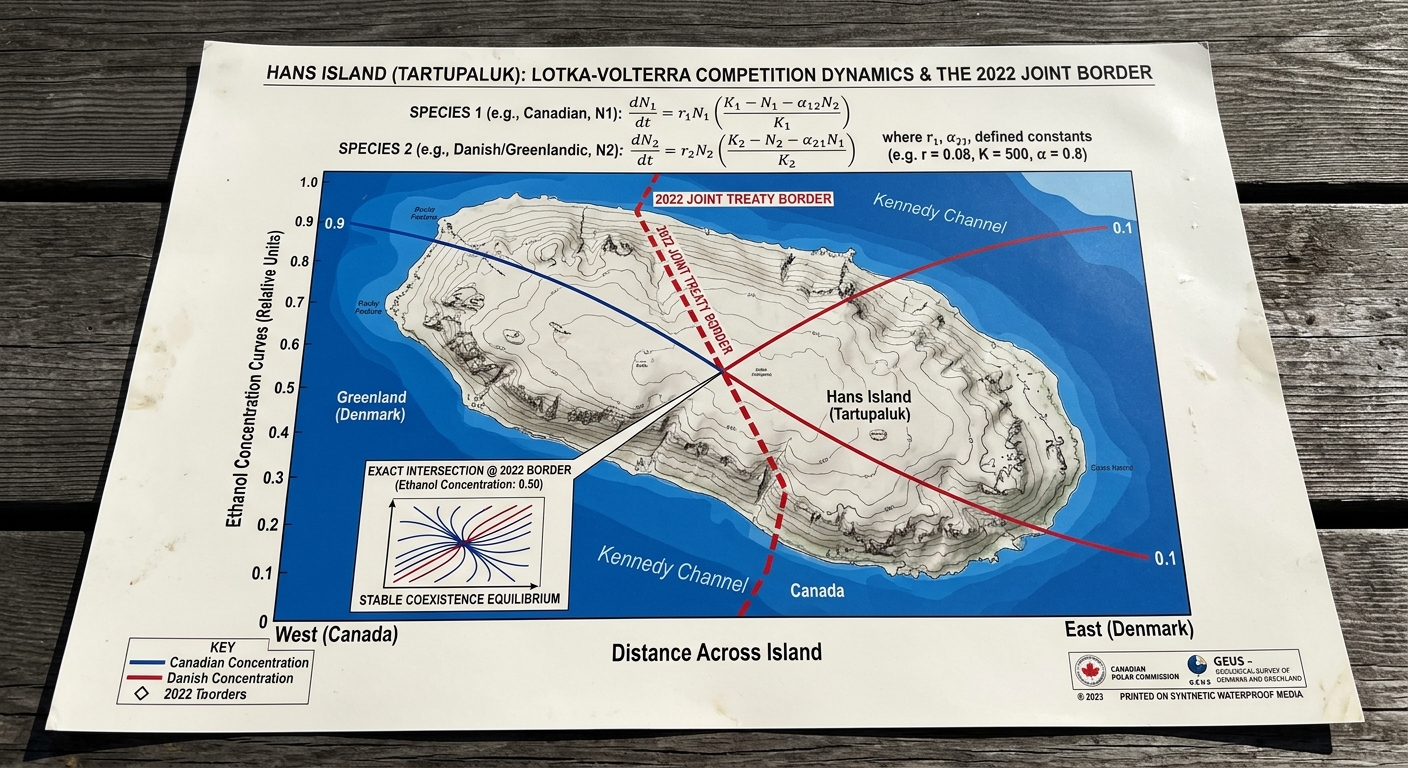
Positioned on Hans Island (Tartupaluk), this 1.3-liter chemostat houses a continuous fed-batch co-culture of Canadian rye yeast (*Saccharomyces cerevisiae*) and Danish aquavit botanical wild yeast, transposing decades of diplomatic liquor exchanges into Lotka-Volterra competition dynamics. In a nutrient-poor regime, both strains produce ethanol end-products that suppress the competitor until reaching a stable coexistence equilibrium. Rather than mutual extinction, the continuous culture undergoes spatial self-organization, forming a stratified biofilm divided precisely along the central axis. The installation maps geopolitical boundary-making as a thermodynamic inevitability, where closed-system friction resolves into co-metabolic zoning.
shown: Installed permanently on the 2022 border line of Hans Island (Tartupaluk), powered by a small wind turbine that maintains the internal bioreactor temperature at a constant fermentation threshold.
shown: Installed permanently on the 2022 border line of Hans Island (Tartupaluk), powered by a small wind turbine that maintains the internal bioreactor temperature at a constant fermentation threshold.
anchor facts used
- The disputed territory is exactly 1.3 square kilometers in area and completely barren.
- Militaries alternately removed flags and deposited bottles of Canadian Crown Royal whisky and Danish Gammel Dansk schnapps.
- The 2022 resolution divided the island along a naturally occurring cleft in the rock, creating a land border.
mechanism
- Mixed-culture continuous fed-batch fermentation — A 1.3-liter chemostat bioreactor represents the 1.3 square kilometers of the island, inoculated with Saccharomyces cerevisiae (isolated from Canadian rye) and a Danish aquavit botanical wild yeast.
1. Inoculation and Volume Mapping - Lotka-Volterra competition dynamics — The two yeast populations fluctuate wildly as they compete for a highly restricted, nutrient-poor sugar substrate, modeling the geopolitical signaling and flag-planting over an economically useless territory.
2. Substrate Competition - Ethanol end-product inhibition — Each yeast strain secretes toxic ethanol that periodically suppresses the competing population's growth, directly mirroring the ritualistic deposition of high-proof alcohol to assert dominance.
3. Biochemical Antagonism - Biofilm spatial stratification — The populations achieve thermodynamic equilibrium by forming a co-metabolic biofilm divided exactly along a microscopic scratch in the bioreactor's glass, sharing the limited substrate without active competition.
4. Sympatric Resolution
lineage
- Oron Catts and Ionat Zurr (Tissue Culture & Art Project), 'Victimless Leather' — Builds on their use of bioreactors as theaters for human socio-political conflict, shifting the focus from ethics to geopolitics.
- Phil Ross, 'Mycotecture' — Extends his application of fungal growth as physical architecture into the realm of biological border formation and territorial stasis.
- Tarah Rhoda, 'Ourglass' — Adopts her use of fluid dynamics, temperature constraints, and osmotic pressure to visualize invisible human-scale political forces in closed biological systems.
curatorial qa (machine verdict, unedited)
SCORE 4/5 after 2 attempt(s)
READS: The visual bifurcation within the chemostat clearly mirrors spatial partitioning. The amber and pale biomasses organize along a central vertical axis, visibly resolving chaotic competition into a stable, bipartite equilibrium against the Arctic landscape.
FAILS: The rapid time-lapse dissolve obscures the incremental mechanics of Lotka-Volterra population shifts and ethanol inhibition, making the physical biofilm formation look like a sudden digital transition rather than continuous biological growth.
READS: The visual bifurcation within the chemostat clearly mirrors spatial partitioning. The amber and pale biomasses organize along a central vertical axis, visibly resolving chaotic competition into a stable, bipartite equilibrium against the Arctic landscape.
FAILS: The rapid time-lapse dissolve obscures the incremental mechanics of Lotka-Volterra population shifts and ethanol inhibition, making the physical biofilm formation look like a sudden digital transition rather than continuous biological growth.
spec: antigravity agent · keyframe/artifact: gemini-3.1-flash-image · video: veo-3.1 image-to-video · qa+wall text: gemini-3.7-flash watching the render · 25.7s total