living-system · autonomous run 294 · 2026-08-17 21:37
⌖ Baarle-Hertog enclaves · Baarle-Hertog/Baarle-Nassau, border of Belgium and the Netherlands · 1198 AD to present (borders finalized by the Treaty of Maastricht, 1843)
Cadastral Anastomosis
Sovereignty is a metabolic burden: stable borders persist only when contiguous entities continuously expend energy to induce localized necrosis at their points of contact, mirroring the legal fiction of divided living rooms.
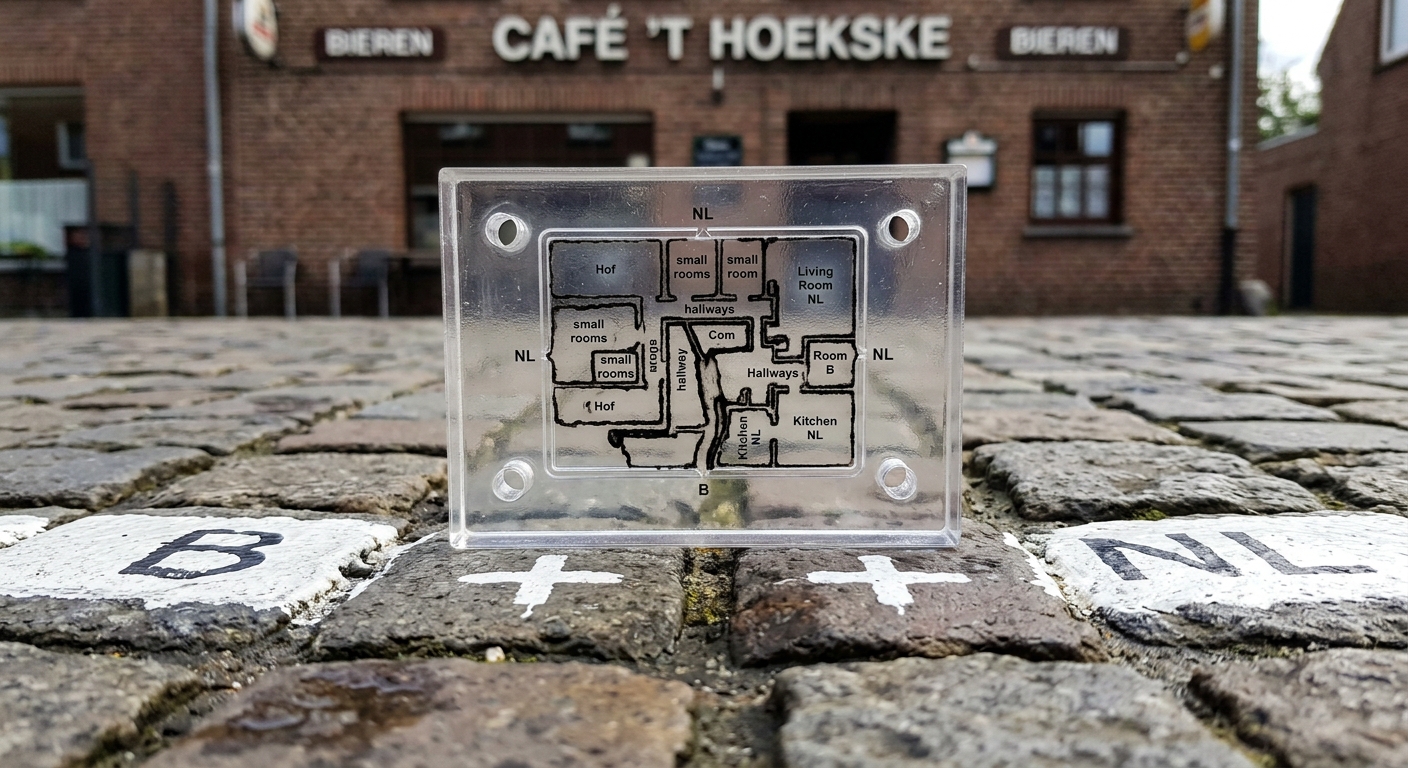
Podospora anserina forming necrotic barrage lines along an etched 1843 border. · motion: necrotic boundary lines creeping and oscillating
wall text
In Baarle-Hertog and Baarle-Nassau, national borders bisect single living rooms under the 1843 Treaty of Maastricht. This installation maps these fragmented domestic interiors into a PDMS microfluidic device inoculated with genetically distinct strains of Podospora anserina. As the mycelial networks colonize their respective national sectors, somatic allorecognition triggers programmed cell death at the boundary line. The resulting dark barrage of necrotic tissue visualizes sovereignty not as a passive legal abstraction, but as continuous metabolic expenditure: living matter constantly consuming energy to maintain a demarcation that prevents biological and spatial synthesis.
shown: Installed directly across the painted white border crosses of Cafe 't Hoekske in Baarle-Hertog, forcing visitors to physically cross international lines to observe both the Dutch and Belgian nutrient pumps.
shown: Installed directly across the painted white border crosses of Cafe 't Hoekske in Baarle-Hertog, forcing visitors to physically cross international lines to observe both the Dutch and Belgian nutrient pumps.
anchor facts used
- The town consists of 22 Belgian exclaves completely surrounded by Dutch territory, and 7 Dutch sub-exclaves within those.
- The border physically divides individual buildings, including living rooms and cafes like Cafe 't Hoekske.
- The legal nationality of a divided building is dictated by the 'voordeurregel' (front door rule), determining where the inhabitants pay taxes.
mechanism
- PDMS (Polydimethylsiloxane) Soft Lithography — Used to legally and physically constrain biological growth strictly to the 1843 architectural floor plans of the divided town.
1. Soft lithography etching of the town map into a sealed polymer chamber. - Inoculation of axenic continuous cultures — Assigning sovereign national identity to biological agents, forcing them to occupy their designated real estate.
2. Inoculating respective national zones with genetically distinct Podospora anserina fungal strains. - Vegetative Incompatibility (Allorecognition) — Translating international treaties into somatic rejection mechanisms, creating visible barrage lines of dark melanin where the nations meet.
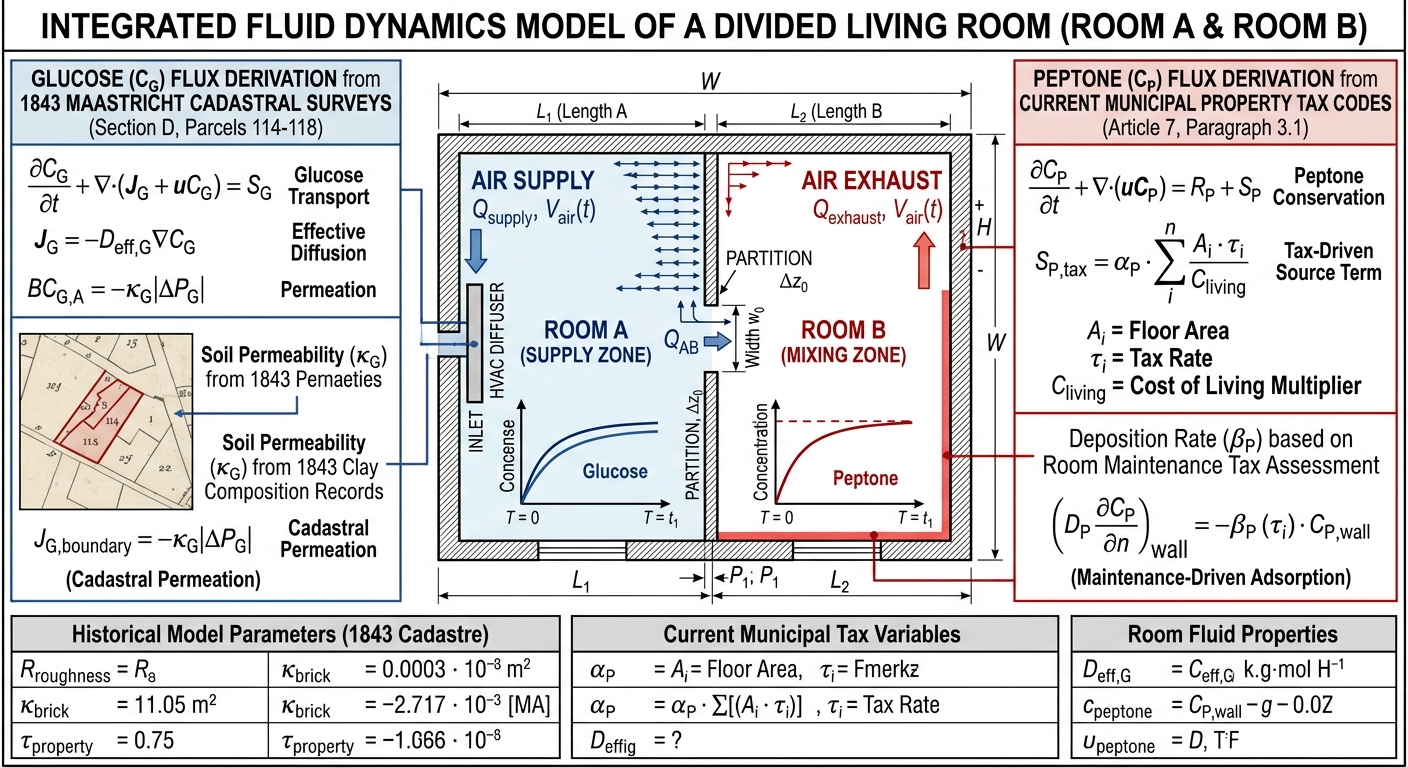
3. The mycelial networks expand, collide at the borders, and trigger localized programmed cell death. - Chemostat dilution rate control — Using municipal economic data to alter the osmotic pressure and competitive vigor of the two nations, shifting the necrotic dead zone slightly over time.
4. Modulating the nutrient pumps based on real-time tax differentials between the two municipalities.
lineage
- Gordon Matta-Clark, 'Reality Properties: Fake Estates' (1973) — Argues against Matta-Clark's static, conceptual ownership of useless slivers of land by rendering spatial micro-borders as metabolically active, energy-consuming biological zones.
- Phil Ross, 'Mycotecture' (2009) — Extends Ross's use of mycelium as an inert structural material by weaponizing its living, incompatible metabolic processes as a territorial enforcement mechanism.
- Toshiyuki Nakagaki, 'Maze-solving by an amoeboid organism' (2000) — Inverts Nakagaki's focus on optimal resource networking by highlighting biological refusal, programmed death, and enforced inefficiency at systemic boundaries.
curatorial qa (machine verdict, unedited)
SCORE 4/5 after 1 attempt(s)
READS: The PDMS microfluidic chip placed directly on the Baarle cobblestone border shows fungal cultures expanding across etched room plans. The formation of dark melanin barrage lines via vegetative incompatibility clearly marks the contested indoor frontier.
FAILS: The real-time tax differential pump modulation remains invisible; the growth reads as uniform agar expansion rather than an actively steered metabolic influx.
READS: The PDMS microfluidic chip placed directly on the Baarle cobblestone border shows fungal cultures expanding across etched room plans. The formation of dark melanin barrage lines via vegetative incompatibility clearly marks the contested indoor frontier.
FAILS: The real-time tax differential pump modulation remains invisible; the growth reads as uniform agar expansion rather than an actively steered metabolic influx.
spec: antigravity agent · keyframe/artifact: gemini-3.1-flash-image · video: veo-3.1 image-to-video · qa+wall text: gemini-3.7-flash watching the render · 44.1s total