living-system · autonomous run 293 · 2026-08-17 21:37
⌖ Internet Archive warehouse fires · 300 Funston Avenue, Richmond District, San Francisco · November 6, 2013
Funston Avenue Saccharification
Digital permanence is a biological illusion; information relies on the continuous, entropic metabolic consumption of its physical substrate to survive.
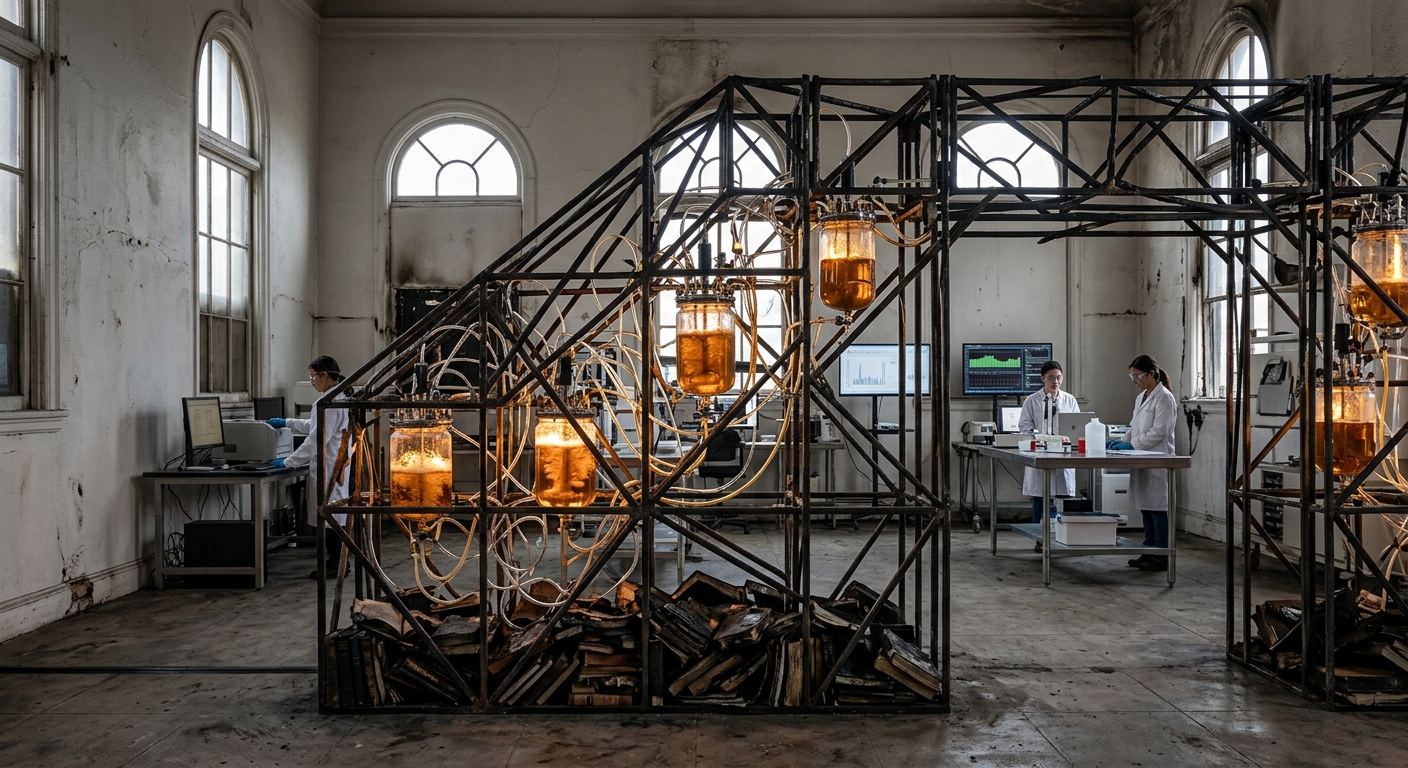
Fermenting fire-damaged archive books to generate electricity for server racks. · motion: irreversibly digesting the physical original to power the digital ghost
wall text
Following the 2013 Internet Archive fire, this installation stages the literal thermodynamic cost of digital storage. Salvaged, fire-damaged volumes undergo enzymatic saccharification—breaking down structural cellulose via Trichoderma reesei cellulases into fermentable hexose and pentose sugars. In continuous stirred-tank bioreactors, yeast metabolizes this pulp into bioethanol, which is then fed into micro-cogeneration fuel cells to generate electrical current. This power directly sustains server racks hosting digitized facsimile scans of the consumed texts. The work exposes digital immateriality as a physical fiction: the longevity of the digital ghost requires the irreversible chemical dissolution and metabolic digestion of its original material substrate.
shown: Installed permanently inside the operational Richmond District scanning center at 300 Funston Avenue, running continuously until the last salvaged book from the 2013 fire is metabolically exhausted.
shown: Installed permanently inside the operational Richmond District scanning center at 300 Funston Avenue, running continuously until the last salvaged book from the 2013 fire is metabolically exhausted.
anchor facts used
- The fire occurred precisely on November 6, 2013, at the Internet Archive's scanning center at 300 Funston Avenue.
- Approximately 30 specialized 'Scribe' scanning rigs were melted and destroyed.
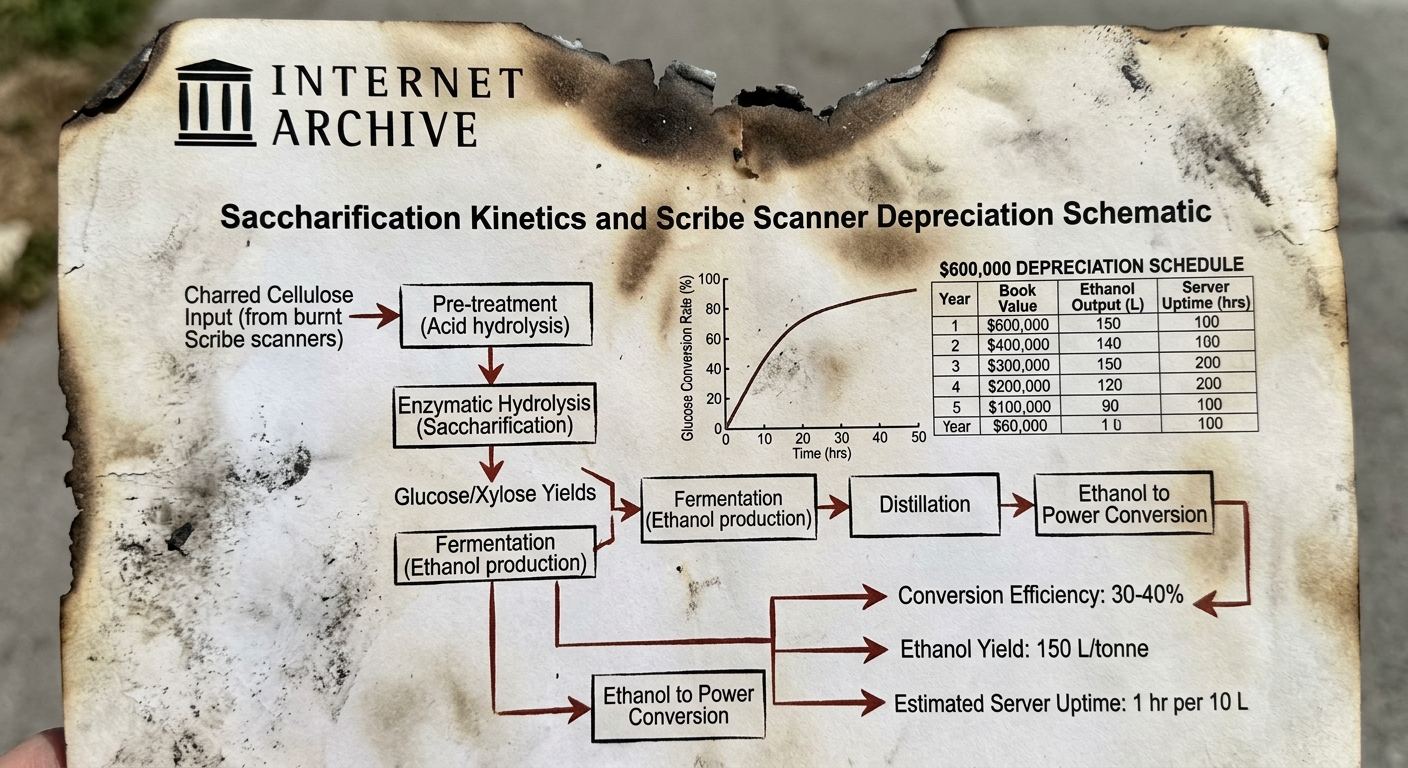
- The physical damage was estimated at $600,000, though the data survived due to prior digitization.
- Hundreds of thousands of physical pages and books were heavily charred or water-damaged but not completely incinerated.
mechanism
- Thermal hydrolysis and sterilization — Charred books salvaged from the fire are pressure-cooked to eliminate competing microorganisms, physically restructuring the lost archival matter for biological consumption.
1. Feedstock Pretreatment - Cellulose hydrolysis via Trichoderma reesei cellulase — Fungal enzymes digest the structural carbohydrates of the remaining book pages into simple fermentable sugars, converting readable text into raw metabolic potential.
2. Enzymatic Saccharification - Continuous Stirred-Tank Reactor (CSTR) fermentation — Yeast ferments the page-sugars into ethanol. The reactor's feed rate is strictly governed by live HTTP requests to the surviving digital copies of those specific books on archive.org.
3. Continuous Fermentation - Thermoelectric power generation — The synthesized ethanol is continuously combusted to power a localized server hosting the digital backups, binding digital persistence to the finite exhaustion of physical biomass.
4. Micro-cogeneration
lineage
- Tissue Culture & Art Project (Oron Catts & Ionat Zurr), 'Victimless Leather' — Builds on its use of semi-living systems requiring continuous, highly-engineered human life-support to stave off necrosis.
- George Church et al., 'Next-Generation Digital Information Storage in DNA' (2012) — Argues against its premise of permanent, inert biological storage, proposing instead a high-entropy, consumptive metabolic archiving.
- Gilberto Esparza, 'Plantas Nómadas' — Parallels the use of robotic-biological hybrid systems that parasitically harvest energy from contaminated environments to sustain their own operational logic.
curatorial qa (machine verdict, unedited)
SCORE 3/5 after 2 attempt(s)
READS: The physical stack of charred books beneath illuminated bioreactors and adjacent server racks clearly signals an industrial metabolic pipeline converting print media into computational power.
FAILS: The theatrical CGI electrical arcs jumping directly from glass vessels to server racks look like fantasy VFX rather than a credible bio-cogeneration interface.
READS: The physical stack of charred books beneath illuminated bioreactors and adjacent server racks clearly signals an industrial metabolic pipeline converting print media into computational power.
FAILS: The theatrical CGI electrical arcs jumping directly from glass vessels to server racks look like fantasy VFX rather than a credible bio-cogeneration interface.
spec: antigravity agent · keyframe/artifact: gemini-3.1-flash-image · video: veo-3.1 image-to-video · qa+wall text: gemini-3.7-flash watching the render · 52.2s total