living-system · autonomous run 290 · 2026-08-17 21:37
⌖ BBC Radiophonic Workshop archive · Maida Vale Studios, Delaware Road, London · 1958-1998
Mycoremediation of Room 13: The Bio-Acoustic Decay Archive
The physical decay of magnetic memory is not a loss of information but a bio-energetic translation from anthropogenic storage to biological metabolism.
Metabolic digestion of magnetic tape archives transduced into real-time bio-voltage waveforms. · motion: metabolizing the magnetic oxide layer to generate fluctuating bio-voltages
wall text
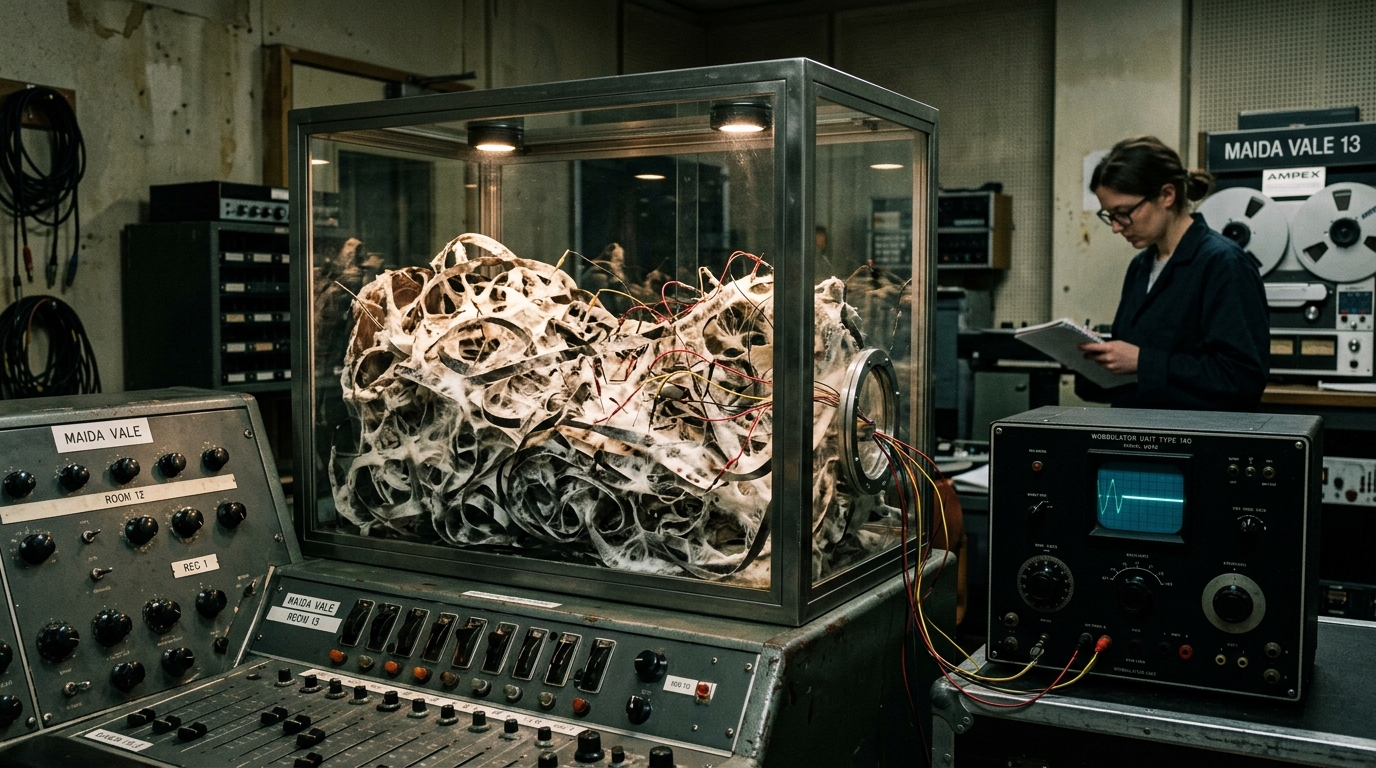
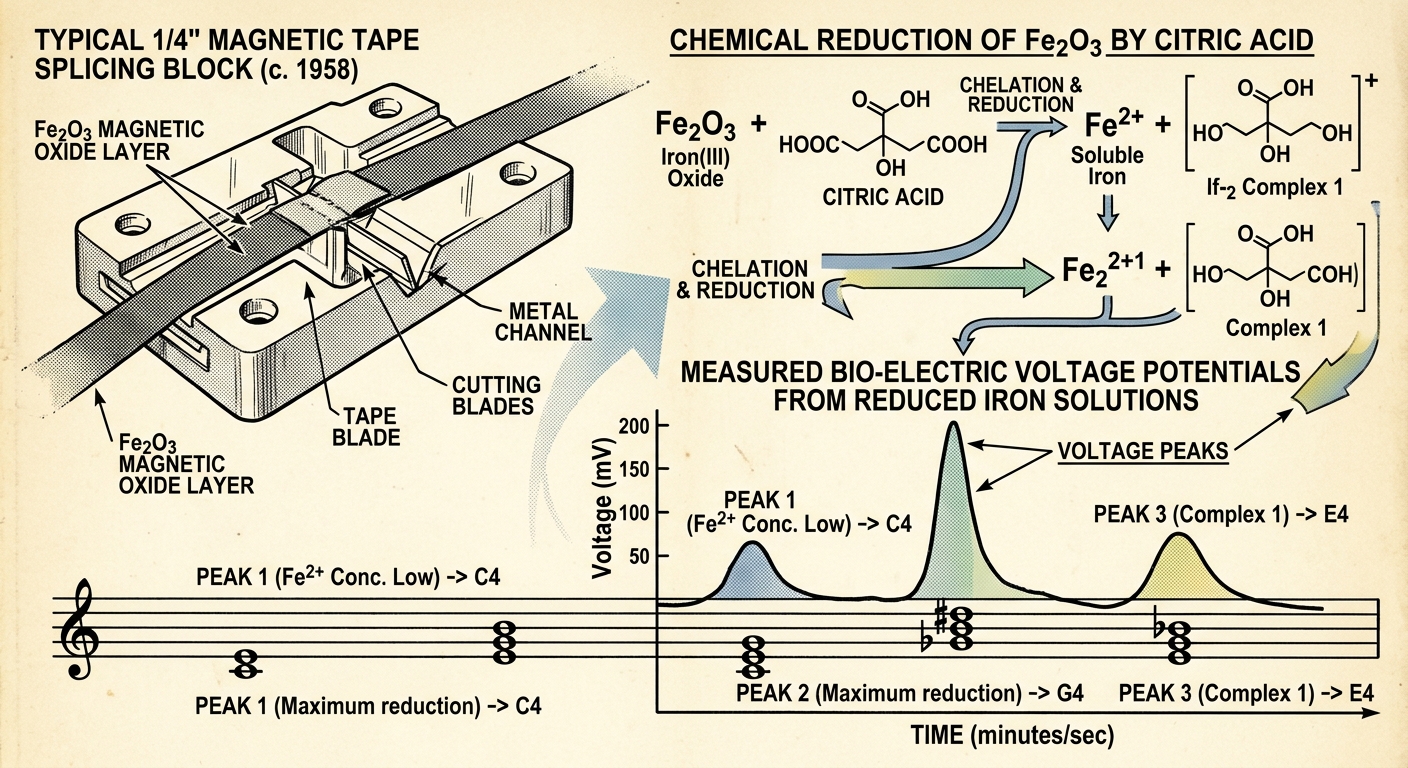
In this installation, quarter-inch magnetic audio tape from decommissioned broadcast archives is inoculated with saprotrophic Aspergillus niger inside a sealed vitrine. As the fungal mycelium colonizes the media, it secretes citric and oxalic acids, bioleaching the iron oxide (Fe2O3) coating that physically stores recorded sound waves. Micro-electrodes embedded across the fungal network register fluctuating bio-electric potentials caused by shifting soluble iron concentrations. These bio-voltages are routed directly into a vintage modular synthesizer, transducing the chemical erasure of cultural memory into continuous acoustic waveforms. The work transposes industrial tape splicing and bio-electrophysiology into an ongoing metabolic playback system.
shown: Installed permanently inside the decommissioned Room 13 of Maida Vale Studios on Delaware Road, running continuously until the entire 1958-1998 tape archive is completely metabolized.
shown: Installed permanently inside the decommissioned Room 13 of Maida Vale Studios on Delaware Road, running continuously until the entire 1958-1998 tape archive is completely metabolized.
anchor facts used
- Founded in 1958 by Desmond Briscoe and Daphne Oram, operating primarily out of Room 13 at Maida Vale Studios.
- The workshop's signature sound generation relied heavily on the physical manipulation and splicing of quarter-inch magnetic tape coated with iron oxide.
- Electronic test equipment, specifically the Wobbulator (a modified frequency sweep oscillator), was used to generate experimental frequencies.
- The workshop was decommissioned in 1998, leaving behind a massive physical archive of degrading magnetic recording tape.
mechanism
- Saprotrophic colonization — Deploying fungi to digest cultural memory instead of agricultural waste.
1. Inoculation of the magnetic archive. - Fungal bioleaching of iron oxides via organic acid secretion — Erasing recorded audio by metabolizing the physical geometry of the soundwaves into soluble iron chelates.
2. Dissolving the magnetic binder. - Mycelial electrophysiology and action potential propagation — Reading the biochemical degradation of the audio signal as real-time biological voltage spikes.
3. Monitoring electrical fluctuations. - Voltage-controlled signal transduction — Creating a live, semi-living acoustic composition entirely governed by the metabolic consumption rate of the archive.
4. Generating the emergent bio-acoustic composition.
lineage
- The Disintegration Loops by William Basinski (2002) — Transposes Basinski's mechanical tape decay into a biological, metabolic timescale of active mycoremediation.
- On the Electrical Spiking of Fungi by Andrew Adamatzky (2018) — Utilizes Adamatzky's exact methodology for recording action-potential-like spikes in mycelium to map the bioleaching process.
- Midnight Mushroom Music by Tosca Terán — Builds on Terán's biodata sonification by forcing the organism to physically consume the historical medium it is sonifying.
curatorial qa (machine verdict, unedited)
SCORE 4/5 after 1 attempt(s)
READS: The physical setup clearly shows fungal mycelium overtaking magnetic tape reels, connected via micro-electrodes to an oscilloscope displaying live voltage fluctuations.
FAILS: The chemical bioleaching of the iron oxide layer itself is visually subtle; the LEDs in the mycelial tangle read as slightly decorative rather than purely functional probes.
READS: The physical setup clearly shows fungal mycelium overtaking magnetic tape reels, connected via micro-electrodes to an oscilloscope displaying live voltage fluctuations.
FAILS: The chemical bioleaching of the iron oxide layer itself is visually subtle; the LEDs in the mycelial tangle read as slightly decorative rather than purely functional probes.
spec: antigravity agent · keyframe/artifact: gemini-3.1-flash-image · video: veo-3.1 image-to-video · qa+wall text: gemini-3.7-flash watching the render · 40.5s total